Posted on

Norvik Press: New Books in 2025

Norvik Press is pleased to announce the forthcoming publication of much-awaited titles. From a stark portrayal of contemporary Greenlandic society to new classics by Lagerlöf and Skram, 2025 is set to be a year of fresh discoveries and exciting reading in the company of Norvik Press!

Sørine Steenholdt: Zombieland

Sørine Steenholdt (b. 1986)

Translated from Greenlandic into Danish by Niviaq Korneliussen

Illustrated by Maja-Lisa Kehlet Hansen

Translated from Danish into English by Charlotte Barslund

Zombieland (Zombiet Nunaat) is cold comfort. Violent events occurring in already vulnerable lives are the turning points for Sørine Steenholdt’s powerful short stories, and it can be hard to distinguish between fantasy and reality. Rape, suicide, drug abuse, fires and car theft … few are spared. It is social criticism that gets under your skin.

Originally published in Greenlandic in 2015, Zombieland was nominated for The Nordic Council Literature Prize in 2016. The book is a collection that combines short stories with short sections of poetry. All texts can be seen as allegories that critique Greenlandic society. Some condemn the older generation of Greenlanders who fell into alcohol abuse and neglected their children. Others express the younger generation’s refusal to be represented as subservient to Denmark. While alcoholism has decreased, and sovereignty has been claimed, the memories of the suffering and betrayal of the older generation remain. All of Steenholdt’s stories emphasise the flaws of contemporary Greenland such as poor journalism, untrustworthy leadership, ineffective social institutions and a dysfunctional legal system making Steenholdt’s Greenland a ‘Zombieland’ – a place where no-one is in control. 

Norvik Press are delighted to announce that this translation is the recipient of a Pen Translates award.

Tasiilaq, Greenland (Carl Skou)

Selma Lagerlöf: A Kaleidoscope of Stories 

Selma Lagerlöf (1858-1940)

This new addition to our well-established ‘Lagerlöf in English’ series will turn the spotlight on the power of short stories.  The volume contains a selection of Lagerlöf’s matchless stories covering a range of themes, genres and periods of her career. Norvik’s prize-winning trio of Lagerlöf translators, Linda Schenck, Peter Graves and Sarah Death, has enjoyed a fruitful collaboration working on this project.

This is a collection of interest to general readers but also a useful teaching tool for Swedish and comparative literature courses around the world. The book includes a comprehensive and accessible introduction by Lagerlöf specialist Bjarne Thorup Thomsen (University of Edinburgh). The nine stories have been arranged into three thematic sections: Women and Writing; Landscapes, Families and ‘Others’; Epochs, Societies and Values. 

Key autobiographical pieces, morality tales both dark and light, legends from several lands and folklore-inspired narratives combine to reveal the breadth and stylistic range of Lagerlöf’s storytelling skills.

Norvik Press ‘Lagerlöf in English’ Series

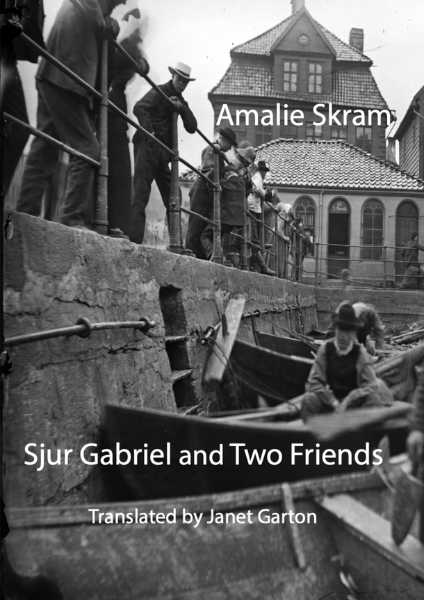
Amalie Skram: Sjur Gabriel and Two Friends

Port of Bergen, late 19th Century (Bergen University Library Collections)

Port of Bergen, late 19th Century (Bergen University Library Collections)

The two short novels Sjur Gabriel and To Venner (Two Friends), both published in 1887, are inspired by Amalie Skram’s early years in the bustling port of Bergen in Western Norway. The eponymous central character of Sjur Gabriel is a subsistence farmer struggling to make a living for himself and his family in the barren countryside, and to stop his wife from drinking to forget her misery. When their son Little-Gabriel is born, life seems brighter for some years – but the fragile hope for the future is threatened when the boy becomes seriously ill.

Two Friends focuses on the story of Sivert, the grandson of Sjur Gabriel. He is an apprentice in Bergen, but haunted by the presence of his grandparents, both of whom wander round the streets of Bergen as grotesque drunks. In order to escape he goes to sea as a cabin boy on the bark Two Friends, where he soon thrives on life at sea on a long voyage to Jamaica. When two Frenchmen come on board with their menagerie of exotic animals to transport back to France, he is befriended by them and becomes indispensable as interpreter and companion; but his inherited flaws of character soon reveal themselves and lead him to gamble away his chance of a better life.

Amalie Skram (1846-1905)

These novels are the first two in a series of four usually referred to as Hellemyrsfolket (The People of Hellemyr). The following two novels, S.G. Myre (1890) and Afkom (Descendants, 1898) follow the story of the family through the next generation in Bergen, as they try to free themselves from the taint of the past and make a better life for themselves and their families.

These two novels are translated from the Norwegian by Janet Garton, who has written a biography of the author and published several volumes of her letters. Also available from Norvik Press are Amalie Skram’s novels Lucie (1888), Fru Inés (1891) and Betrayed (1892), all translated by Katherine Hanson and Judith Messick.

Posted on

Women in Translation Month: Enduring storytellers and fresh talent. #WITMonth

Norvik Press’s credentials in translating and publishing work by women writers remain impressive. In 2025, for example, we are publishing three titles by women writers, and four out of our five translators for those titles are women, too. 

Our latest blog looks at two of our regular favourites – a Swedish and a Norwegian author, each with a peerless storytelling pedigree – and introduces a modern-day writer from Greenland whose stories paint a startling picture of her country.

Selma Lagerlöf

Selma Lagerlöf’s youthful work Gösta Berlings saga was the jumping-off point for an extraordinary career. this largely home-schooled young trainee teacher decided to submit some chapters to a writing competition in Stockholm – and won! She then expanded those chapters into to a novel, which was published in 1891. It, and many of the novels that followed it, are whirlwinds of betrayal, love, human weakness and redemption.

Selma Lagerlöf (1858-1940)

The majority of the fast-moving romantic adventures are set around the shores of a lake in the dramatic north-westerly landscapes of Lagerlöf’s native province, Värmland. 

Värmland. Photograph: Martin Edström

The author’s early works completely confounded the literary establishment of the time, but like so much of Lagerlöf’s masterly storytelling they have remained enduringly popular not only within Sweden but around the world. The prime example is her much-loved adventure tale Nils Holgersson’s Wonderful Journey through Sweden, about a boy punished for laziness by an elf who shrinks his size. The boy is then carried the length and breadth of the land on the back of a goose, learning precious life lessons by becoming part of the flock. 

Norvik Press’s long-running ‘Lagerlöf in English’ series spans the full range of Lagerlöf’s work, from her action-packed Löwensköld Ring series to her multi-faceted trio of Mårbacka ‘memoirs’ via many standalone titles such as the touching and melancholy Emperor of Portugallia, and Banished, with its harrowing First World War scenes and ultimately uplifting pacifist message.

Steve Sem-Sandberg, winner of the Selma Lagerlöf Literature Prize 2024 awarded this month, spoke admiringly of her narrative instincts and her powers of imagination.  Lagerlöf, he said, possessed a unique ability to combine the time-bound and the timeless, to take things and people she had herself experienced and transform them. Norvik’s three translators – Sarah Death, Peter Graves and Linda Schenck – can only concur. They take delight in translating Selma’s work and are currently enjoyably engaged on their first team project, an anthology of her short stories. This newest addition to the ‘Lagerlöf in English’ series will be published next year under the title A Kaleidoscope of Stories.

Amalie Skram

Amalie Skram (1846-1905)

This adventurous nineteenth-century Norwegian writer is nowadays mostly known – and still widely read – for her novels about the unenviable fates of young women in a society which expects them to be modest and chaste, and brings them up to be obedient wives and devoted mothers. Norvik Press has previously published three of these, translated by the talented American translating team of Katherine Hanson and Judith Messick.

In Betrayed, the child-like Aurora embarks on marriage – and a long sea voyage – with her worldly-wise new husband as ship’s captain, only to discover with horror that he has had a number of sexual encounters; the discovery both repels and fascinates her, and drives her to torment him until both become victims of a repressive social system. Fru Inés tells the story of a woman married to a callous and profligate husband, who longs to experience the sexual ecstasy she has never known. The novel is set in Constantinople, a city the author knew well, and the sights, sounds and smells of the teeming metropolis blend with the growing anguish of Inés to reach a dreadful climax. The heroine of Lucie, on the other hand, is a girl from the other side of the tracks, a dancing girl and mistress of a respectable civil servant, Theodor Gerner; he decides to redeem her by marrying her, only to destroy her by his rigid expectations of acceptable behaviour.

Our new venture is a translation of the work which was originally considered Amalie Skram’s crowning achievement, the four-volume series The People of Hellemyr. The novels have often been compared to Zola’s Rougon-Macquart series; they are set in and around Skram’s native Bergen, and the narrow alleys and bustling harbour of the old port are central to the action.

Bergen harbour, late 19th century. Photograph: Bergen fotoarkiv

The first two volumes, in Janet Garton’s translation, will be published in 2025. Sjur Gabriel follows the struggle for existence of a desperately poor farming family, scraping a living from the stony soil, until the arrival of a golden child seems to offer a faint hope of a richer life. Two Friends follows the adventures of their grandson Sivert, who becomes a sailor and travels to Jamaica; he is a strong and willing lad who seems to have every chance of getting on in life, but he cannot flee from the fatal weakness of character which he has inherited.

Sörine Steenholdt

In a new departure for Norvik Press, we are excited to announce that we will also be publishing a Greenlandic book in 2025. Sørine Steenholdt was born in Paamiut in southern Greenland in 1986, and in 2015 her debut book, a short story and poetry collection called Zombiet Nunaat (Zombieland), was published.

Sörine Steenholdt (b. 1986). Photograph: Ulannaq Ingemann

All the texts can be seen as allegories that critique Greenlandic society. Some condemn the older generation of Greenlanders who fell into alcohol abuse and neglected their children, whilst others express the younger generation’s refusal to be represented as subservient to Denmark. While alcoholism has decreased, and sovereignty has been claimed, the memories of the suffering and betrayal of the older generation remain. Steenholdt’s stories emphasise the flaws of contemporary Greenland such as poor journalism, untrustworthy leadership, ineffective social institutions and a dysfunctional legal system, making her Greenland a ‘Zombieland’ – a place where no-one is in control.

Zombieland, cover of the original Greenlandic edition

The book was nominated for the Nordic Council Literature prize on first publication, and Norvik Press has been awarded a PEN translation grant for this translation. It will be translated from Danish by the well-known literary translator Charlotte Barslund.

Other Norvik Press translations of women writers:

Inga Ābele: The Year the River Froze Twice (translated by Christopher Moseley)

Victoria Benedictsson: Money (translated by Sarah Death)

Karin Boye: Crisis (translated by Amanda Doxtater) 

Fredrika Bremer: The Colonel’s Family (translated by Sarah Death)

Suzanne Brøgger: A Fighting Pig’s Too Tough to Eat (and Other Prose Texts) (translated by Marina Allemano) 

Camilla Collett: The District Governors Daughters (translated by Kirsten Seaver)

Kerstin Ekman: Witches’ Rings (translated by Linda Schenck), The Spring (translated by Linda Schenck), The Angel House (translated by Sarah Death), City of Light (translated by Linda Schenck), Childhood (translated by Rochelle Wright).

Janet Garton (ed.): Contemporary Norwegian Womens Writing

Svava Jakobsdóttir: Gunnlöth’s Tale (translated by Oliver Watts)

Viivi Luik: The Beauty of History (translated by Hildi Hawkins)

Hagar Olsson: Chitambo (translated by Sarah Death) 

Hanne Marie Svendsen: Under the Sun (translated by Marina Allemano)

Kirsten Thorup: The God of Chance (translated by Janet Garton)

Helene Uri: Honey Tongues (translated by Kari Dickson)

Elin Wägner: Penwoman (translated by Sarah Death)

Dorrit Willumsen: Bang: A Novel About the Danish Writer (translated by Marina Allemano)

To order the Norvik Press books highlighted in this blog, please follow the green hyperlinks or request the titles you would like at your favourite bookshop.

Posted on

The European Literary Map of London

Our friends at University College London are crowdsourcing an interactive map that traces European literary encounters across London.

You can explore (and submit new pins to!) the map here: https://www.europeanliterarylondon.org/

The map inspired us here at Norvik Press to think about how London is portrayed within our books. We have zoomed in on two of our favourite examples of London in literature below.


Kirsten Thorup: The God of Chance

Ana had got into the habit of travelling into the City at around four in the afternoon. She took the underground to Bank and rose up into the anonymous security of marble and glass. She felt at home in the City’s ivory-coloured concrete desert, where she had been a frequent visitor over the past ten to twelve years. She knew the streets, the cafés, the bars, the smooth upthrust of the buildings which blocked out the sky. She knew the well-cut suits and jackets, the high heels and the brief cases with the same label as her own. She knew the purposeful steps which echoed back from between the walls like the hollow beat of drumsticks.

She had finally arranged an interview with the HR manager. She circled around City Place House where Rower had its premises, and ended up sitting in the large high-ceilinged bar just opposite. She placed herself strategically at a table right next to the glass façade, so that she had a view of her former workplace. Sitting in the low armchair, she sipped her Campari soda. She leafed absent-mindedly through the Financial Times, and felt she was out of circulation. She recognised some of her former colleagues as they walked past on the pavement and cut across the square in front of the entrance. […]

She finished her drink and walked out of the bar and across towards City Place House and the sterile little marble square. With her smart appearance, the discreet elegance of her suit, the shoes moulded perfectly to her feet, and the stiletto heels which added three inches to her height, she looked like the career woman she had been in her earlier life, and blended in with her surroundings. It struck her that the fountain in the middle of the square looked touching in its stripped-down minimalism with the threadlike jets gathered into vertical bundles.

–– Translated by Janet Garton

Amalie Skram: Betrayed

Their baggage had been sent on board and after Ory and Riber had said good-bye to their landlady, they went out to buy a few little things before departure.

‘Is there anything else?’ Riber asked, holding packages in his hands. They had walked out of a shop in St. Paul’s Churchyard.

Ory stood for a moment and thought carefully. ‘Nothing I remember,’ she said. ‘Of course we’ll be forgetting the most important thing.’ […]

Down the street they hailed a cab. Riber called out “Victoria Docks” as they got inside and off they went as fast as the moving throng of pedestrians and vehicles allowed. […]

Then the cab stopped. Riber shot up, put on his hat, pulled on his overcoat, stepped out and paid the driver.

Ory gathered her packages. Riber held his hand out to her and she jumped down.

Silently they walked side by side across the paved wharf that looked like an enormous courtyard, huge warehouses on three sides, reverberating with activity and tumult. The fourth side was open to the water, chock-full of large-hulled steamers and high-masted sailing ships; all the vessels that could find room were alongside the paved wharf, loading or unloading cargo.

‘Stop, Aurora! Here is the ship. Orion ahoy!’

‘Ahoy!’ came back in return, and a red-freckled man wearing a flat-crowned cap and a wool scarf around his neck appeared waving from the rail of a full-rigged ship.

–– Translated by Katherine Hanson and Judith Messick

Read more about the European Literary Map of London here, and the ‘Lost & Found: Mapping European Literary London’ exhibition.

Happy exploring!

Posted on

Let’s Celebrate Women in Translation! #WITMonth

August is Women in Translation month, and as editors and translators here at Norvik Press we would like to make a bit of a fuss about ours. The Press has always prioritised Nordic women writers, whether it be lesser-known classics like Camilla Collett (The District Governor’s Daughters) and Fredrika Bremer (The Colonel’s Family) or modern writers so far little known in English, such as the Danish Dorrit Willumsen, the Norwegian Helene Uri and the Icelandic Svava Jacobsdóttir. All of our directors and the majority of our translators are also women. This month we are highlighting three of our major women writers: Amalie Skram (Norway), Kerstin Ekman (Sweden) and Kirsten Thorup (Denmark).

Amalie Skram

by Janet Garton

Born in 1846 into a relatively prosperous family in the bustling port of Bergen, Amalie Skram had an unusual early life for a middle-class woman in the mid-nineteenth century; at the age of eighteen she married a ship’s captain and sailed the world with him and their two sons. Her adventurous life came to an abrupt stop when in 1877 she filed for an acrimonious divorce. Soon after she embarked on a literary career which brought her into contact with Bjørnstjerne Bjørnson, Georg Brandes and eventually Erik Skram, with whom she fell in love and who became her second husband in 1884. From then on she earned a precarious living as a writer, living in Copenhagen and writing novels, many of which have become enduring classics. She died in 1905 at the age of 58.

Amalie Skram

Norvik Press has published three of Amalie Skram’s novels, Lucie (1888), Fru Inés (1891) and Betrayed (1892), all translated by the indefatigable US translators and Skram enthusiasts Katherine Hanson and Judith Messick. The novels are similar in that they all have as central characters women who have been damaged by the contemporary double standard of morality, which encouraged men to be promiscuous whilst punishing women who wanted any sexual freedom – but at the same time they illuminate very different perspectives. Lucie is a girl who has transgressed the norms and is the kept mistress of a civil servant in Kristiania; he falls in love with her and decides to make her a respectable married woman – only to be defeated by her irrepressible high spirits. Fru Inés is a woman trapped in a loveless marriage and longing for sexual fulfilment, but finds when she tries to break free that a dreadful fate awaits her. And Ory in Betrayed is an innocent young girl who marries a ship’s captain, but can not accept or forgive that he has known other women; her probing drives him to despair. The settings of all three novels reflect the author’s wide knowledge of the world. Lucie is set in the Kristiania she knew so well, and brings to life the streets and buildings of that time; Betrayed gives a vivid picture of life on board a sailing ship, and includes a visit to a London full of dance halls and oyster restaurants. Fru Inés takes place in Constantinople, and the sights, sounds and smells reveal Skram’s intimate first-hand knowledge of the city.

Collage of Amalie Skram book covers

As a long-time admirer of Amalie Skram’s writing – I have written a biography of her and published several volumes of her correspondence – I am delighted to say that I am about to start work on a new translation. This is of a very different work than the ones above; it will be the first two volumes of a four-volume series called The People of Hellemyr (1887–98), which is set amongst fisherfolk in and around her native Bergen. It follows the lives of a desperately poor farmer and his family as they struggle to lift themselves out of poverty – a study of lives lived against the odds and the fatal flaws that are passed on from generation to generation.

Kerstin Ekman

by Sarah Death

Kerstin Ekman, doyenne of the Swedish literary scene, has been entertaining and enchanting her readers with a wide sweep of works for over sixty years. This month she reaches the grand age of 90, and she is still busy writing.

Kerstin Ekman. Copyright/photograph: Thron Ullberg

Norvik Press is delighted to be the publisher of five of her books. Her extended autobiographical poem Childhood, translated by Rochelle Wright, is a distillation of so much that we learn of Ekman’s life and times from her wider oeuvre. ‘You have to admire the persistence of time/ that it doesn’t grow tired and get stuck’, she writes, and indeed the theme of time thundering onwards is central to her ground-breaking quartet of novels set in a small southern Swedish town, sometimes collectively called ‘Women and the City’ but also known as the Katrineholm quartet, and originally published in Sweden between 1974 and 1983. These were translated into English for Norvik Press by Linda Schenck (three volumes) and me (one volume), both of us long-standing devotees of the author’s work. The series is essentially a women’s eye view of the changes wrought in ordinary people’s lives by events and innovations of the past century and a half, not least the impact of the coming of the railway to a small rural community, where progress and tradition clash. Ekman’s multi-generational cast of characters (who can forget Sara Sabina or Tora, Jenny, Ingrid or Anne-Marie?), artfully woven plots and fine evocations of time and place make this series thoroughly deserving of its ‘modern classic’ label.  

The Katrineholm quartet

Our profound response to special reading experiences lies at the heart of Kerstin Ekman’s latest work, which is being published to coincide with her landmark birthday in August: Min bokvärld (My World of Books, Albert Bonniers förlag, 2023) is an exploration in twenty-four chapters of the reading experiences close to Ekman’s heart, from childhood to the present day. At the time of writing only the table of contents was available, but it is a great indication of the treasure trove in store. One of her choices felt particularly appropriate to me as her reader and translator: The Golden Bough, the classic study of mythology, magic and comparative religion by Scottish anthropologist and folklorist James Frazer. I have more than once found myself consulting it in a quest for details of myths, legends and archetypes that I came across in Ekman’s writing.  

Cover of Min bokvärld

From Homer’s Odyssey via a good many nineteenth-century European classics to twentieth-century works by the likes of Philip Roth, Doris Lessing and Ray Bradbury, this is a revealing and substantial bookshelf selection. Emily Brontë sits alongside Albert Camus; Sweden’s Moa Martinson and Norway’s Cora Sandel rub shoulders with Thomas Mann and Russian greats.  It is gratifying to see other Norvik authors finding a place here: Herman Bang, Hjalmar Bergman and – naturally – Selma Lagerlöf. Ekman nominates Lagerlöf’s complex Bannlyst, a cry of pain from the aftermath of the First World War that grapples with moral dilemmas still relevant today. Part of Norvik’s prizewinning ‘Lagerlöf in English’ series, this novel was translated for us by Linda Schenck as Banished.  

In a pleasing footnote of literary continuity, it is intriguing to see that Kerstin Ekman shares some of her choices with the youthful Lagerlöf, whose discovery of the wonderful world of reading is described in the author’s semi-autobiographical Memoirs of a Child (1930). Ibsen, Dickens, Tolstoy and Turgenev feature on both their lists of favoured authors.

Kirsten Thorup

by Janet Garton

Kirsten Thorup (b. 1942) is the author of a large number of novels – and some plays and poetry – over the last fifty years which have earned her a central place in Danish literature. Her themes and settings are extremely varied and often experimental in terms of narrative perspective and plot. An early success came with Lille Jonna (Little Jonna, 1977), the first in a series of novels about a girl growing up in a rural family on the island of Funen; academically gifted, she battles to gain a good education – which leads to estrangement from her family and roots. The novels reflect the author’s own background and her experience of a similar alienation. Thorup’s most recent work is Indtil vanvid, indtil døden (Unto Madness, Unto Death, 2020), the first novel of a planned trilogy which narrates the trials of Harriet, the widow of a Danish soldier who has died fighting for the Germans on the Eastern Front in 1942. In order to understand his death she travels to Munich that same year, and tries to reconcile the brutalities of the Nazi regime which she witnesses at first hand with her loyalty to her husband’s memory and beliefs.  

Kirsten Thorup. Photograph: Lærke Posselt

A few years ago I translated one of Thorup’s novels from 2011, Tilfældets Gud (The God of Chance, 2014). The novel is about two very different women: Ana, a successful Danish financier who is on holiday in Gambia to recover from over-work, and Mariama, a young beach-seller who accosts her on the beach outside her hotel. Ana feels an immediate bond with the girl; she has found ‘her platonic other half which she had been separated from at the dawn of time’, and decides to help her to go to school, eventually moving to London in order to bring her over to educate and foster her. But the situation becomes extremely complicated because of Mariama’s family’s demands and Ana’s own unacknowledged neediness, and the philanthropic urge ends in catastrophe for both.  

The silos in Copenhagen, where Ana lives

In this novel Thorup takes up the fraught question of global inequality and our attempts to redress it; what are we doing when we provide so-called aid, and is our help really altruistic or just a sop to our bad consciences? Can our model of what constitutes a good life be applied to other cultures, or are we destroying a functioning social structure and leaving people rootless? The urge to help in the face of extreme deprivation seems laudable, yet it can so easily turn into another form of imperialism.

To order the Norvik Press books highlighted in this blog, please follow the green hyperlinks or request the titles you would like at your favourite bookshop.

Posted on

Reading recommendations for International Women’s Day and Women’s History Month

Logo for International Women’s Day (IWD) 2023.

The month of March marks both International Women’s Day, on 8 March, and Women’s History Month. In honour of these occasions, this blog profiles our pioneering women writers. We are very proud to have played a part in facilitating access to their work for English-speaking readers – frequently through women translators, and with cover designs by women – and can think of nothing better than inviting them all to a literary dinner party!


Fredrika Bremer (1801–1865) would be the ideal dinner party guest, as she would be very well-placed to supervise all the cooking! We recently re-issued The Colonel’s Family, originally published in two parts (or should that be ‘courses?!’) in 1830–31 and translated by Sarah Death. The novel, which is narrated by a no-nonsense cook-housekeeper with a warm heart and an eye for human weaknesses, now comes to you with an utterly delicious new cover. Pudding, anyone?


Camilla Collett (1813–1895) is a pioneer in Norwegian literature. Translated by Kirsten Seaver, her novel The District Governor’s Daughters portrays a bourgeois society in which marriage is a woman’s only salvation, and follows sympathetically the struggles of one intelligent young woman to break out of this mould.


Amalie Skram (1846–1905) is not for the faint-hearted. Her oeuvre includes Betrayed, Fru Inés, and Lucie, as well as her correspondence: Skram had access to the leading figures of the time, from radical writers and critics to politicians, so there’s plenty to whet one’s appetite!


Victoria Benedictsson (1850–1888) would be an esteemed guest at the party. Her first novel, Money, was published in 1885. Set in rural southern Sweden where the author lived, it follows the fortunes of Selma Berg, a girl whose fate has much in common with that of Flaubert’s Madame Bovary and Ibsen’s Nora. The seating plan would need to allow for everyone wanting to converse with Benedictsson about the radical literary movement of the 1880s known as Scandinavia’s Modern Breakthrough.


Selma Lagerlöf (1858–1940): definitely a seat at the head of the table for her! Reading Lagerlöf is life-changing. A good place to start is with our Lagerlöf in English series. You can thank us later!


Elin Wägner (1892–1949): feminist, suffragist, pacifist and environmentalist, Wägner was the author of a prodigious amount of journalism, political pamphlets and prose fiction as well as an acclaimed biography of Selma Lagerlöf (see above!). The edited volume Re-Writing the Script: Gender and Community in Elin Wägner shows how Wägner’s texts outlined bold alternatives to the Swedish welfare state, and how her combined focus on gender and environmentalism anticipated much more recent ecocritical works. The title of her novel Penwoman, about the Swedish women’s suffrage movement, speaks for itself and applies to all the other guests at this soirée.


Hagar Olsson (1893–1978) and Karin Boye (1900–1941) would absolutely be seated together, and we would recommend reading them together, too: Chitambo and Crisis are the perfect modernist pairing.


Kerstin Ekman (b. 1933) provides a literary smörgåsbord to choose from. She is the author of Childhood, and of our recently reissued Women and the City tetralogy. Begin with Witches’ Rings: the central character is a woman so anonymous that her name is not even mentioned on her gravestone. You can read excerpts from Ekman’s other work published in translation by our friends over at Swedish Book Review.


Dorrit Willumsen (b. 1940), author of the novel Bangcame to visit us here at Norvik Press for a chat with her translator, Marina Allemano, about their shared fascination in the (endlessly fascinating!) life of Herman Bang. Bang is welcome to join the party too: he will make a most excellent speaker in the after-dinner slot.


Kirsten Thorup (b. 1942) is unafraid to tackle meaty topics in her work. In The God of Chance, translated by Janet Garton, she unflinchingly explores the problematic relationship between sponsor or donor and recipient. Scenes move from colourful depictions of life in a luxury hotel in Africa, cheek by jowl with desperate poverty, to elite designer flats in Copenhagen, and finally the bustling multicultural community on the streets of London.


Suzanne Brøgger (b. 1944) surely takes the prize for best title with her prose collection, A Fighting Pig’s Too Tough to Eat. Brøgger’s writings transgress genre and have often prompted comparison with her fellow countrywoman, Karen Blixen. This collection traces her development from social rebel to iconoclast and visionary.


Vigdis Hjorth (b. 1959) is an eminent guest. A House in Norway tells the story of Alma, a divorced textile artist who makes a living from weaving standards for trade unions and marching bands. When a Polish family moves into her apartment, their activities challenge her unconscious assumptions and her self-image as a “good feminist”. Is it possible to reconcile the desire to be tolerant and altruistic with the imperative need for creative and personal space?

Happy Women’s History Month and International Women’s Day!

Posted on

Norwegian gems

Professor Janet Garton, a Director of Norvik Press, recently gave a talk on a selection of our Norwegian novels in translation. You can watch her presentation below.

Video showcasing our favourite Norwegian gems

The gems under discussion are:

Click on the links in the book titles to find out more about each of these treasures!

Posted on

Amalie Skram: feminist or not?

In many ways, the Norwegian writer Amalie Skram (1846–1905) was an archetypal feminist. Outspoken and daring as a child, she had set out as a teenager for a life of adventure as the wife of a ship’s captain, sailing round the world before she was twenty-five. She later published critical articles in the national papers, and was unafraid to clash swords with public figures such as Bjørnstjerne Bjørnson and Georg Brandes, leaders of the Modern Breakthrough movement. She divorced her first husband despite the fact that such an action was regarded as scandalous, and determined to make her living by her pen, which she duly did.

Amalie Skram

Amalie Skram’s second husband, the Dane Erik Skram, was as unusual a man as she was a woman; a journalist and writer himself, he thoroughly accepted her compulsion to write, and supported her career in any way he could, to the extent of caring for their little daughter while she wrote. Yet writing was for her a continual struggle, and making a living from it always precarious. At a time when most Nordic writers of any distinction were supported by government grants, Amalie Skram was refused a grant by Norway – because she was married to a Dane – and refused a grant by Denmark – because she was originally Norwegian. After her second marriage failed, she spent several years in illness and poverty, before dying at the age of 58.

It was during Amalie Skram’s years in Denmark that the European women’s movements began in earnest, and in 1888 the first meeting of the various Nordic societies for women’s emancipation was held in Copenhagen. The energetic chairman of the Danish society, Matilde Bajer, wrote to Amalie Skram to ask her to participate. Her answer was unequivocal: ‘I cannot be involved as a participant or committee member for the Women’s Congress. Although I have of course great sympathy for and interest in the cause of women’s emancipation, it is my immovable decision to refrain from all practical involvement. There are many ways of working for a cause, and the way I have attempted to do so takes up all my time, all my abilities and all my love.’ (Letter 7/2/1887)

So it is to her novels that Amalie Skram maintained we should look for her feminist commitment – and indeed it is in evidence there. Norvik Press has published three novels by Amalie Skram, all in translations by the indefatigable Katherine Hanson and Judith Messick: Lucie (1888), Fru Inés (1891)and Betrayed (1892). All are stories of women whose hopes of a life of love and fulfilment are dashed by the societies they live in; all are in some way betrayed. Lucie is a fun-loving former dancer, whose besotted lover marries her – but can then never forgive her for being unable to transform herself into a refined middle-class lady and lose her ‘over-familiar’ manners. Fru Inés is a Spanish Levantine living in Constantinople and married to a sadistic older man; she seeks love in an affair with a much younger lover, but finds only disillusion and disappointment. And Aurora in Betrayed is a lively young woman who, like her author, marries a sea captain and sets sail for a life of adventure, only to find that her sheltered upbringing has left her ill prepared for the realities of married life.
Betrayed

Here is an excerpt from the first chapter of Betrayed, where Aurora is talking to her mother on her wedding day:

‘A bride who loves her husband is entering into the greatest joy in life. And you have taken him of your own free will, and for love, haven’t you, Ory?’

‘Yes, but now I have to sleep in the same bed with him’— her voice changed to a broken, distressed whisper as she straightened up, walked quickly across the room and faced her mother, her hand clenched on the corner of a chest of drawers. ‘Granny Riber told me that she had brought her mother’s bridal bed down from the attic and that it was going to be my bridal bed too.’ She gasped and looked at her mother as if expecting her to collapse in horror.

‘You knew about this!’ Ory leaned forward. ‘Knew it and didn’t say a word about anything to me. Oh Mama, Mama, how could you do that!’ Ory threw herself down in a chair, writhing as if in pain. 

‘Why should I soil your imagination before it was necessary? Sit up, Ory, you are crushing your dress against the drawers.’

Ory obeyed and looked over at her mother with a pained, questioning expression.

‘You are behaving unnaturally, Ory. And besides, it’s only for one night.’

‘Then why couldn’t I stay home on this one night,’ Ory said despairingly as she prowled around the room, biting her handkerchief. ‘What was the point of all this fuss about staying at Granny Riber’s? To think you would refuse me this, Mama, after all my begging and pleading.’

‘Please, Ory, we could hardly let Riber stay at the hotel on his wedding night.  If only to keep people from talking we couldn’t do that.’ …

‘Well, why didn’t you tell me about this before, Mama? Then I could have saved myself in time.’

‘I really thought you and your girlfriends knew about these things. It was different when I was young, but now in 1869?’

‘I don’t know anything,’ Ory said, trembling with anxiety. ‘Mally told me once that you got babies by being alone with your husband at night, but I thought that sounded like nonsense.’

‘Just be sweet and obedient, Ory, and everything will be fine. It’s really not so bad, believe me.’

‘You said soil,’ Ory wept. ‘You didn’t want to soil my imagination, you said. Oh Mama, Mama, how could you—my own mother—treat me this way?’

‘I just want the best for you, my dearest daughter. Only the best for you. And so it’s my duty to tell you that from now on your husband has complete power and authority over you. You must yield to him and be as obedient as a lamb, otherwise he will be poorly served by his sweet little wife. And otherwise you set yourself against God’s commandments, which is the worst thing of all.’

Posted on

Betrayed

This is a new translation of a Norwegian literary classic, Forraadt (Betrayed) by Amalie Skram. When Forraadt was first published in 1892, Skram was well-known in Scandinavia as the controversial author of novels that exposed marriage as an institution demeaning to women. She had broken social taboos with her frank discussions about sexuality and the double standard. In Constance Ring, Lucie and Fru Inés she had explored the demoralizing effect of a system which allowed men to pursue sexual pleasure freely while insisting women remain pure before marriage and then absolutely faithful to their husbands. In Betrayed she sharpens her focus and examines a marital relationship from its very beginning.

The novel opens on the night of Ory’s wedding. Family and friends are gathered in the home of Ory’s parents to celebrate the marriage; the party is breaking up and the groom, Captain Adolph Riber, is impatient to leave with his young bride and finally be alone with her. But Ory wants desperately to stay, not merely in her parents’ home, but in the nursery with her younger brothers and sisters—she has just been told she will be sleeping in the same room, even the same bed, as Captain Riber, and she is terrified.     

If you think you know where this story is headed, you may be surprised. You would expect Skram’s sympathy to be squarely with Ory, the child bride whose mother failed to prepare her for married life. The mother’s parting admonition to her daughter is to honour and obey her husband, strive to please him in every way. But the Captain, though gruff and short tempered, is not a demanding and unfeeling husband. He is troubled by his wife’s unhappiness, struggles to understand what is causing it, asks himself what he might have done or said to offend her. Riber is well-intentioned, but not very perceptive; and Ory is not always as sweet-tempered and innocent as she first appeared. The reader finds her sympathy shifting as the story unfolds.

Skram is a wonderfully descriptive writer and one of the pleasures of reading Betrayed is taking in the sights and sounds and smells of life in London and aboard a merchant ship in the 1860s. The day after their wedding the newlyweds sail from Bergen to London where Captain Riber’s ship is being loaded with cargo. There are vivid depictions of London’s street life, restaurants and dance halls, and the wharf on the Thames where the Orion is docked. The last half of the novel takes place at sea and the ship and its crew are portrayed in authentic detail—as a young woman Skram had herself sailed as a captain’s wife on Norwegian merchant ships. As the Orion passes through storms, then good weather, and is finally becalmed in the doldrums, the onboard tensions build to a horrifying conclusion.

By Katherine Hanson and Judith Messick, translators of Amalie Skram’s Betrayed.

Click here to purchase Betrayed from Waterstone’s.