Posted on

Amalie Skram’s Bergen

The Bergen in which Amalie Skram was born and grew up was a bustling cosmopolitan port, with trading links to the rest of Europe and beyond, in many ways a more important centre than the capital Christiania over the other side of the country. From a young age she was allowed to roam freely around the town, observing the characters and settings which were to provide inspiration for some of her best writing. The series of novels known as The People of Hellemyr is largely set in and around Bergen, as the fate of the family is followed through several generations, from subsistence farmers to aspiring middle-class citizens. 

Amalie Skram (1846-1905)

Although Bergen has of course grown and changed dramatically since the mid-nineteenth century, a large part of the old town which Amalie knew so well has survived to this day. With its narrow alleyways and steep cobbled streets, wooden merchants’ houses and wharves, it makes it easy to imagine Madam Tosspot and Tippler Tom stumbling drunkenly through the byways or Sivert watching the ships tying up and dreaming of running away to sea.

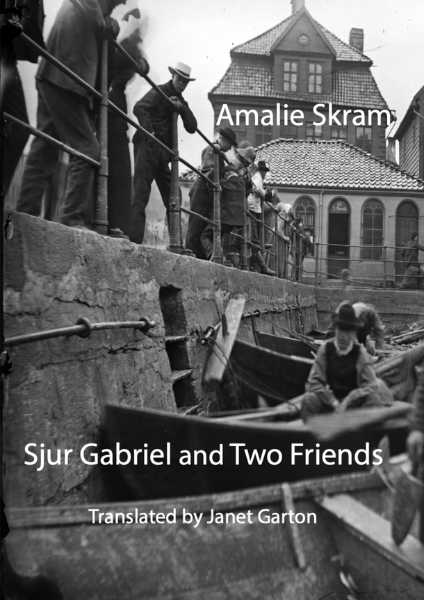
Port of Bergen, late 19th Century (Bergen University Library Collections)
Bergen today (© Janet Garton)

The first chapters of Two Friends bring together the characters of Oline (Madam Tosspot) and her grandson Sivert, whose shame at his grandmother’s drunkenness drives him as far away from the town as he can go – by ship all the way to Jamaica. But nowhere is far enough away to escape the inherited flaws which he will always carry with him.

Here is a short excerpt from the beginning of the novel, following Sivert and his grandmother in the streets of Bergen:

A fifteen-year-old boy in grey trousers held up by braces over his shoulders with a grey woollen shirt underneath came walking up Øvregaden. He was humming a popular song, marking the beats by stamping his wooden clogs on the sharp cobbles; when the melody demanded it he took a few dance steps. On his head sat a cap with a stiff peak shading his eyes, and under his arm he carried a bundle.

When he caught sight of the crowd up by Smedesmugalmindingen, he stretched out his neck with a look of curiosity in his wide-open eyes, and set off running towards it.

At that moment the knot of people began to move. The circle opened up, and he could see Tippler Tom with something in his hand which he was dragging along the street, and with Oline on his arm, lurching towards him. With a jerk the boy came to a sudden halt. His head sank forwards as if his neck had been broken. His fingers groped irresolutely down his trousers, and he turned round slowly. All at once his back hunched and his whole body seemed to shrink. It looked as if he wanted to leave, but couldn’t move. He stared down as if paralysed at one of his clogs which had fallen off his foot. He could hear the crowd approaching. In a moment it would knock him over if he didn’t move. He stole a glance to each side. Just next to him on the left was Bødkersmuget. Suddenly he bent down, snatched up the clog, took a couple of long unsteady strides over the gutter and the narrow pavement and reached the alley, starting to climb up its steep stone steps.

‘Come along wi’ us, Sivert! Tippler Tom an’ Madam Tosspot’s goin’ t’ Påtholleter sell ‘er skirt for booze!’ a boy’s voice called after him.

Bergen today (© Janet Garton)
Janet Garton by the statue of Amalie Skram, Bergen (© Gunnar Staalesen)

The book Sjur Gabriel and Two Friends can be purchased by clicking here.

Posted on

Summer reads from Norway

Credit: Jonas Gunnarsson/Westend61 GmbH

If you’re looking for something a bit off the beaten track to tempt you during the summer season, how about a Norwegian novel? Norvik Press has published translations of three of Norway’s most popular contemporary authors, which in their very different ways will transport you to an unfamiliar world.

Book cover A House in Norway

VIGDIS HJORTH: A HOUSE IN NORWAY (2014), translated by Charlotte Barslund.

Alma is a textile artist who receives an exciting commission, to design a tapestry for an exhibition to celebrate the centenary of women’s suffrage in Norway. The research is interesting and the money welcome – like many artists, she has a struggle to make ends meet – but she soon finds that it is not straightforward. An additional complication is that she is living in a large and impractical old house, and to help with the upkeep she rents out a part of it. Her new tenants are a young Polish couple, who at first seem quiet and undemanding; but soon the man disappears in suspicious circumstances, the woman has a baby and there are ongoing problems – their lifestyles are completely different, the woman keeps complaining, the rent is not paid … . Alma becomes increasingly unsettled, torn between her image of herself as an altruistic and open-minded modern feminist and her need for personal and private space in order to create. The conflict builds to a dramatic confrontation, but can there be a satisfactory resolution?

Vigdis Hjorth is an outspoken and controversial author who explores the boundaries between public persona and private trauma. Charlotte Barslund is a prize-winning translator, who was recently awarded the Believer Book Award for her translation of one of Vigdis Hjorth’s novels.

Book cover Lobster Life

ERIK FOSNES HANSEN: LOBSTER LIFE (2016), translated by Janet Garton.

Young Sedd, named after a witch by his long-vanished mother, is being brought up by his grandparents, the proprietors of one of Norway’s most resplendent and traditional mountain hotels. In the intervals between his hotel duties, he plays the role of private detective, attempting to discover the secrets of his own past. Yet for all his precocious abilities, he misses the vital clues as to what is happening around him: the family hotel, his inheritance, is on the brink of bankruptcy as its regular guests desert the glories of the Norwegian landscape for the hot beaches of Spain. The novel is full of humour, as Sedd becomes in turn a child of nature escorting German fishermen around the fish-filled mountain lakes, a world-weary sophisticate trying to impress an annoying teenager, or an impeccable waiter serving a party of funeral directors who let their hair down with astonishing abandon. Beneath the surface, however, the personal and financial tensions are slowly increasing, to a point where the secrets of the past and the conflicts of the present trigger an irreversible act of destruction.

Erik Fosnes Hansen’s novels are extremely diverse in form and content, ranging from the wildest of fantasies to the most carefully-researched realism. His early prize-winning novel Psalm at Journey’s End (1996) follows the lives of a group of musicians whose final engagement is on board the Titanic as it sails to its doom.

Book cover Berge

JAN KJÆRSTAD: BERGE (2017), translated by Janet Garton.

On a lovely summer’s day in 2008, the whole of Norway is shocked by the news of a brutal killing: in their peaceful country cabin, the popular Labour politician Arve Storefjeld and several members of his family have had their throats cut as they slept. The mysterious killer has left no trace. As the investigation unfolds, we follow the story through the eyes of three different actors in the drama: Ine Wang, an investigative journalist who stumbles on a vital clue, Peter Malm, the distinguished judge who presides over the trial, and Nicolai Berge, the writer who soon becomes the main suspect. All have their own demons to do battle with; all are in different ways critical of a society which has assumed that such things only happen elsewhere. When they meet at the trial, it is not only the accused who must face a reckoning.

Jan Kjærstad is best known abroad for his trilogy about another fictional representative of modern Norway, Jonas Wergeland, in The Seducer (1993), The Conqueror (1996) and The Discoverer (1999). The novel Berge, says the author, would not have been written without the events of 22 July 2011, when 77 youngsters attending a Labour party summer camp on the island of Utøya were shot dead by one rogue gunman. On that day the myth of Norwegian exceptionalism expired.