Posted on

Amalie Skram’s Bergen

The Bergen in which Amalie Skram was born and grew up was a bustling cosmopolitan port, with trading links to the rest of Europe and beyond, in many ways a more important centre than the capital Christiania over the other side of the country. From a young age she was allowed to roam freely around the town, observing the characters and settings which were to provide inspiration for some of her best writing. The series of novels known as The People of Hellemyr is largely set in and around Bergen, as the fate of the family is followed through several generations, from subsistence farmers to aspiring middle-class citizens. 

Amalie Skram (1846-1905)

Although Bergen has of course grown and changed dramatically since the mid-nineteenth century, a large part of the old town which Amalie knew so well has survived to this day. With its narrow alleyways and steep cobbled streets, wooden merchants’ houses and wharves, it makes it easy to imagine Madam Tosspot and Tippler Tom stumbling drunkenly through the byways or Sivert watching the ships tying up and dreaming of running away to sea.

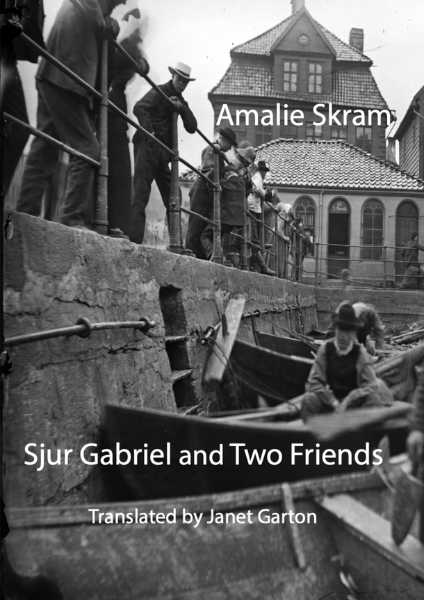
Port of Bergen, late 19th Century (Bergen University Library Collections)
Bergen today (© Janet Garton)

The first chapters of Two Friends bring together the characters of Oline (Madam Tosspot) and her grandson Sivert, whose shame at his grandmother’s drunkenness drives him as far away from the town as he can go – by ship all the way to Jamaica. But nowhere is far enough away to escape the inherited flaws which he will always carry with him.

Here is a short excerpt from the beginning of the novel, following Sivert and his grandmother in the streets of Bergen:

A fifteen-year-old boy in grey trousers held up by braces over his shoulders with a grey woollen shirt underneath came walking up Øvregaden. He was humming a popular song, marking the beats by stamping his wooden clogs on the sharp cobbles; when the melody demanded it he took a few dance steps. On his head sat a cap with a stiff peak shading his eyes, and under his arm he carried a bundle.

When he caught sight of the crowd up by Smedesmugalmindingen, he stretched out his neck with a look of curiosity in his wide-open eyes, and set off running towards it.

At that moment the knot of people began to move. The circle opened up, and he could see Tippler Tom with something in his hand which he was dragging along the street, and with Oline on his arm, lurching towards him. With a jerk the boy came to a sudden halt. His head sank forwards as if his neck had been broken. His fingers groped irresolutely down his trousers, and he turned round slowly. All at once his back hunched and his whole body seemed to shrink. It looked as if he wanted to leave, but couldn’t move. He stared down as if paralysed at one of his clogs which had fallen off his foot. He could hear the crowd approaching. In a moment it would knock him over if he didn’t move. He stole a glance to each side. Just next to him on the left was Bødkersmuget. Suddenly he bent down, snatched up the clog, took a couple of long unsteady strides over the gutter and the narrow pavement and reached the alley, starting to climb up its steep stone steps.

‘Come along wi’ us, Sivert! Tippler Tom an’ Madam Tosspot’s goin’ t’ Påtholleter sell ‘er skirt for booze!’ a boy’s voice called after him.

Bergen today (© Janet Garton)
Janet Garton by the statue of Amalie Skram, Bergen (© Gunnar Staalesen)

The book Sjur Gabriel and Two Friends can be purchased by clicking here.

Posted on

Norwegian gems

Professor Janet Garton, a Director of Norvik Press, recently gave a talk on a selection of our Norwegian novels in translation. You can watch her presentation below.

Video showcasing our favourite Norwegian gems

The gems under discussion are:

Click on the links in the book titles to find out more about each of these treasures!

Posted on

Jens Bjørneboe

‘… it struck me again that we inhabit an earth which is filled with a beauty beyond all understanding – and that we’ve turned this paradise into a slaughterhouse and a criminal asylum – into an all-embracing La Morgue, stinking of benzol and chloroform – instead of making water on finance ministers (as the hospital cat does) and singing, drinking wine, praising the solar system, frolicking, mating with each other, writing plays, and praying to the stars.’

This quotation from Powderhouse encapsulates the central concerns of the trilogy by Norwegian writer Jens Bjørneboe (1920–76) in the 1960s and 70s: Moment of Freedom (Frihetens øyeblikk, 1966); Powderhouse (Kruttårnet, 1969); and The Silence (Stillheten, 1973). Throughout his writing career Bjørneboe had been preoccupied with investigating injustice and cruelty, from the inhumanity of the World War II concentration camps to the brutalizing prison system and the regimented education system, stamping those who are different as ‘sub-normal’. In this trilogy he attempts through different narrators to address the fundamental issue of the problem of evil: why, when we have been presented with this beautiful earth, have we set out to destroy it and one another?

These three books – he calls them ‘manuscripts’ or ‘protocols’ rather than novels – range over a large amount of historical material, from witch-burning to public executions, from Verdun and Dachau to Cortez’ destruction of the Aztec empire and Pisarro’s destruction of the Inca empire. The investigations are conducted by a narrator who is variously a court official arranging trials, the caretaker of a lunatic asylum and an unidentified observer. Dark as his journey is, it is relieved by moments of intense awareness of the coolness of the night air, the taste of fine wine or the warmth of a lover’s body; and the trilogy culminates in the realisation that even if our capacity for evil is overwhelming, so is our capacity for good. He has researched the case for the prosecution, but there is also a case for the defence, ‘of man the incomprehensible – endlessly evil, endlessly good – all-renewing, all-destroying’.

 It was largely thanks to the Herculean efforts of Bjørneboe’s American translator, Esther Greenleaf Mürer, that Norvik Press was able to publish this trilogy in 1999-2000. The rather stunning covers of the first edition of the books were taken from works by one of Norway’s most important twentieth-century painters, Frans Widerberg.

In 2017 we reissued the three books in a new format and with a different cover design by Essi Viitanen:

One year after The Silence, Bjørneboe published his final novel, The Sharks (Haiene, 1974). This is a more traditional novel than the trilogy, and full of action and suspense; it is a thrilling story of mutiny and shipwreck, stranding on a desert island and survival against the odds. But at the same time it resounds with the urgency of all of Bjørneboe’s work, here addressing the problem of how a small community might construct a fair and equal society. It is Bjørneboe’s vision of an anarchist Utopia, of power shared by all and of commitment to another human being which provides a reason for hope of a better future.

This novel too was translated by Esther Greenleaf Mürer and first published by Norvik Press in 1992. Our first edition sold out, and we republished the book in 2016.

It is now just over a hundred years since Jens Bjørneboe was born, forty-five years since he took his own life, and memories of his hugely controversial life and writings have faded somewhat. But the questions he asked, uncomfortable as they were, are questions we need to go on asking. Indeed, it might be said that in the present context, his concerns about the future of Planet Earth are more pressing than ever.

Posted on 2 Comments

Norvik’s Norwegian autumn

As the weather turns chillier, we’re delighted to bring you not one but two contemporary Norwegian novels. Curl up in your favourite chair and enjoy two of Norway’s most acclaimed authors, both translated into English by Janet Garton.

Heading for all good bookstores this October, Jan Kjærstad’s thought-provoking and subtle Berge weaves together the voices of three citizens, each affected in their own way by a heinous crime in the forest outside Oslo. Read a preview here.

Erik Fosnes Hansen’s Lobster Life captures the absurdities and tragedies of life in a country hotel on the brink of ruin. Like a latter-day Holden Caulfield, the orphaned Sedd reminds us that humans are a lot like lobsters: their vulnerable innards are not reliably protected by their hard shells. But struggle on we must, even if we lose a claw or two along the way. Click here to read a preview, or find Lobster Life in all good bookstores, or via norvikpress.com.

Find more information on both novels in our Norwegian Autumn leaflet: