Posted on

26th September: The European Day of Languages

John Linnell (1792-1882), after Edward Price (active c.1823-1854), View Across the Fiord from Herrinsholmen, circa 1826-27 from series Seven Views in Norway, etching on paper (UCL Art Museum LDUCS-1456).

Celebrate The European Day of Languages on 26 September by learning a Nordic language!

Did you know that 26 September is The European Day of Languages (EDL)? This celebration was first introduced in 2001 during the European Year of Languages when the Council of Europe’s Committee of Ministers ultimately decided to make EDL a yearly occurrence. The day is an opportunity to promote multilingualism, linguistic diversity and language learning.

At Norvik Press we are obviously big fans of this yearly celebration and of the many activities organised to draw attention to Europe’s linguistic and cultural diversity. So why not mark the day by learning something new about one of the languages of the Nordic Region? 

You can do this, for instance, by exploring The Language and Culture Show and Tell series, a set of free online language tasters and related materials created around objects mostly from UCL Art Collections. In January 2023, the series also became the basis of the UCL Art Museum exhibition called ‘Not Just Words: Learning Languages through Art and Objects’, which one of our Directors, Dr Elettra Carbone, co-curated with Dr Andrea Fredericksen (Curator, UCL Art Museum). 

The ‘Not Just Words’ exhibition in the Summer of 2024. Photographer: K. Holst. 

The series and the exhibition show how a collection-based approach to language learning can successfully and simultaneously promote the importance of language awareness and the relevance of university collections to academic and non-academic audiences. Many modern languages spoken in the Nordic Region are represented in this series, including Danish, Faroese, Finnish, Icelandic, Norwegian and Swedish. We hope you enjoy these resources and wish a happy EDL to all our readers and followers!

Posted on

Announcing our Latest Title: A Kaleidoscope of Stories 

Selma Lagerlöf’s A Kaleidoscope of Stories (Norvik Press, July 2025)

‘Osceola’ by George Catlin (1838)

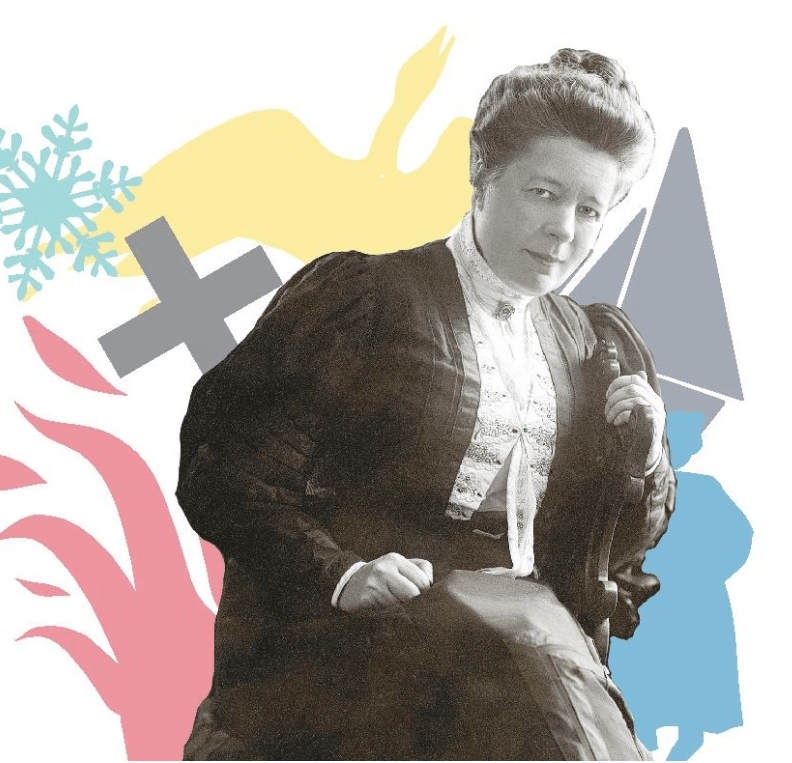
Selma Lagerlöf’s vivid recollection of discovering the heady delights of the adventure story Oseola (sometimes known as Osceola) as a child is taken from ‘Two Prophecies’, one of the autobiographical texts in this volume. It seems a fitting way to open this blogpost about the latest addition to our ‘Lagerlöf in English’ series, which turns the spotlight on the power of short stories.  The volume contains a carefully chosen selection of Lagerlöf’s most important stories covering a range of themes, genres and periods of her career, translated by our prize-winning trio of Lagerlöf translators, Linda Schenck, Peter Graves and Sarah Death. After each story they also provide explanatory notes where appropriate.

Långserud, Värmland (Martin Edström/imagebank.sweden.se)

Midsummer folk dance, Öland (Bernt Fransson)

Lucca, Church of St. John and St. Reparata, 4th Century (Syrio)

Key autobiographical pieces, morality tales both dark and light, legends from several lands and folklore-inspired narratives combine to reveal the breadth and stylistic range of Lagerlöf’s storytelling skills. This is a collection of interest to general readers but also a useful teaching tool for Swedish and comparative literature courses around the world. The volume includes a comprehensive and accessible introduction by Lagerlöf specialist Bjarne Thorup 
Thomsen (University of Edinburgh). The nine stories have been arranged into three thematic sections: Women, Work and Writing; Landscapes, Families and ‘Others’; Epochs, Societies and Values.

As our specialist scholar writes in his introduction, the collection has been designed to offer the reader a multifaceted mixture of stories. The selected narratives showcase different times, places, atmospheres, styles and genre modes. Some stories are obvious instances of prose fiction, while others are balanced somewhere between fictional and factual writing. With the nine narratives listed chronologically according to their dates of first publication, the content of the volume is as follows (annotations by Bjarne Thorup Thomsen):

‘Mamsell Fredrika’ / ‘Miss Fredrika’ – an imaginative and extravagantly expressed tribute to a female trailblazer in Swedish literature, centred, like many of Lagerlöf’s stories, around Christmas.

‘De fågelfrie’ / ‘The Outlaws’ – a narrative, steeped in nature mysticism and fin-de-siècle-feel, about clashes, but also fluid boundaries, between pagan and Christian mindsets in medieval times, fuelled by the descriptive energy that Lagerlöf attributed to her writing at the time.

‘Gudsfreden’ / ‘God’s Peace at Christmas’ – an enquiry into a close encounter, with elements of crime, between human and animal, and Lagerlöf’s first depiction of the Ingmarssons, the powerful family of peasants that would take centre stage in Jerusalem.

‘Spelmannen’ / ‘The Fiddler’ – a story, both playful and uncanny, about a self-assured musician and the shadows of abandoned family, set during a Nordic summer night in a landscape that is both attraction and trap.

‘Silvergruvan’ / ‘The Silver Mine’ – a nation-orientated narrative about the homeland’s real riches, anticipating some of the major themes in Nils Holgersson

‘Två spådomar’ / ‘Two Prophecies’ – a biographical sketch in six life moments, infused with motifs of deciphering, reading and writing, about Lagerlöf’s route to becoming an author, published at a time when her national, and indeed international, fame was growing fast.

‘Bortbytingen’ / ‘The Changeling’ – a suspense-filled story about unexpected contact and strange parallels between a human and an ‘alien’ sphere, featuring an unconventional and resourceful heroine.

‘Den heliga bilden i Lucca’ / ‘The Sacred Image in Lucca’ – a miraculous legend and picaresque travel adventure played out in Italy, foregrounding poor but hopeful working-class characters and told in a lucid style and light-hearted tone.

‘Dimman’ / ‘The Mist’ – a modern parable with a punishing ending, published in the context of the First World War and critiquing attitudes, including artistic ones, to the reality of global conflict and suffering.

We enthusiastically echo Bjarne’s assessment that Lagerlöf’s rich corpus of short stories and related forms of short prose deserves renewed attention – and up-to-date translations. These are the first retranslations of the texts in our anthology for over a century. We are sure that all anglophone readers, from committed Selma followers to those discovering her work for the first time, will fall under the spell of her storytelling in this varied volume.

Posted on

Norvik Press: New Books in 2025

Norvik Press is pleased to announce the forthcoming publication of much-awaited titles. From a stark portrayal of contemporary Greenlandic society to new classics by Lagerlöf and Skram, 2025 is set to be a year of fresh discoveries and exciting reading in the company of Norvik Press!

Sørine Steenholdt: Zombieland

Sørine Steenholdt (b. 1986)

Translated from Greenlandic into Danish by Niviaq Korneliussen

Illustrated by Maja-Lisa Kehlet Hansen

Translated from Danish into English by Charlotte Barslund

Zombieland (Zombiet Nunaat) is cold comfort. Violent events occurring in already vulnerable lives are the turning points for Sørine Steenholdt’s powerful short stories, and it can be hard to distinguish between fantasy and reality. Rape, suicide, drug abuse, fires and car theft … few are spared. It is social criticism that gets under your skin.

Originally published in Greenlandic in 2015, Zombieland was nominated for The Nordic Council Literature Prize in 2016. The book is a collection that combines short stories with short sections of poetry. All texts can be seen as allegories that critique Greenlandic society. Some condemn the older generation of Greenlanders who fell into alcohol abuse and neglected their children. Others express the younger generation’s refusal to be represented as subservient to Denmark. While alcoholism has decreased, and sovereignty has been claimed, the memories of the suffering and betrayal of the older generation remain. All of Steenholdt’s stories emphasise the flaws of contemporary Greenland such as poor journalism, untrustworthy leadership, ineffective social institutions and a dysfunctional legal system making Steenholdt’s Greenland a ‘Zombieland’ – a place where no-one is in control. 

Norvik Press are delighted to announce that this translation is the recipient of a Pen Translates award.

Tasiilaq, Greenland (Carl Skou)

Selma Lagerlöf: A Kaleidoscope of Stories 

Selma Lagerlöf (1858-1940)

This new addition to our well-established ‘Lagerlöf in English’ series will turn the spotlight on the power of short stories.  The volume contains a selection of Lagerlöf’s matchless stories covering a range of themes, genres and periods of her career. Norvik’s prize-winning trio of Lagerlöf translators, Linda Schenck, Peter Graves and Sarah Death, has enjoyed a fruitful collaboration working on this project.

This is a collection of interest to general readers but also a useful teaching tool for Swedish and comparative literature courses around the world. The book includes a comprehensive and accessible introduction by Lagerlöf specialist Bjarne Thorup Thomsen (University of Edinburgh). The nine stories have been arranged into three thematic sections: Women and Writing; Landscapes, Families and ‘Others’; Epochs, Societies and Values. 

Key autobiographical pieces, morality tales both dark and light, legends from several lands and folklore-inspired narratives combine to reveal the breadth and stylistic range of Lagerlöf’s storytelling skills.

Norvik Press ‘Lagerlöf in English’ Series

Amalie Skram: Sjur Gabriel and Two Friends

Port of Bergen, late 19th Century (Bergen University Library Collections)

Port of Bergen, late 19th Century (Bergen University Library Collections)

The two short novels Sjur Gabriel and To Venner (Two Friends), both published in 1887, are inspired by Amalie Skram’s early years in the bustling port of Bergen in Western Norway. The eponymous central character of Sjur Gabriel is a subsistence farmer struggling to make a living for himself and his family in the barren countryside, and to stop his wife from drinking to forget her misery. When their son Little-Gabriel is born, life seems brighter for some years – but the fragile hope for the future is threatened when the boy becomes seriously ill.

Two Friends focuses on the story of Sivert, the grandson of Sjur Gabriel. He is an apprentice in Bergen, but haunted by the presence of his grandparents, both of whom wander round the streets of Bergen as grotesque drunks. In order to escape he goes to sea as a cabin boy on the bark Two Friends, where he soon thrives on life at sea on a long voyage to Jamaica. When two Frenchmen come on board with their menagerie of exotic animals to transport back to France, he is befriended by them and becomes indispensable as interpreter and companion; but his inherited flaws of character soon reveal themselves and lead him to gamble away his chance of a better life.

Amalie Skram (1846-1905)

These novels are the first two in a series of four usually referred to as Hellemyrsfolket (The People of Hellemyr). The following two novels, S.G. Myre (1890) and Afkom (Descendants, 1898) follow the story of the family through the next generation in Bergen, as they try to free themselves from the taint of the past and make a better life for themselves and their families.

These two novels are translated from the Norwegian by Janet Garton, who has written a biography of the author and published several volumes of her letters. Also available from Norvik Press are Amalie Skram’s novels Lucie (1888), Fru Inés (1891) and Betrayed (1892), all translated by Katherine Hanson and Judith Messick.

Rein Raud: The Sun Script

The Sun Script (Päikesekiri, 2021) is an absorbing work of fiction which ranges across many countries and has a large gallery of fascinating characters, focusing in particular on the adventures of Lily, an Estonian strongwoman loosely modelled on the sumo wrestler Anette Busch (1882-1969), and Tsuneo, an amateur Japanese linguist who is the guardian of a secret cosmic language. The novel combines fast-paced events and high tension with more reflective passages about the possibilities of international understanding and the nature of writing and language.

Anette Busch (1882-1969)

Rein Raud (b. 1961) is an outstanding Estonian writer who has won many awards for his fiction and poetry, as well as being himself a translator. The Sun Script has been translated into several languages.

Rein Raud (b. 1961)

The novel is translated by Christopher Moseley, a highly experienced translator from Estonian and Latvian, whose translations for Norvik Press include Ilmar Taska’s Pobeda 1946 (2018) and Inga Ābele’s The Year The River Froze Twice (2020). This translation of The Sun Script is an exciting addition to Norvik Press’s Baltic titles. 

Posted on

Jógvan Isaksen’s DEAD MEN DANCING wins the Petrona award for the best Scandinavian crime novel of the year 2024

‘Thirty or forty years ago there was a rockslide on Beinisvørđ. And it was no small one. Guillemot cliff ledges disappeared by the dozen, seal caves were closed off, and the entire profile of the headland changed. What I think I remember, and I don’t know where I’m getting it from, is that when the dust settled the bones of a human arm were found on the shore unearthed by the rockslide.’

I’ve never heard of that, but so many a man has met his maker in those parts that it wouldn’t be particularly odd if skeleton fragments were found.’

‘With a shackle dangling from the wrist?’ I asked, peering straight into the editor’s dark eyes.

Norvik Press is delighted to announce that Deydningar dansa á sandi by the Faroese author Jógvan Isaksen, translated by Marita Thomsen as Dead Men Dancing, has won the Petrona award for 2024. Many congratulations to author and translator!

Dead Men Dancing is the second of Jógvan Isaksen’s series of novels about the journalist and amateur detective Hannis Martinsson to be published by Norvik Press, after Walpurgis Tide (translated by John Keithsson) in 2016. The novel begins with the discovery of a corpse on the beach, the body of a man who has been shackled to rocks and left to drown. As Hannis investigates, he comes across evidence of more deaths which have been caused in the same way, and starts to realise that they are all linked to a local revolt several decades earlier, which tore a community apart. The repercussions have continued to the present day, and Hannis’ enquiries soon put his own life in danger.

To order the novel, click here: https://norvikpress.com/product/dead-men-dancing/

Posted on

Women in Translation Month: Enduring storytellers and fresh talent. #WITMonth

Norvik Press’s credentials in translating and publishing work by women writers remain impressive. In 2025, for example, we are publishing three titles by women writers, and four out of our five translators for those titles are women, too. 

Our latest blog looks at two of our regular favourites – a Swedish and a Norwegian author, each with a peerless storytelling pedigree – and introduces a modern-day writer from Greenland whose stories paint a startling picture of her country.

Selma Lagerlöf

Selma Lagerlöf’s youthful work Gösta Berlings saga was the jumping-off point for an extraordinary career. this largely home-schooled young trainee teacher decided to submit some chapters to a writing competition in Stockholm – and won! She then expanded those chapters into to a novel, which was published in 1891. It, and many of the novels that followed it, are whirlwinds of betrayal, love, human weakness and redemption.

Selma Lagerlöf (1858-1940)

The majority of the fast-moving romantic adventures are set around the shores of a lake in the dramatic north-westerly landscapes of Lagerlöf’s native province, Värmland. 

Värmland. Photograph: Martin Edström

The author’s early works completely confounded the literary establishment of the time, but like so much of Lagerlöf’s masterly storytelling they have remained enduringly popular not only within Sweden but around the world. The prime example is her much-loved adventure tale Nils Holgersson’s Wonderful Journey through Sweden, about a boy punished for laziness by an elf who shrinks his size. The boy is then carried the length and breadth of the land on the back of a goose, learning precious life lessons by becoming part of the flock. 

Norvik Press’s long-running ‘Lagerlöf in English’ series spans the full range of Lagerlöf’s work, from her action-packed Löwensköld Ring series to her multi-faceted trio of Mårbacka ‘memoirs’ via many standalone titles such as the touching and melancholy Emperor of Portugallia, and Banished, with its harrowing First World War scenes and ultimately uplifting pacifist message.

Steve Sem-Sandberg, winner of the Selma Lagerlöf Literature Prize 2024 awarded this month, spoke admiringly of her narrative instincts and her powers of imagination.  Lagerlöf, he said, possessed a unique ability to combine the time-bound and the timeless, to take things and people she had herself experienced and transform them. Norvik’s three translators – Sarah Death, Peter Graves and Linda Schenck – can only concur. They take delight in translating Selma’s work and are currently enjoyably engaged on their first team project, an anthology of her short stories. This newest addition to the ‘Lagerlöf in English’ series will be published next year under the title A Kaleidoscope of Stories.

Amalie Skram

Amalie Skram (1846-1905)

This adventurous nineteenth-century Norwegian writer is nowadays mostly known – and still widely read – for her novels about the unenviable fates of young women in a society which expects them to be modest and chaste, and brings them up to be obedient wives and devoted mothers. Norvik Press has previously published three of these, translated by the talented American translating team of Katherine Hanson and Judith Messick.

In Betrayed, the child-like Aurora embarks on marriage – and a long sea voyage – with her worldly-wise new husband as ship’s captain, only to discover with horror that he has had a number of sexual encounters; the discovery both repels and fascinates her, and drives her to torment him until both become victims of a repressive social system. Fru Inés tells the story of a woman married to a callous and profligate husband, who longs to experience the sexual ecstasy she has never known. The novel is set in Constantinople, a city the author knew well, and the sights, sounds and smells of the teeming metropolis blend with the growing anguish of Inés to reach a dreadful climax. The heroine of Lucie, on the other hand, is a girl from the other side of the tracks, a dancing girl and mistress of a respectable civil servant, Theodor Gerner; he decides to redeem her by marrying her, only to destroy her by his rigid expectations of acceptable behaviour.

Our new venture is a translation of the work which was originally considered Amalie Skram’s crowning achievement, the four-volume series The People of Hellemyr. The novels have often been compared to Zola’s Rougon-Macquart series; they are set in and around Skram’s native Bergen, and the narrow alleys and bustling harbour of the old port are central to the action.

Bergen harbour, late 19th century. Photograph: Bergen fotoarkiv

The first two volumes, in Janet Garton’s translation, will be published in 2025. Sjur Gabriel follows the struggle for existence of a desperately poor farming family, scraping a living from the stony soil, until the arrival of a golden child seems to offer a faint hope of a richer life. Two Friends follows the adventures of their grandson Sivert, who becomes a sailor and travels to Jamaica; he is a strong and willing lad who seems to have every chance of getting on in life, but he cannot flee from the fatal weakness of character which he has inherited.

Sörine Steenholdt

In a new departure for Norvik Press, we are excited to announce that we will also be publishing a Greenlandic book in 2025. Sørine Steenholdt was born in Paamiut in southern Greenland in 1986, and in 2015 her debut book, a short story and poetry collection called Zombiet Nunaat (Zombieland), was published.

Sörine Steenholdt (b. 1986). Photograph: Ulannaq Ingemann

All the texts can be seen as allegories that critique Greenlandic society. Some condemn the older generation of Greenlanders who fell into alcohol abuse and neglected their children, whilst others express the younger generation’s refusal to be represented as subservient to Denmark. While alcoholism has decreased, and sovereignty has been claimed, the memories of the suffering and betrayal of the older generation remain. Steenholdt’s stories emphasise the flaws of contemporary Greenland such as poor journalism, untrustworthy leadership, ineffective social institutions and a dysfunctional legal system, making her Greenland a ‘Zombieland’ – a place where no-one is in control.

Zombieland, cover of the original Greenlandic edition

The book was nominated for the Nordic Council Literature prize on first publication, and Norvik Press has been awarded a PEN translation grant for this translation. It will be translated from Danish by the well-known literary translator Charlotte Barslund.

Other Norvik Press translations of women writers:

Inga Ābele: The Year the River Froze Twice (translated by Christopher Moseley)

Victoria Benedictsson: Money (translated by Sarah Death)

Karin Boye: Crisis (translated by Amanda Doxtater) 

Fredrika Bremer: The Colonel’s Family (translated by Sarah Death)

Suzanne Brøgger: A Fighting Pig’s Too Tough to Eat (and Other Prose Texts) (translated by Marina Allemano) 

Camilla Collett: The District Governors Daughters (translated by Kirsten Seaver)

Kerstin Ekman: Witches’ Rings (translated by Linda Schenck), The Spring (translated by Linda Schenck), The Angel House (translated by Sarah Death), City of Light (translated by Linda Schenck), Childhood (translated by Rochelle Wright).

Janet Garton (ed.): Contemporary Norwegian Womens Writing

Svava Jakobsdóttir: Gunnlöth’s Tale (translated by Oliver Watts)

Viivi Luik: The Beauty of History (translated by Hildi Hawkins)

Hagar Olsson: Chitambo (translated by Sarah Death) 

Hanne Marie Svendsen: Under the Sun (translated by Marina Allemano)

Kirsten Thorup: The God of Chance (translated by Janet Garton)

Helene Uri: Honey Tongues (translated by Kari Dickson)

Elin Wägner: Penwoman (translated by Sarah Death)

Dorrit Willumsen: Bang: A Novel About the Danish Writer (translated by Marina Allemano)

To order the Norvik Press books highlighted in this blog, please follow the green hyperlinks or request the titles you would like at your favourite bookshop.

Posted on

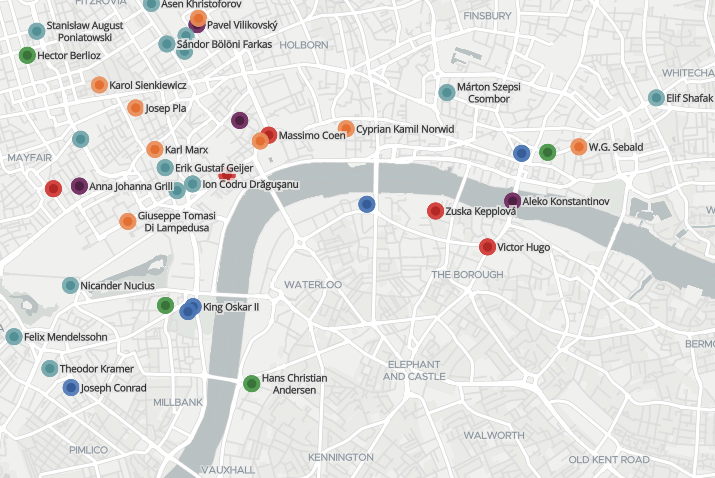
The European Literary Map of London

Our friends at University College London are crowdsourcing an interactive map that traces European literary encounters across London.

You can explore (and submit new pins to!) the map here: https://www.europeanliterarylondon.org/

The map inspired us here at Norvik Press to think about how London is portrayed within our books. We have zoomed in on two of our favourite examples of London in literature below.


Kirsten Thorup: The God of Chance

Ana had got into the habit of travelling into the City at around four in the afternoon. She took the underground to Bank and rose up into the anonymous security of marble and glass. She felt at home in the City’s ivory-coloured concrete desert, where she had been a frequent visitor over the past ten to twelve years. She knew the streets, the cafés, the bars, the smooth upthrust of the buildings which blocked out the sky. She knew the well-cut suits and jackets, the high heels and the brief cases with the same label as her own. She knew the purposeful steps which echoed back from between the walls like the hollow beat of drumsticks.

She had finally arranged an interview with the HR manager. She circled around City Place House where Rower had its premises, and ended up sitting in the large high-ceilinged bar just opposite. She placed herself strategically at a table right next to the glass façade, so that she had a view of her former workplace. Sitting in the low armchair, she sipped her Campari soda. She leafed absent-mindedly through the Financial Times, and felt she was out of circulation. She recognised some of her former colleagues as they walked past on the pavement and cut across the square in front of the entrance. […]

She finished her drink and walked out of the bar and across towards City Place House and the sterile little marble square. With her smart appearance, the discreet elegance of her suit, the shoes moulded perfectly to her feet, and the stiletto heels which added three inches to her height, she looked like the career woman she had been in her earlier life, and blended in with her surroundings. It struck her that the fountain in the middle of the square looked touching in its stripped-down minimalism with the threadlike jets gathered into vertical bundles.
–– Translated by Janet Garton

Amalie Skram: Betrayed

Their baggage had been sent on board and after Ory and Riber had said good-bye to their landlady, they went out to buy a few little things before departure.

‘Is there anything else?’ Riber asked, holding packages in his hands. They had walked out of a shop in St. Paul’s Churchyard.

Ory stood for a moment and thought carefully. ‘Nothing I remember,’ she said. ‘Of course we’ll be forgetting the most important thing.’ […]

Down the street they hailed a cab. Riber called out “Victoria Docks” as they got inside and off they went as fast as the moving throng of pedestrians and vehicles allowed. […]

Then the cab stopped. Riber shot up, put on his hat, pulled on his overcoat, stepped out and paid the driver.

Ory gathered her packages. Riber held his hand out to her and she jumped down.

Silently they walked side by side across the paved wharf that looked like an enormous courtyard, huge warehouses on three sides, reverberating with activity and tumult. The fourth side was open to the water, chock-full of large-hulled steamers and high-masted sailing ships; all the vessels that could find room were alongside the paved wharf, loading or unloading cargo.

‘Stop, Aurora! Here is the ship. Orion ahoy!’

‘Ahoy!’ came back in return, and a red-freckled man wearing a flat-crowned cap and a wool scarf around his neck appeared waving from the rail of a full-rigged ship.

–– Translated by Katherine Hanson and Judith Messick

Read more about the European Literary Map of London here, and the ‘Lost & Found: Mapping European Literary London’ exhibition.

Happy exploring!

Posted on Leave a comment

Nordic novels to curl up with at Christmas

cup of coffee and christmas ornaments on a window sill

It’s December, and time for our festive blog! We’ve compiled a fireside reading list for you to enjoy this season.

1. A naughty boy learns his lesson – and teaches their lessons to Swedish children.

‘He stared and stared and could not believe his eyes. What at first had seemed to be a shadow became more and more solid and he could soon see that it was something real. Without a shadow of doubt, there was an elf sitting astride the edge of the chest.’

Nils, a fourteen-year-old farmer’s boy, is lazy and unkind. He meets his match when he tries to trick an elf, who shrinks him so that he’s elf-size himself. Trying to stop a farm gander from escaping to join some wild geese, he is whisked into the sky and travels far and wide with the geese, learning kindness as well as geography on the way.

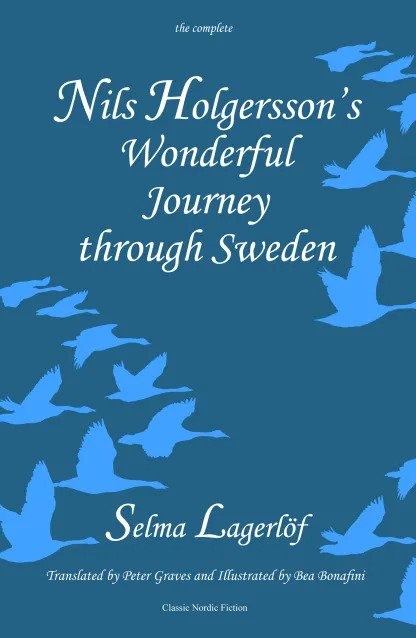
Selma Lagerlöf’s Nils Holgersson’s Wonderful Journey Through Sweden (1906–07, translated by Peter Graves) was written to teach Swedish schoolchildren about the history, topography and culture of their own country. Like the consummate story-teller she is, the author transforms a school textbook into a magical adventure story full of talking animals and mythical battles, in which Nils comes to understand the value of selflessness and compassion.

In a beautifully-produced hardback volume, Bea Bonafini’s quirky illustrations capture the fairy-tale atmosphere.


2. Secrets lurk in the corridors of a Norwegian mountain hotel

‘My mother disappeared early on and is therefore impossible to remember. It seems she was a witch. Not a real witch, of course, but she wanted to be one. That’s what Jim told me, because he knew her. A bit, anyway. He thought it all came from listening too much to that Donovan song ‘Season of the Witch’, and then reading too many weird books about witches, before she made her mind up and set off to find Bloksberg or inner peace and was taken by Time. That’s why I have such a strange first name, Sedgewick, because there was a famous witch whose surname it was, until she was burnt.’

In this novel young Sedgewick, who helps his grandparents to run a splendid and traditional mountain hotel, sets out to find the truth about his origins. His parents have vanished and no-one talks about them. As he slowly uncovers the secrets of his past, he realises that the present holds secrets too – and one of the biggest is that the impressive family hotel is on the brink of bankruptcy. Grandfather is struggling to maintain the façade as matters become more and more desperate, and the secrets of the past and the present collide in a blazing denouement.

In Lobster Life (2016, translated by Janet Garton), Erik Fosnes Hansen looks at life and its challenges from the viewpoint of an adolescent boy, whose seriousness provides much inadvertent humour.

The hotel guests are an eccentric collection of individuals who require special treatment, one of the strangest being the national organization of funeral directors, who hold their annual feast at the hotel and embark on riotous songs to celebrate their achievements:

A timer on a bomb clicked home, a plane fell from the sky

Our Daimler plucked up bodies by the score.

Titanic was a great success, our boat was just nearby

We dived and pulled them out again to bury them once more.

3. The storybook life of the great storyteller

‘If the little ones at Mårbacka had not found out some other way that Christmas was coming, they would certainly have realised when they saw von Wachenfeldt arriving.

And they were beside themselves with glee to see his horse and one-man sleigh at the top of the avenue. They ran all through the house to proclaim the good news, they stood on the front steps to receive him, they shouted good day and welcome, they brought bread for his horse and they carried his meagre carpet bag, embroidered with cross-stitch flowers and leaves, down to the office where the guest was to reside.

It was strange, really, that the children always received Warrant Officer von Wachenfeldt so warmly. They could expect neither sweets nor presents from him but they must have felt he was all part of Christmas, and that was the reason for their delight. At any rate, it was just as well they treated him kindly, for the grown-ups made no fuss of him.’

From the age of three, the little Selma was acutely observant of life at the family estate of Mårbacka; growing up in the 1860s surrounded by the events of the farming year, the eccentric members of her wider family and her lively brothers and sisters, she had in many ways an idyllic childhood. Through her eyes we follow the dramatic events, comical behaviour and, at times, poignantly sad fates of Swedish provincial life, as the skies begin to darken and the very basis of life itself, the family farm, comes under threat.

Selma Lagerlöf has written three autobiographical novels, of which the first two, Mårbacka (1922) and Memoirs of a Child (1930, both translated by Sarah Death) have been published by Norvik Press. They turn her childhood into a story, part autobiography and part myth-making. ‘I can’t do with relying just on my memory, I must have artistic form,’ as the author commented herself.


4. Atmospheric smalltown memories and a mother’s nightmare

‘I’d decided to collect everything that belonged to Elizabeth in one special box. But there was so little that was hers, a thin layer of clothes just covering the bottom and a pair of worn boots, a few bottles and tubes of cheap cosmetics. Nothing she owned seemed to have been particularly affected by having passed through her hands. When she was little I knew every seam of her clothes and every broken edge of her wooden toys. Now I didn’t know her at all.’

Self-questioning Ann-Marie is engulfed by memories and anxieties when she returns to her home town and takes up residence among assorted down-and-out lodgers in the old family home, camping out in its clutter as she tries desperately to track down her missing daughter Elizabeth. She spends a makeshift Christmas with a close family friend, and continues her efforts to make sense of the physical remnants of her father’s life as an inventor, and a drinker. Her mind is a whirl of images of the generations of individuals she has known in the town. A tall man dressed as a magician has arrived on the same train, and as the hunt for Elisabeth intensifies, this close-to-the-bone story of filial frailties and jagged maternal love is deepened by hints of mythology and magical realism.

Kerstin Ekman is acknowledged as a towering figure in contemporary Swedish storytelling. City of Light (1983), a rich and many-layered novel, was translated for Norvik Press by Linda Schenck in 2003. It is the final part in Ekman’s Katrineholm quartet, also known as ‘Women and the City’, a women’s-eye view of the development of a small southern Swedish town, from the coming of the railway through to the 1980s.


If poetry is your bag: dual-language Nordic masters

Book cover Window Left Open

1. Hans Børli: lumberjack and poet of the Norwegian forests

Vi eier skogene

Jeg har aldri eid et tre.

Ingen av mitt folk

Har noensinne eid et tre –

Skjønt slektens livs-sti slynget seg

Over århundrers blå høgder

Av skog.
We Own the Forests

I have never owned a tree.

None of my people

has ever owned a tree –

though my family’s life-path winds

over centuries’ blue heights

of forest.

Hans Børli (1918–89) spent his whole life as a lumberjack working in the vast forests of south-eastern Norway, and writing his poetry in his spare time. We Own the Forests (translated by Louis Muinzer) is a selection of the poems written over his lifetime, alive with his experiences of the natural world. The world of trees and the world of words flow together in these poems, firmly anchored in his native soil.


2. Pentti Saarikoski: modernist poet of the Finnish soul

LVIII

Aina minä löydän kiven

jonka maan mullistukset

ja sateet ja tuuli

ovat tehneet ihmiselle sopivaksi istuimeksi

selkänojalliseksi tai voi istua kyynärpäät polvilla

kuljettaa sormea kiveen hakatussa kirjoituksessa
LVIII

I’ll always find a stone

that’s been moulded into a seat fit for a man

by the convulsions of the ground

and the rains and the wind

either it’s got a back or I can sit with my elbows resting on my knees

tracing with my finger the writing chiselled into the stone

Pentti Saarikoski (1937–83) was a Bohemian poet with a turbulent private life, a modernist who was also a political commentator. His preoccupations were wide-ranging and his poetry prolific and varied in form and content. This selection of his work, A Window Left Open, translated by Emily Jeremiah and Fleur Jeremiah, gives a taste of his achievements and an indication of the reasons for his enduring popularity in his native Finland.


Or how about some Nordic Noir for the dark winter nights?

Jógvan Isaksen: Murder on the Faroe Islands

‘I’m telling you, if you’re up to your old tricks again, I’ll smash your face in.’

‘That seems an appropriate way of dealing with a member of the public,’ I replied.

‘Don’t you start again! It’s been so wonderfully peaceful round here while you’ve been off overseas. You’ve been back for two minutes and you’re already giving me hassle.’

The angry man was Detective Inspector Piddi í Útistovu, a man I’d had rather a lot to do with in the past.

Hannis Martinsson has returned to the Faroes after living in Copenhagen for many years. He sets out to make his living as a free-lance journalist and amateur sleuth, a pursuit which often leads to uncomfortable relations with the police. But his dogged determination and lively curiosity help him to solve conundrums which have the official forces baffled.

Jógvan Isaksen’s detective novels play out against the rugged landscape and sea-swept coasts of the Faroe Islands, and have been dramatised in the TV series Trom. In Walpurgis Tide (2005, translated by John Keithsson) Hannis investigates the murders of two anti-whaling activists – and stumbles upon an international conspiracy which goes far beyond the dispute about hunting whales to threaten the very existence of the Faroese way of life. In Dead Men Dancing (2011, translated by Marita Thomsen) his realisation of the links between a series of gruesome discoveries of skeletons chained in caves takes him to remote corners of the isles; his own life is increasingly in danger as he gets nearer to exposing the murderer.

Happy Reading!

Posted on

Cover reveal, and a book launch! #FaroeseNoir

Exciting news: we’re unveiling the cover of our new book, and you’re invited to the in-person launch event for it!

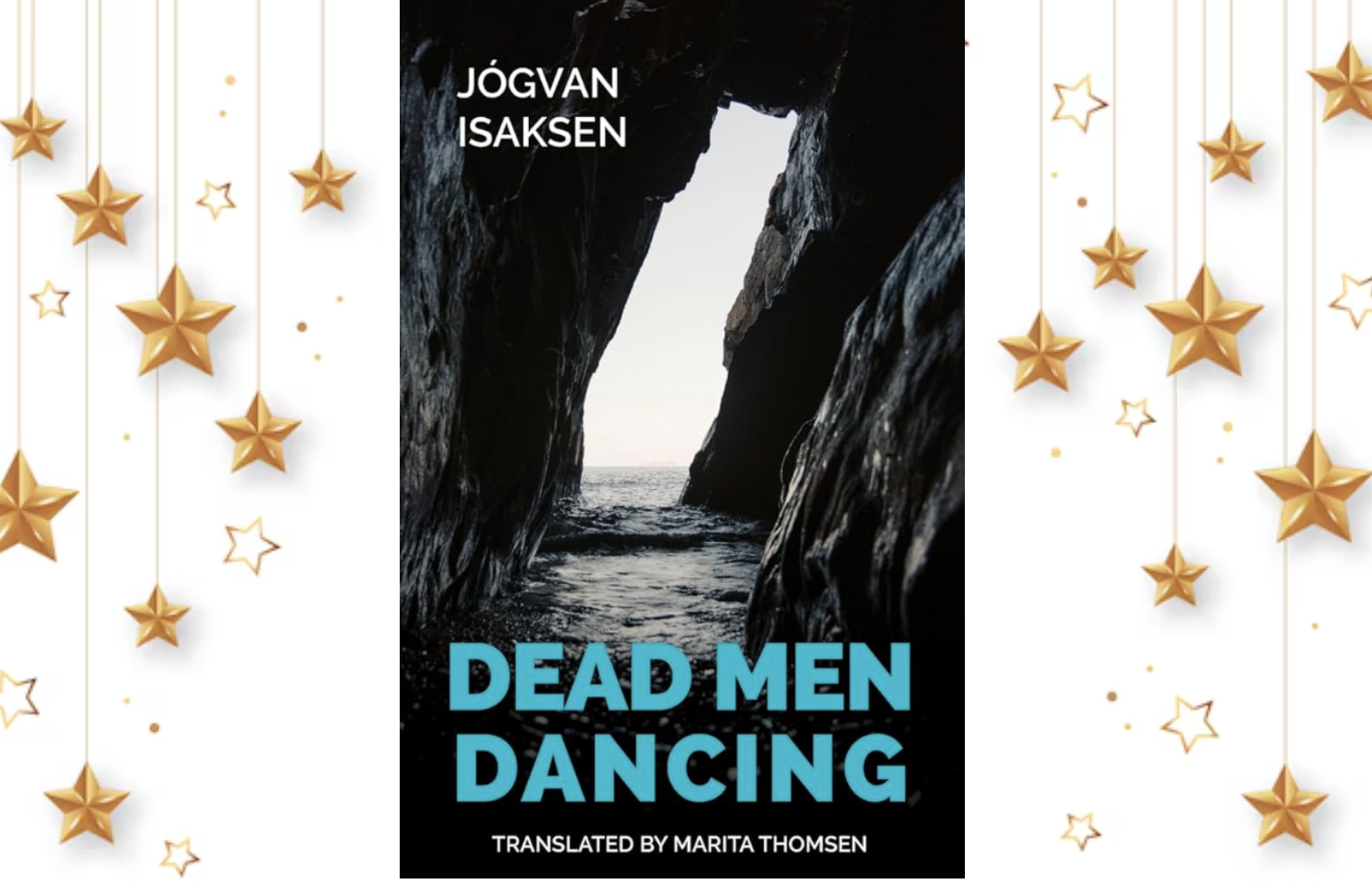
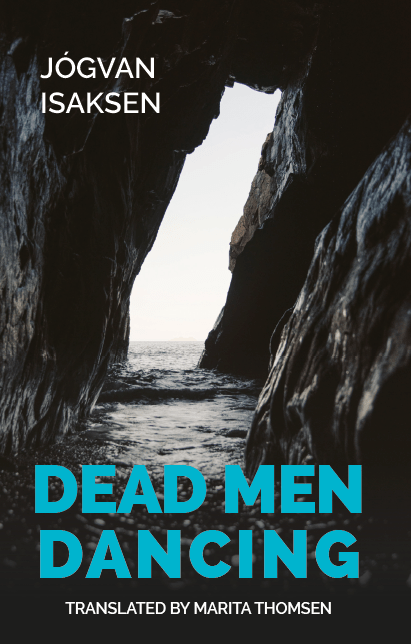
Dead Men Dancing

‘He realised that he would drown here. Someone had crafted this seat to drown people. To drown him. Terror rushed from his brain to rouse every cell in his body, but there was nothing to be done. He was well and truly tethered. Slowly it dawned on him that he did know why he was sitting here. He’d spent all his life running from this nightmare, and now he’d landed in its clutches.’

Dead Men Dancing (in Faroese Deydningar dansa á sandi), by the best-selling Faroese crime writer, Jógvan Isaksen, begins with the discovery of a corpse on the beach – the body of a man who has been shackled to rocks and left to drown. As the journalist Hannis Martinsson investigates, he comes across evidence of more deaths which have been caused in the same way, and he starts to realise that they are all linked to a local revolt several decades earlier, which tore a community apart. The repercussions have continued to the present day, and Hannis’ enquiries soon put his own life in danger.

The Hannis Martinsson detective series

With support from FarLit, Norvik Press are publishing this crime novel from Isaksen’s Martinsson series, in English translation by Marita Thomsen. You may have read other novels in the Martinsson series – Walpurgis Tide (Krossmessa), translated by John Keithsson and published by Norvik Press in 2016, is available in print and as an eBook – or you may have seen the TV series TROM, which is adapted from Isaksen’s books.

Either way, we think you’ll be interested in what follows!

Choosing the cover

The Norvik Press team looked at several different cover designs before choosing the winner, created by Essi Viitanen. With striking teal text on a dark background (and a coloured spine to match!), it depicts an eerie cave-mouth viewed from within. Readers of the opening scene of Dead Men Dancing will appreciate this reference immediately. Intriguingly, this exact cave-mouth actually exists in the Faroe Islands.

Cover design: Essi Viitanen. Cover image Easton Mok for Unsplash.

Ready to launch!

Norvik Press and the Representation of the Faroe Islands to the UK cordially invite you to the launch of Dead Men Dancing.

Join us for an evening of Faroese Noir, with renowned crime fiction and film specialist, Barry Forshaw (Crime Time) in conversation with the author Jógvan Isaksen, the translator Marita Thomsen and the screenwriter and creator of the TV crime series TROM, Torfinnur Jákupsson. We will be celebrating contemporary Faroese creativity and getting a first-hand insight into Faroese crime writing, both on the page and adapted for the screen.

A reception will follow the discussion, and copies of Dead Men Dancing will be available for purchase, as well as Walpurgis Tide.

Sign up for your free ticket here: bitly.ws/Wmw8

View our press release: Press Release – Dead Men Dancing

#FaroeseNoir

Posted on

Let’s Celebrate Women in Translation! #WITMonth

August is Women in Translation month, and as editors and translators here at Norvik Press we would like to make a bit of a fuss about ours. The Press has always prioritised Nordic women writers, whether it be lesser-known classics like Camilla Collett (The District Governor’s Daughters) and Fredrika Bremer (The Colonel’s Family) or modern writers so far little known in English, such as the Danish Dorrit Willumsen, the Norwegian Helene Uri and the Icelandic Svava Jacobsdóttir. All of our directors and the majority of our translators are also women. This month we are highlighting three of our major women writers: Amalie Skram (Norway), Kerstin Ekman (Sweden) and Kirsten Thorup (Denmark).

Amalie Skram

by Janet Garton

Born in 1846 into a relatively prosperous family in the bustling port of Bergen, Amalie Skram had an unusual early life for a middle-class woman in the mid-nineteenth century; at the age of eighteen she married a ship’s captain and sailed the world with him and their two sons. Her adventurous life came to an abrupt stop when in 1877 she filed for an acrimonious divorce. Soon after she embarked on a literary career which brought her into contact with Bjørnstjerne Bjørnson, Georg Brandes and eventually Erik Skram, with whom she fell in love and who became her second husband in 1884. From then on she earned a precarious living as a writer, living in Copenhagen and writing novels, many of which have become enduring classics. She died in 1905 at the age of 58.

Amalie Skram

Norvik Press has published three of Amalie Skram’s novels, Lucie (1888), Fru Inés (1891) and Betrayed (1892), all translated by the indefatigable US translators and Skram enthusiasts Katherine Hanson and Judith Messick. The novels are similar in that they all have as central characters women who have been damaged by the contemporary double standard of morality, which encouraged men to be promiscuous whilst punishing women who wanted any sexual freedom – but at the same time they illuminate very different perspectives. Lucie is a girl who has transgressed the norms and is the kept mistress of a civil servant in Kristiania; he falls in love with her and decides to make her a respectable married woman – only to be defeated by her irrepressible high spirits. Fru Inés is a woman trapped in a loveless marriage and longing for sexual fulfilment, but finds when she tries to break free that a dreadful fate awaits her. And Ory in Betrayed is an innocent young girl who marries a ship’s captain, but can not accept or forgive that he has known other women; her probing drives him to despair. The settings of all three novels reflect the author’s wide knowledge of the world. Lucie is set in the Kristiania she knew so well, and brings to life the streets and buildings of that time; Betrayed gives a vivid picture of life on board a sailing ship, and includes a visit to a London full of dance halls and oyster restaurants. Fru Inés takes place in Constantinople, and the sights, sounds and smells reveal Skram’s intimate first-hand knowledge of the city.

Collage of Amalie Skram book covers

As a long-time admirer of Amalie Skram’s writing – I have written a biography of her and published several volumes of her correspondence – I am delighted to say that I am about to start work on a new translation. This is of a very different work than the ones above; it will be the first two volumes of a four-volume series called The People of Hellemyr (1887–98), which is set amongst fisherfolk in and around her native Bergen. It follows the lives of a desperately poor farmer and his family as they struggle to lift themselves out of poverty – a study of lives lived against the odds and the fatal flaws that are passed on from generation to generation.

Kerstin Ekman

by Sarah Death

Kerstin Ekman, doyenne of the Swedish literary scene, has been entertaining and enchanting her readers with a wide sweep of works for over sixty years. This month she reaches the grand age of 90, and she is still busy writing.

Kerstin Ekman. Copyright/photograph: Thron Ullberg

Norvik Press is delighted to be the publisher of five of her books. Her extended autobiographical poem Childhood, translated by Rochelle Wright, is a distillation of so much that we learn of Ekman’s life and times from her wider oeuvre. ‘You have to admire the persistence of time/ that it doesn’t grow tired and get stuck’, she writes, and indeed the theme of time thundering onwards is central to her ground-breaking quartet of novels set in a small southern Swedish town, sometimes collectively called ‘Women and the City’ but also known as the Katrineholm quartet, and originally published in Sweden between 1974 and 1983. These were translated into English for Norvik Press by Linda Schenck (three volumes) and me (one volume), both of us long-standing devotees of the author’s work. The series is essentially a women’s eye view of the changes wrought in ordinary people’s lives by events and innovations of the past century and a half, not least the impact of the coming of the railway to a small rural community, where progress and tradition clash. Ekman’s multi-generational cast of characters (who can forget Sara Sabina or Tora, Jenny, Ingrid or Anne-Marie?), artfully woven plots and fine evocations of time and place make this series thoroughly deserving of its ‘modern classic’ label.  

The Katrineholm quartet

Our profound response to special reading experiences lies at the heart of Kerstin Ekman’s latest work, which is being published to coincide with her landmark birthday in August: Min bokvärld (My World of Books, Albert Bonniers förlag, 2023) is an exploration in twenty-four chapters of the reading experiences close to Ekman’s heart, from childhood to the present day. At the time of writing only the table of contents was available, but it is a great indication of the treasure trove in store. One of her choices felt particularly appropriate to me as her reader and translator: The Golden Bough, the classic study of mythology, magic and comparative religion by Scottish anthropologist and folklorist James Frazer. I have more than once found myself consulting it in a quest for details of myths, legends and archetypes that I came across in Ekman’s writing.  

Cover of Min bokvärld

From Homer’s Odyssey via a good many nineteenth-century European classics to twentieth-century works by the likes of Philip Roth, Doris Lessing and Ray Bradbury, this is a revealing and substantial bookshelf selection. Emily Brontë sits alongside Albert Camus; Sweden’s Moa Martinson and Norway’s Cora Sandel rub shoulders with Thomas Mann and Russian greats.  It is gratifying to see other Norvik authors finding a place here: Herman Bang, Hjalmar Bergman and – naturally – Selma Lagerlöf. Ekman nominates Lagerlöf’s complex Bannlyst, a cry of pain from the aftermath of the First World War that grapples with moral dilemmas still relevant today. Part of Norvik’s prizewinning ‘Lagerlöf in English’ series, this novel was translated for us by Linda Schenck as Banished.  

In a pleasing footnote of literary continuity, it is intriguing to see that Kerstin Ekman shares some of her choices with the youthful Lagerlöf, whose discovery of the wonderful world of reading is described in the author’s semi-autobiographical Memoirs of a Child (1930). Ibsen, Dickens, Tolstoy and Turgenev feature on both their lists of favoured authors.

Kirsten Thorup

by Janet Garton

Kirsten Thorup (b. 1942) is the author of a large number of novels – and some plays and poetry – over the last fifty years which have earned her a central place in Danish literature. Her themes and settings are extremely varied and often experimental in terms of narrative perspective and plot. An early success came with Lille Jonna (Little Jonna, 1977), the first in a series of novels about a girl growing up in a rural family on the island of Funen; academically gifted, she battles to gain a good education – which leads to estrangement from her family and roots. The novels reflect the author’s own background and her experience of a similar alienation. Thorup’s most recent work is Indtil vanvid, indtil døden (Unto Madness, Unto Death, 2020), the first novel of a planned trilogy which narrates the trials of Harriet, the widow of a Danish soldier who has died fighting for the Germans on the Eastern Front in 1942. In order to understand his death she travels to Munich that same year, and tries to reconcile the brutalities of the Nazi regime which she witnesses at first hand with her loyalty to her husband’s memory and beliefs.  

Kirsten Thorup. Photograph: Lærke Posselt

A few years ago I translated one of Thorup’s novels from 2011, Tilfældets Gud (The God of Chance, 2014). The novel is about two very different women: Ana, a successful Danish financier who is on holiday in Gambia to recover from over-work, and Mariama, a young beach-seller who accosts her on the beach outside her hotel. Ana feels an immediate bond with the girl; she has found ‘her platonic other half which she had been separated from at the dawn of time’, and decides to help her to go to school, eventually moving to London in order to bring her over to educate and foster her. But the situation becomes extremely complicated because of Mariama’s family’s demands and Ana’s own unacknowledged neediness, and the philanthropic urge ends in catastrophe for both.  

The silos in Copenhagen, where Ana lives

In this novel Thorup takes up the fraught question of global inequality and our attempts to redress it; what are we doing when we provide so-called aid, and is our help really altruistic or just a sop to our bad consciences? Can our model of what constitutes a good life be applied to other cultures, or are we destroying a functioning social structure and leaving people rootless? The urge to help in the face of extreme deprivation seems laudable, yet it can so easily turn into another form of imperialism.

To order the Norvik Press books highlighted in this blog, please follow the green hyperlinks or request the titles you would like at your favourite bookshop.

Posted on

Reading recommendations for International Women’s Day and Women’s History Month

Logo for International Women’s Day (IWD) 2023.

The month of March marks both International Women’s Day, on 8 March, and Women’s History Month. In honour of these occasions, this blog profiles our pioneering women writers. We are very proud to have played a part in facilitating access to their work for English-speaking readers – frequently through women translators, and with cover designs by women – and can think of nothing better than inviting them all to a literary dinner party!


Fredrika Bremer (1801–1865) would be the ideal dinner party guest, as she would be very well-placed to supervise all the cooking! We recently re-issued The Colonel’s Family, originally published in two parts (or should that be ‘courses?!’) in 1830–31 and translated by Sarah Death. The novel, which is narrated by a no-nonsense cook-housekeeper with a warm heart and an eye for human weaknesses, now comes to you with an utterly delicious new cover. Pudding, anyone?


Camilla Collett (1813–1895) is a pioneer in Norwegian literature. Translated by Kirsten Seaver, her novel The District Governor’s Daughters portrays a bourgeois society in which marriage is a woman’s only salvation, and follows sympathetically the struggles of one intelligent young woman to break out of this mould.


Amalie Skram (1846–1905) is not for the faint-hearted. Her oeuvre includes Betrayed, Fru Inés, and Lucie, as well as her correspondence: Skram had access to the leading figures of the time, from radical writers and critics to politicians, so there’s plenty to whet one’s appetite!


Victoria Benedictsson (1850–1888) would be an esteemed guest at the party. Her first novel, Money, was published in 1885. Set in rural southern Sweden where the author lived, it follows the fortunes of Selma Berg, a girl whose fate has much in common with that of Flaubert’s Madame Bovary and Ibsen’s Nora. The seating plan would need to allow for everyone wanting to converse with Benedictsson about the radical literary movement of the 1880s known as Scandinavia’s Modern Breakthrough.


Selma Lagerlöf (1858–1940): definitely a seat at the head of the table for her! Reading Lagerlöf is life-changing. A good place to start is with our Lagerlöf in English series. You can thank us later!


Elin Wägner (1892–1949): feminist, suffragist, pacifist and environmentalist, Wägner was the author of a prodigious amount of journalism, political pamphlets and prose fiction as well as an acclaimed biography of Selma Lagerlöf (see above!). The edited volume Re-Writing the Script: Gender and Community in Elin Wägner shows how Wägner’s texts outlined bold alternatives to the Swedish welfare state, and how her combined focus on gender and environmentalism anticipated much more recent ecocritical works. The title of her novel Penwoman, about the Swedish women’s suffrage movement, speaks for itself and applies to all the other guests at this soirée.


Hagar Olsson (1893–1978) and Karin Boye (1900–1941) would absolutely be seated together, and we would recommend reading them together, too: Chitambo and Crisis are the perfect modernist pairing.


Kerstin Ekman (b. 1933) provides a literary smörgåsbord to choose from. She is the author of Childhood, and of our recently reissued Women and the City tetralogy. Begin with Witches’ Rings: the central character is a woman so anonymous that her name is not even mentioned on her gravestone. You can read excerpts from Ekman’s other work published in translation by our friends over at Swedish Book Review.


Dorrit Willumsen (b. 1940), author of the novel Bangcame to visit us here at Norvik Press for a chat with her translator, Marina Allemano, about their shared fascination in the (endlessly fascinating!) life of Herman Bang. Bang is welcome to join the party too: he will make a most excellent speaker in the after-dinner slot.


Kirsten Thorup (b. 1942) is unafraid to tackle meaty topics in her work. In The God of Chance, translated by Janet Garton, she unflinchingly explores the problematic relationship between sponsor or donor and recipient. Scenes move from colourful depictions of life in a luxury hotel in Africa, cheek by jowl with desperate poverty, to elite designer flats in Copenhagen, and finally the bustling multicultural community on the streets of London.


Suzanne Brøgger (b. 1944) surely takes the prize for best title with her prose collection, A Fighting Pig’s Too Tough to Eat. Brøgger’s writings transgress genre and have often prompted comparison with her fellow countrywoman, Karen Blixen. This collection traces her development from social rebel to iconoclast and visionary.


Vigdis Hjorth (b. 1959) is an eminent guest. A House in Norway tells the story of Alma, a divorced textile artist who makes a living from weaving standards for trade unions and marching bands. When a Polish family moves into her apartment, their activities challenge her unconscious assumptions and her self-image as a “good feminist”. Is it possible to reconcile the desire to be tolerant and altruistic with the imperative need for creative and personal space?

Happy Women’s History Month and International Women’s Day!