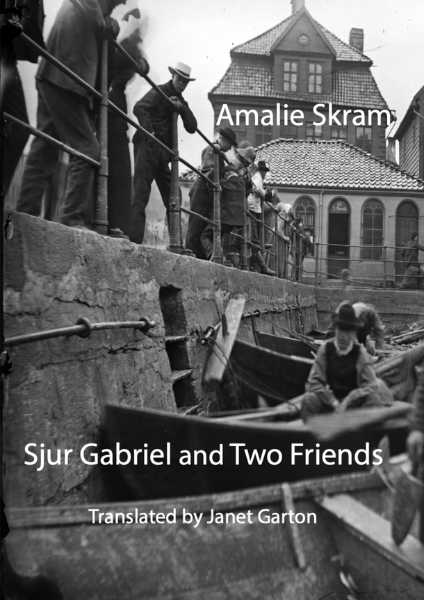
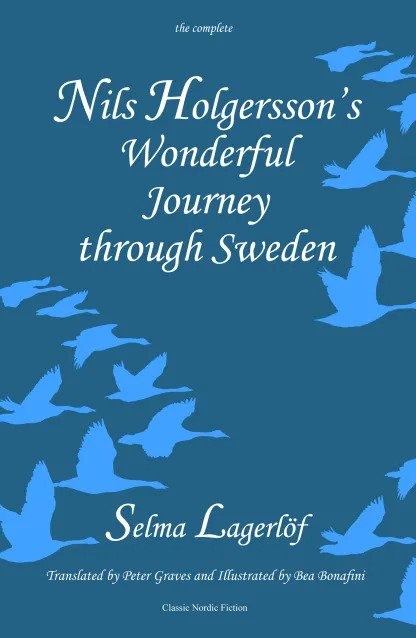
The Bergen in which Amalie Skram was born and grew up was a bustling cosmopolitan port, with trading links to the rest of Europe and beyond, in many ways a more important centre than the capital Christiania over the other side of the country. From a young age she was allowed to roam freely around the town, observing the characters and settings which were to provide inspiration for some of her best writing. The series of novels known as The People of Hellemyr is largely set in and around Bergen, as the fate of the family is followed through several generations, from subsistence farmers to aspiring middle-class citizens.
Amalie Skram (1846-1905)
Although Bergen has of course grown and changed dramatically since the mid-nineteenth century, a large part of the old town which Amalie knew so well has survived to this day. With its narrow alleyways and steep cobbled streets, wooden merchants’ houses and wharves, it makes it easy to imagine Madam Tosspot and Tippler Tom stumbling drunkenly through the byways or Sivert watching the ships tying up and dreaming of running away to sea.
Port of Bergen, late 19th Century (Bergen University Library Collections)
The first chapters of Two Friends bring together the characters of Oline (Madam Tosspot) and her grandson Sivert, whose shame at his grandmother’s drunkenness drives him as far away from the town as he can go – by ship all the way to Jamaica. But nowhere is far enough away to escape the inherited flaws which he will always carry with him.
Here is a short excerpt from the beginning of the novel, following Sivert and his grandmother in the streets of Bergen:
A fifteen-year-old boy in grey trousers held up by braces over his shoulders with a grey woollen shirt underneath came walking up Øvregaden. He was humming a popular song, marking the beats by stamping his wooden clogs on the sharp cobbles; when the melody demanded it he took a few dance steps. On his head sat a cap with a stiff peak shading his eyes, and under his arm he carried a bundle.
When he caught sight of the crowd up by Smedesmugalmindingen, he stretched out his neck with a look of curiosity in his wide-open eyes, and set off running towards it.
At that moment the knot of people began to move. The circle opened up, and he could see Tippler Tom with something in his hand which he was dragging along the street, and with Oline on his arm, lurching towards him. With a jerk the boy came to a sudden halt. His head sank forwards as if his neck had been broken. His fingers groped irresolutely down his trousers, and he turned round slowly. All at once his back hunched and his whole body seemed to shrink. It looked as if he wanted to leave, but couldn’t move. He stared down as if paralysed at one of his clogs which had fallen off his foot. He could hear the crowd approaching. In a moment it would knock him over if he didn’t move. He stole a glance to each side. Just next to him on the left was Bødkersmuget. Suddenly he bent down, snatched up the clog, took a couple of long unsteady strides over the gutter and the narrow pavement and reached the alley, starting to climb up its steep stone steps.
‘Come along wi’ us, Sivert! Tippler Tom an’ Madam Tosspot’s goin’ t’ Påtholleter sell ‘er skirt for booze!’ a boy’s voice called after him.
It’s December, and time for our festive blog! We’ve compiled a fireside reading list for you to enjoy this season.
1. A naughty boy learns his lesson – and teaches their lessons to Swedish children.
‘He stared and stared and could not believe his eyes. What at first had seemed to be a shadow became more and more solid and he could soon see that it was something real. Without a shadow of doubt, there was an elf sitting astride the edge of the chest.’
Nils, a fourteen-year-old farmer’s boy, is lazy and unkind. He meets his match when he tries to trick an elf, who shrinks him so that he’s elf-size himself. Trying to stop a farm gander from escaping to join some wild geese, he is whisked into the sky and travels far and wide with the geese, learning kindness as well as geography on the way.
Selma Lagerlöf’s Nils Holgersson’s Wonderful Journey Through Sweden (1906–07, translated by Peter Graves) was written to teach Swedish schoolchildren about the history, topography and culture of their own country. Like the consummate story-teller she is, the author transforms a school textbook into a magical adventure story full of talking animals and mythical battles, in which Nils comes to understand the value of selflessness and compassion.
In a beautifully-produced hardback volume, Bea Bonafini’s quirky illustrations capture the fairy-tale atmosphere.
2. Secrets lurk in the corridors of a Norwegian mountain hotel
‘My mother disappeared early on and is therefore impossible to remember. It seems she was a witch. Not a real witch, of course, but she wanted to be one. That’s what Jim told me, because he knew her. A bit, anyway. He thought it all came from listening too much to that Donovan song ‘Season of the Witch’, and then reading too many weird books about witches, before she made her mind up and set off to find Bloksberg or inner peace and was taken by Time. That’s why I have such a strange first name, Sedgewick, because there was a famous witch whose surname it was, until she was burnt.’
In this novel young Sedgewick, who helps his grandparents to run a splendid and traditional mountain hotel, sets out to find the truth about his origins. His parents have vanished and no-one talks about them. As he slowly uncovers the secrets of his past, he realises that the present holds secrets too – and one of the biggest is that the impressive family hotel is on the brink of bankruptcy. Grandfather is struggling to maintain the façade as matters become more and more desperate, and the secrets of the past and the present collide in a blazing denouement.
In Lobster Life (2016, translated by Janet Garton), Erik Fosnes Hansen looks at life and its challenges from the viewpoint of an adolescent boy, whose seriousness provides much inadvertent humour.
The hotel guests are an eccentric collection of individuals who require special treatment, one of the strangest being the national organization of funeral directors, who hold their annual feast at the hotel and embark on riotous songs to celebrate their achievements:
A timer on a bomb clicked home, a plane fell from the sky

Our Daimler plucked up bodies by the score.

Titanic was a great success, our boat was just nearby

We dived and pulled them out again to bury them once more.
3. The storybook life of the great storyteller
‘If the little ones at Mårbacka had not found out some other way that Christmas was coming, they would certainly have realised when they saw von Wachenfeldt arriving.
And they were beside themselves with glee to see his horse and one-man sleigh at the top of the avenue. They ran all through the house to proclaim the good news, they stood on the front steps to receive him, they shouted good day and welcome, they brought bread for his horse and they carried his meagre carpet bag, embroidered with cross-stitch flowers and leaves, down to the office where the guest was to reside.
It was strange, really, that the children always received Warrant Officer von Wachenfeldt so warmly. They could expect neither sweets nor presents from him but they must have felt he was all part of Christmas, and that was the reason for their delight. At any rate, it was just as well they treated him kindly, for the grown-ups made no fuss of him.’
From the age of three, the little Selma was acutely observant of life at the family estate of Mårbacka; growing up in the 1860s surrounded by the events of the farming year, the eccentric members of her wider family and her lively brothers and sisters, she had in many ways an idyllic childhood. Through her eyes we follow the dramatic events, comical behaviour and, at times, poignantly sad fates of Swedish provincial life, as the skies begin to darken and the very basis of life itself, the family farm, comes under threat.
Selma Lagerlöf has written three autobiographical novels, of which the first two, Mårbacka(1922) and Memoirs of a Child (1930, both translated by Sarah Death) have been published by Norvik Press. They turn her childhood into a story, part autobiography and part myth-making. ‘I can’t do with relying just on my memory, I must have artistic form,’ as the author commented herself.
4. Atmospheric smalltown memories and a mother’s nightmare
‘I’d decided to collect everything that belonged to Elizabeth in one special box. But there was so little that was hers, a thin layer of clothes just covering the bottom and a pair of worn boots, a few bottles and tubes of cheap cosmetics. Nothing she owned seemed to have been particularly affected by having passed through her hands. When she was little I knew every seam of her clothes and every broken edge of her wooden toys. Now I didn’t know her at all.’
Self-questioning Ann-Marie is engulfed by memories and anxieties when she returns to her home town and takes up residence among assorted down-and-out lodgers in the old family home, camping out in its clutter as she tries desperately to track down her missing daughter Elizabeth. She spends a makeshift Christmas with a close family friend, and continues her efforts to make sense of the physical remnants of her father’s life as an inventor, and a drinker. Her mind is a whirl of images of the generations of individuals she has known in the town. A tall man dressed as a magician has arrived on the same train, and as the hunt for Elisabeth intensifies, this close-to-the-bone story of filial frailties and jagged maternal love is deepened by hints of mythology and magical realism.
Kerstin Ekman is acknowledged as a towering figure in contemporary Swedish storytelling. City of Light (1983), a rich and many-layered novel, was translated for Norvik Press by Linda Schenck in 2003. It is the final part in Ekman’s Katrineholm quartet, also known as ‘Women and the City’, a women’s-eye view of the development of a small southern Swedish town, from the coming of the railway through to the 1980s.
If poetry is your bag: dual-language Nordic masters
1. Hans Børli: lumberjack and poet of the Norwegian forests
Vi eier skogene

Jeg har aldri eid et tre.

Ingen av mitt folk

Har noensinne eid et tre –

Skjønt slektens livs-sti slynget seg

Over århundrers blå høgder

Av skog.
We Own the Forests

I have never owned a tree.

None of my people

has ever owned a tree –

though my family’s life-path winds

over centuries’ blue heights

of forest.
Hans Børli (1918–89) spent his whole life as a lumberjack working in the vast forests of south-eastern Norway, and writing his poetry in his spare time. We Own the Forests (translated by Louis Muinzer) is a selection of the poems written over his lifetime, alive with his experiences of the natural world. The world of trees and the world of words flow together in these poems, firmly anchored in his native soil.
2. Pentti Saarikoski: modernist poet of the Finnish soul
LVIII

Aina minä löydän kiven

jonka maan mullistukset

ja sateet ja tuuli

ovat tehneet ihmiselle sopivaksi istuimeksi

selkänojalliseksi tai voi istua kyynärpäät polvilla

kuljettaa sormea kiveen hakatussa kirjoituksessa
LVIII

I’ll always find a stone

that’s been moulded into a seat fit for a man

by the convulsions of the ground

and the rains and the wind

either it’s got a back or I can sit with my elbows resting on my knees

tracing with my finger the writing chiselled into the stone
Pentti Saarikoski (1937–83) was a Bohemian poet with a turbulent private life, a modernist who was also a political commentator. His preoccupations were wide-ranging and his poetry prolific and varied in form and content. This selection of his work, A Window Left Open, translated by Emily Jeremiah and Fleur Jeremiah, gives a taste of his achievements and an indication of the reasons for his enduring popularity in his native Finland.
Or how about some Nordic Noir for the dark winter nights?
Jógvan Isaksen: Murder on the Faroe Islands
‘I’m telling you, if you’re up to your old tricks again, I’ll smash your face in.’
‘That seems an appropriate way of dealing with a member of the public,’ I replied.
‘Don’t you start again! It’s been so wonderfully peaceful round here while you’ve been off overseas. You’ve been back for two minutes and you’re already giving me hassle.’
The angry man was Detective Inspector Piddi í Útistovu, a man I’d had rather a lot to do with in the past.
Hannis Martinsson has returned to the Faroes after living in Copenhagen for many years. He sets out to make his living as a free-lance journalist and amateur sleuth, a pursuit which often leads to uncomfortable relations with the police. But his dogged determination and lively curiosity help him to solve conundrums which have the official forces baffled.
Jógvan Isaksen’s detective novels play out against the rugged landscape and sea-swept coasts of the Faroe Islands, and have been dramatised in the TV series Trom. In Walpurgis Tide (2005, translated by John Keithsson) Hannis investigates the murders of two anti-whaling activists – and stumbles upon an international conspiracy which goes far beyond the dispute about hunting whales to threaten the very existence of the Faroese way of life. In Dead Men Dancing (2011, translated by Marita Thomsen) his realisation of the links between a series of gruesome discoveries of skeletons chained in caves takes him to remote corners of the isles; his own life is increasingly in danger as he gets nearer to exposing the murderer.
Glögg, or mulled wine, is a warm beverage best enjoyed during the cold weeks leading up to Christmas. It tastes even better if you drink it with gingerbread snaps. Credit: Emelie Asplund/imagebank.sweden.se
‘I can well understand that Maria was obliged to send you packing Alfred, today of all days,’ says Mama. ‘A madcap like you is the last person one wants around when Christmas preparations are in full swing.’
It’s approaching that time of year again: of ginger snaps and glögg by the fire, and some cosy Christmassy reading! The above quote is a little snippet of our gift to you: an exclusive seasonal extract from the newest addition to our Lagerlöf in English series, Memoirs of a Child.
Memoirs of a Child continues the story of Selma Lagerlöf’s childhood that was begun in Mårbacka, and its scenes of Värmland county and preparations for winter festivities are the perfect accompaniment this winter. Open up our extract below:
Cover of Memoirs of a Child, the newest addition to the Lagerlöf in English series
We are delighted to announce a forthcoming addition to our Lagerlöf in English series: Memoirs of a Child.
Memoirs of a Child is the second part of a (notionally!) autobiographical trilogy by Selma Lagerlöf. Continuing on from the personal creation myth begun in Mårbacka, Lagerlöf here broadens the perspective from the farm where she grew up to include the people and places around Lake Fryken in her beloved Värmland county and a focus on the self-discipline and imagination needed to fulfil a childhood ambition to become an author. Pursuing this ambition is hard work that sometimes means taking a stand against convention. It is also a deeply enriching process in a home steeped in storytelling and books. The mature author reveals the roots of the young bibliophile’s growing skill in deploying fiction to manipulate and embellish reality, producing a wryly charming, tongue-in-cheek account – one that we should beware of taking at face value…!
We hope to publish this sequel by the end of November 2022, in good time for Lagerlöf fans to curl up with it by a cosy fire, or to gift it for Christmas.
If you would like to remind yourself of Mårbacka beforehand, you can listen to a reading of it linked from this Tweet (very in keeping with the storytelling theme); and you can order your copy of it here, or from your favourite bookshop.
And because we always like to treat our readers: here is an exclusive extract from Memoirs of a Child, pre-publication:
Panellists at the live launch of Some Would Call This Living, an anthology of Herman Bang’s writings
This is the second of two blogs reporting on our recent book launch event for an anthology of writings by Herman Bang: Some Would Call This Living. In part two, we hear from the translators.
Charlotte Barslund on her translations of short stories
While working on his short stories, I have come to appreciate just how well Bang captures the inner lives of characters who might at first sight not be regarded as worthy protagonists. He nails the stifled, impoverished lives of decent people. They try their hardest to improve their lot in life, and the few happy times they have and their lives of endless drudgery are invoked with agonising accuracy, leaving the reader with a sense of outrage and frustration at the harshness of the human condition. At the same time he is an astute, witty and entertaining observer of human nature’s less attractive sides: greed, vanity, self-importance, desire, snobbery. These themes are universal, they span generations and cultures.
As a literary translator working in commercial publishing, rather than academia, my priority was to produce translations which would make it clear why Bang is a writer who deserves wider recognition. When I encountered issues in the Danish text such as terms which nobody knew, inconsistencies in the geography in some short stories and errors in the naming of characters, I was very keen that these should be resolved and cleared up. I was surprised at how many anomalies we spotted, given that Bang had presumably had an editor for his published works. One unintentionally funny error included a heroine’s brother and love interest both being given the same name on the final few pages, which spiced up the plot no end. Either Bang’s editor wasn’t paying attention, or it was a case of not questioning what they presumed to be a divinely inspired author. However, in my experience working with 21st-century publishers, you do your authors no favours by not fixing their mistakes.
Paul Russell Garrett on Bang’s autobiographical accounts
Herman Bang was a very complex personality, who wrote in different ways in different genres. It was a stimulating part of this enterprise to be sent several collections of his texts to read, and to be able to compare solutions with other translators.
There is a great deal of humour in Bang’s autobiographical writings, sometimes at his own expense, as in his account of the lamentable reception of a tour of Bornholm he undertook with fellow artists. He can be extremely sarcastic – for example in his description of the Kaiser’s family, whose only function in life seems to be to pose for photographs – and is fond of biting understatements. Otherwise he is frequently a sympathetic observer of the different classes of society, especially those who are lower down the social scale.
He can also write very subtly, making oblique hints at events rather than explaining them fully. In ‘Expelled from Germany’, for example, he dances around the question as to why he is driven out of one place after another, leaving it to the reader to conjecture as to the cause of his discomfort.
Janet Garton on her translations
Bang’s fiction is at times problematic, even frustrating to unravel. He has often been called Denmark’s most important impressionist writer; his style is allusive and the meaning often elusive. He refers to things obliquely, giving the reader a glimpse of a person or a situation which suggests hidden depths or ambiguities which you are left to guess at. Let me give an example.
The long story ‘The Ravens’ tells of an old lady, Frøken Sejer, who is presumed to be wealthy, and is surrounded by a family who are all keen to inherit her wealth and stop her squandering it. She gives a lavish dinner for all of them, which they enjoy greedily, at the same time as wondering privately how much it has cost and counting the silver cutlery and cut-glass bowls, which seem to be mysteriously disappearing. Some of them are hoping to have her declared incapable of managing her affairs and confined to an asylum, and there is a great deal of half-concealed jostling for attention and point-scoring against perceived rivals for the inheritance, not to mention downright thieving. There are many unsubtle hints at possible strategies to worm Frøken Sejer’s money out of her, while she enjoys the whole situation hugely.
There is also a concealed homosexual thread running through the story – concealed because of course it could not be openly acknowledged in 1902. There are odd references to having some business in a kiosk, making it sound as if they are places for flirtation, whether hetero- or homosexual. One of the characters in this story, Willy Hauch, is clearly homosexual; he is introduced as being ‘polished to a shine all over’ and comes in apologising for being late because he has had ‘an errand at a kiosk’. He makes various remarks about not being the marrying kind, and during dinner he keeps an eye on Herr Lauritzen, the attractive young hired waiter, who assures Willy at one point that he has ‘many strings to my bow’. As people depart after the dinner, Willy jumps on to an electric tram and, the narrator tells us,
suddenly spotted Herr Lauritzen …
‘Fancy meeting you here, Lauritzen,’ Willy said, ‘we’ve caught the same tram.’
‘So it would appear, Herr Hauch,’ Lauritzen replied with a nod.
No more is said, and they both leave the story at this point.
Panellists at the live launch of Some Would Call This Living, an anthology of Herman Bang’s writings
This is the first of two blogs reporting on our recent book launch event for an anthology of writings by Herman Bang: Some Would Call This Living. Part one introduces the anthology using comments from two of the panellists.
Paul Binding on the writer Herman Bang
Herman Bang was a master of very different forms of writing, although there is a thematic unity in his production which binds it all together. On the one hand, he was a superb and respected journalist with an enormous social compass, a sharp observer of social distinctions and dramatic events. In his description of the catastrophic Christiansborg fire of 1884, the immediacy of his account makes the reader feel the heat and hear the flames; in his brief recording of a fatal car accident, ‘In a Flash’, he brings home the terrible finality of violent death.
On the other hand, he also wrote many wonderful short stories and novellas, like Ved vejen (Katinka), often recording the quiet existence of those on the sidelines of life, those whose fates are normally unrecorded. This was the era of the short story, and Bang admired amongst others Maupassant and Chekhov. In a story like ‘Frøken Kaja’ he brings to life the inhabitants of a boarding house with a keen awareness of the tiny distinctions which mark out some of the boarders as being of a slightly higher class than the others.
Bang was in many ways an outsider in Danish literary circles. Although he shared many of the preoccupations of the Modern Breakthrough movement with its emphasis on realistic depictions of contemporary society, he had strained relations with its Danish leaders, Georg and Edvard Brandes – perhaps partly because of his precocious early success as a critic with Realisme og Realister, published when he was only 22. He was also an outsider because of his sexuality, being homosexual during a period when it was regarded with hostility. Despite fleeing abroad, he never achieved a harmonious relationship, perhaps because he was too complicated for anyone to be able to reciprocate fully.
The subversive nature of sexuality is a theme of many of his stories, such as ‘Les Quatre Diables’, which tells of a circus act of high-flying trapeze artists, two men and two women whose harsh early lives have led them to form an intimate bond through their act. But their work and dedication is undermined by desire, as Fritz is seduced by an aristocratic lady who saps his strength in their encounters. Here sexuality is shown to be a threat to a well-regulated society.
Dorrit Willumsen’s novel Bang (also published by Norvik Press) is one of the best ever written about a creative writer, tracing how Herman Bang was hounded across Europe, at one and the same time suffering acutely and deliberately provoking his own tragedy.
Janet Garton on the background to the publication
The story of this anthology goes back to 2018, when I was contacted by a group of Danes going by the mysterious name of De Bangske Morgenmænd (translates roughly as The Bangian Morning Men). I had not heard of them, but it transpired that they are a group of men with a passion for Herman Bang’s works and a desire to promote them, who meet every year on the morning of his birthday to celebrate his achievements. They were aware of how little Bang is known in the English-speaking world, and suggested that Norvik Press might consider publishing some of his short stories and journalism, two genres in which he excelled and which have hardly been translated into English at all. They sent us a quite long and very varied list of short stories, autobiographical pieces, journalism and letters – which is practically identical with the final contents of our volume. We were a little daunted at first by the prospect of such a large publication – a total of 170,000 words to translate – but decided that it would be a really worthwhile undertaking, if we could raise enough funding to cover the substantial costs. It helped a lot that De Bangske Morgenmænd are well connected. We were able to discuss the project in detail when I was in Copenhagen in the autumn of 2019, and as a result we applied to and received funding from Augustinus Fonden and Consul George Jorck og hustru Emma Jorck’s Fond. Professor Poul Houe from the University of Minnesota, who is one of the Morgenmænd, brought us some funding from his university as well as supplying the informative introduction. And the translations were also supported by the ever-reliable Statens Kunstfond. That is how we were able to produce this handsome volume.
Part two will delve into the translators’ experiences while working on this project. Stay tuned!
Cover of Some Would Call This Living, an anthology of Herman Bang’s writings
Some Would Call This Living: An Anthology brings together a selection of Herman Bang’s writings – short stories, autobiographical pieces, reportage – in English translation from the original Danish.
Readers familiar with the eccentricities of Bang will enjoy having his fiction and non-fiction gems available in one handsome volume; and readers new to Bang are in for a real treat! For the Bang-curious, you can read two extracts from the Anthology below which provide a flavour of his inimitable flair across prose genres:
Where has the summer gone?! With the reading-hammocks being folded away and back-to-school beckoning, this week we’re highlighting two resources: our new ebook catalogue, and recommendations for university reading lists.
Hot off the (digital) press, our 2020 Ebook Catalogue collects together all the Norvik titles that are currently available for you to download and enjoy instantly on your Kindle or other e-reader device:
Kirsten Thorup’s timely The God of Chance, translated by Janet Garton
Jógvan Isaksen’s Walpurgis Tide, translated by John Keithsson – a slice of Faroese eco-crime
We hope to digitise more of our backlist in future, too.For those returning to campus – in-person, or remotely – we recommend some autumnal poetry: Hans Børli’s We Own the Forest: And Other Poems presents a dual-language text with facing-page English translations rendered by Louis A. Muinzer. This work by the ‘lumberjack poet’ – a phrase I’ve never had occasion to write before! – is ideal for Norwegian classes. Students of Finnish may also be interested in our forthcoming selection of poems by Pentti Saarikoski, A Window Left Open, jointly translated by Emily Jeremiah and Fleur Jeremiah and also in a dual-language format.
This week we’re highlighting two translations from our Lagerlöf in English series: Nils Holgersson’s Wonderful Journey through Sweden (1906-07), available here; and The Phantom Carriage (1912), available here, both translated by Peter Graves.
This blogpost is adapted from a longer essay by one of our directors, Claire Thomson. If you read Swedish, you can download it for free here.
As we begin to understand Covid-19, this dreadful new disease afflicting humankind, there is some comfort to be found in the thought that within the last century, great leaps were made in the treatment and control of another scourge: tuberculosis. In Sweden alone, half a million people died of tuberculosis between 1900 and 1950. In 1904, the Swedish National Association Against Tuberculosis (Nationalföreningen mot Tuberkulos) was established to coordinate public health education about the disease. One of the association’s founders, alongside Crown Prince Gustav, was the author Selma Lagerlöf.
In its first few decades, a key activity for the Association was to organise peripatetic lectures and film and slide shows educating Swedes about hygiene and other preventative measures against tuberculosis. Money was raised for research and education through the sale of stamps and the majblomma flower pin. But a subtler means of raising awareness was Lagerlöf’s writing; she was encouraged by the Association to write the novella The Phantom Carriage (Körkarlen, 1912), a ghost story which lays bare the sickness, poverty and misery engendered by tuberculosis. The novella was adapted for the silver screen in 1920-21 by the great Swedish director and actor Victor Sjöström. A blockbuster of its day, it was one of the first films to use double exposure, and inspired the young Ingmar Bergman to take up filmmaking.
Feature films and literature can, of course, indirectly promote public health messages. But in the days before television and social media, purpose-made short films were widely used in public information campaigns. In 1952, twelve years after her death, Lagerlöf’s writing again played a role in educating the Swedish populace about the fight against tuberculosis. By this time, half a century of research had resulted in effective prevention and treatment, and Sweden had been one of the countries to pioneer a nation-wide screening and vaccination programme in the 1940s (including the use of miniature x-ray machines in buses). The dramatist Martin Söderhjelm was commissioned by the National Association Against Tuberculosis to make a short film reminding Swedes of the work of the Association, encouraging them to participate in medical screening programmes, and looking to the future. The sixteen-minute film, shown in cinemas around the country in autumn 1952, was Medan det ännu är tid: ‘While there’s still time’.
In order to engage its audience, Medan det ännu är tid opens with a tale that every Swedish cinema-goer would remember from their school days: an episode from Lagerlöf’s Nils Holgersson. Chapter XLIV of the epic novel fills in the back-story of two recurring characters, Åsa the goose-girl and her little brother Mats, and the film devotes its first five minutes to the sad fate of these fictional children. Åsa and Mats are from a poor Småland family. Their siblings and mother are infected by a traveller and die one by one, and their father flees. The orphaned Åsa and Mats attend a lecture explaining the symptoms, prevention and treatment of tuberculosis, and they realize that their family died of the disease, not of the sick traveller’s curse. Åsa and Mats embark on their own journey through Sweden to find their father, navigating forests, towns and frozen lakes (see below), and along the way they tell the people they encounter about the need for good hygiene in combating the spread of tuberculosis. The film thus stages the historical phenomenon of travelling public health lecturers, an authentic detail already embedded in the novel by an author who was herself a founding member of the National Association Against Tuberculosis. But in typical Lagerlöf style, public health education is also framed in Nils Holgersson as a kind of mythical or folktale-style wandering across the national map, undertaken by the good citizens Åsa and Mats.
Both in Lagerlöf’s novel and Söderhjelm’s film, the fight against tuberculosis thus emerges as a collective undertaking for Swedish society, a battle that is fought not only by scientists and medics, but by ordinary people doing simple, everyday things – like washing their hands.
* * *
For Peter Graves’ translation of Nils Holgersson’s Wonderful Journey through Sweden, Norvik Press commissioned original illustrations from the illustrator Bea Bonafini. Bea comments here on her illustration for chapter XXV, which depicts a dramatic episode in Åsa and Mats’ trek through Sweden:
Possibly my favourite image, I chose this tragic moment for its visual power, as well as for how poignantly Lagerlöf depicts the race for survival of the brother and sister. I imagined the aerial view of the running children, seen from the perspective of the gander and the boy as they direct the children out of the maze of cracking ice. The image evokes the precarious balance between life and death as the children try to avoid running into dead ends while making their way across. It is the first inverted image I use, where the picture of the iced lake fills a negative space, causing an initial sense of disorientation appropriate to the nature of the image.
‘The Ice Breaks Up’, illustration by Bea Bonafini for Nils Holgersson’s Wonderful Journey through Sweden
Malin Forst is a precocious, devout twenty-year-old woman attending a Stockholm teachers’ college in the 1930s. Confounded by a sudden crisis of faith, Malin plunges into a depression and a paralysis of will. Oscillating between poetic prose, social realism, fragments of correspondence, and imagined dialogues between the forces of nature, Crisis telescopes Malin’s distress out into metaphysical planes and back, as her mind stages struggles between black and white, Dionysian and Apollonian, and with an everyday existence that has become unbearably arduous.
And then an intense infatuation with a classmate reorients everything.
First published in Swedish as Kris in 1934, Boye’s meditation on a crisis of faith and queer desire is recognised as a modernist classic for its stylistic and literary experimentation. Now, in January 2020, the full text is available in English for the first time, translated by Amanda Doxtater. You can find it in all good bookstores, or via norvikpress.com.
For a taster of a key scene, download an extract here.