
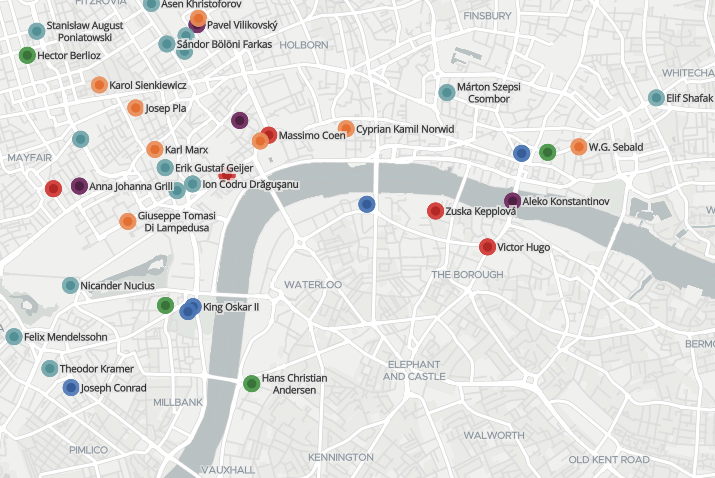
Our friends at University College London are crowdsourcing an interactive map that traces European literary encounters across London.
You can explore (and submit new pins to!) the map here: https://www.europeanliterarylondon.org/
The map inspired us here at Norvik Press to think about how London is portrayed within our books. We have zoomed in on two of our favourite examples of London in literature below.
Kirsten Thorup: The God of Chance

Ana had got into the habit of travelling into the City at around four in the afternoon. She took the underground to Bank and rose up into the anonymous security of marble and glass. She felt at home in the City’s ivory-coloured concrete desert, where she had been a frequent visitor over the past ten to twelve years. She knew the streets, the cafés, the bars, the smooth upthrust of the buildings which blocked out the sky. She knew the well-cut suits and jackets, the high heels and the brief cases with the same label as her own. She knew the purposeful steps which echoed back from between the walls like the hollow beat of drumsticks.
She had finally arranged an interview with the HR manager. She circled around City Place House where Rower had its premises, and ended up sitting in the large high-ceilinged bar just opposite. She placed herself strategically at a table right next to the glass façade, so that she had a view of her former workplace. Sitting in the low armchair, she sipped her Campari soda. She leafed absent-mindedly through the Financial Times, and felt she was out of circulation. She recognised some of her former colleagues as they walked past on the pavement and cut across the square in front of the entrance. […]
She finished her drink and walked out of the bar and across towards City Place House and the sterile little marble square. With her smart appearance, the discreet elegance of her suit, the shoes moulded perfectly to her feet, and the stiletto heels which added three inches to her height, she looked like the career woman she had been in her earlier life, and blended in with her surroundings. It struck her that the fountain in the middle of the square looked touching in its stripped-down minimalism with the threadlike jets gathered into vertical bundles.
–– Translated by Janet Garton
Amalie Skram: Betrayed

Their baggage had been sent on board and after Ory and Riber had said good-bye to their landlady, they went out to buy a few little things before departure.
‘Is there anything else?’ Riber asked, holding packages in his hands. They had walked out of a shop in St. Paul’s Churchyard.
Ory stood for a moment and thought carefully. ‘Nothing I remember,’ she said. ‘Of course we’ll be forgetting the most important thing.’ […]
Down the street they hailed a cab. Riber called out “Victoria Docks” as they got inside and off they went as fast as the moving throng of pedestrians and vehicles allowed. […]
Then the cab stopped. Riber shot up, put on his hat, pulled on his overcoat, stepped out and paid the driver.
Ory gathered her packages. Riber held his hand out to her and she jumped down.
Silently they walked side by side across the paved wharf that looked like an enormous courtyard, huge warehouses on three sides, reverberating with activity and tumult. The fourth side was open to the water, chock-full of large-hulled steamers and high-masted sailing ships; all the vessels that could find room were alongside the paved wharf, loading or unloading cargo.
‘Stop, Aurora! Here is the ship. Orion ahoy!’
‘Ahoy!’ came back in return, and a red-freckled man wearing a flat-crowned cap and a wool scarf around his neck appeared waving from the rail of a full-rigged ship.
–– Translated by Katherine Hanson and Judith Messick
Read more about the European Literary Map of London here, and the ‘Lost & Found: Mapping European Literary London’ exhibition.
Happy exploring!







 For further reading in the New Year, watch out for the brilliant Pobeda, coming very soon.

