Posted on Leave a comment

Nordic novels to curl up with at Christmas

cup of coffee and christmas ornaments on a window sill

It’s December, and time for our festive blog! We’ve compiled a fireside reading list for you to enjoy this season.

1. A naughty boy learns his lesson – and teaches their lessons to Swedish children.

‘He stared and stared and could not believe his eyes. What at first had seemed to be a shadow became more and more solid and he could soon see that it was something real. Without a shadow of doubt, there was an elf sitting astride the edge of the chest.’

Nils, a fourteen-year-old farmer’s boy, is lazy and unkind. He meets his match when he tries to trick an elf, who shrinks him so that he’s elf-size himself. Trying to stop a farm gander from escaping to join some wild geese, he is whisked into the sky and travels far and wide with the geese, learning kindness as well as geography on the way.

Selma Lagerlöf’s Nils Holgersson’s Wonderful Journey Through Sweden (1906–07, translated by Peter Graves) was written to teach Swedish schoolchildren about the history, topography and culture of their own country. Like the consummate story-teller she is, the author transforms a school textbook into a magical adventure story full of talking animals and mythical battles, in which Nils comes to understand the value of selflessness and compassion.
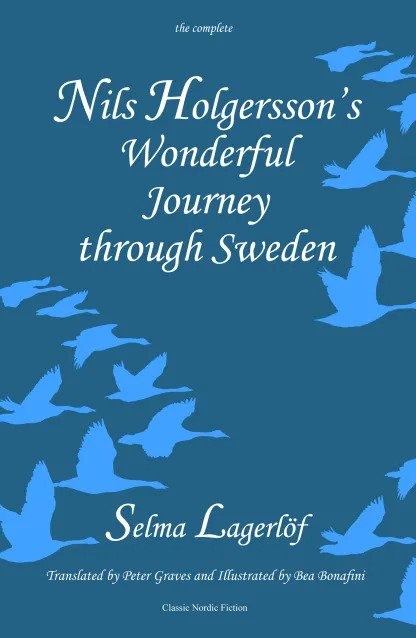
In a beautifully-produced hardback volume, Bea Bonafini’s quirky illustrations capture the fairy-tale atmosphere.


2. Secrets lurk in the corridors of a Norwegian mountain hotel

‘My mother disappeared early on and is therefore impossible to remember. It seems she was a witch. Not a real witch, of course, but she wanted to be one. That’s what Jim told me, because he knew her. A bit, anyway. He thought it all came from listening too much to that Donovan song ‘Season of the Witch’, and then reading too many weird books about witches, before she made her mind up and set off to find Bloksberg or inner peace and was taken by Time. That’s why I have such a strange first name, Sedgewick, because there was a famous witch whose surname it was, until she was burnt.’

In this novel young Sedgewick, who helps his grandparents to run a splendid and traditional mountain hotel, sets out to find the truth about his origins. His parents have vanished and no-one talks about them. As he slowly uncovers the secrets of his past, he realises that the present holds secrets too – and one of the biggest is that the impressive family hotel is on the brink of bankruptcy. Grandfather is struggling to maintain the façade as matters become more and more desperate, and the secrets of the past and the present collide in a blazing denouement.

In Lobster Life (2016, translated by Janet Garton), Erik Fosnes Hansen looks at life and its challenges from the viewpoint of an adolescent boy, whose seriousness provides much inadvertent humour.

The hotel guests are an eccentric collection of individuals who require special treatment, one of the strangest being the national organization of funeral directors, who hold their annual feast at the hotel and embark on riotous songs to celebrate their achievements:

A timer on a bomb clicked home, a plane fell from the sky

Our Daimler plucked up bodies by the score.

Titanic was a great success, our boat was just nearby

We dived and pulled them out again to bury them once more.

3. The storybook life of the great storyteller

‘If the little ones at Mårbacka had not found out some other way that Christmas was coming, they would certainly have realised when they saw von Wachenfeldt arriving.

And they were beside themselves with glee to see his horse and one-man sleigh at the top of the avenue. They ran all through the house to proclaim the good news, they stood on the front steps to receive him, they shouted good day and welcome, they brought bread for his horse and they carried his meagre carpet bag, embroidered with cross-stitch flowers and leaves, down to the office where the guest was to reside.

It was strange, really, that the children always received Warrant Officer von Wachenfeldt so warmly. They could expect neither sweets nor presents from him but they must have felt he was all part of Christmas, and that was the reason for their delight. At any rate, it was just as well they treated him kindly, for the grown-ups made no fuss of him.’

From the age of three, the little Selma was acutely observant of life at the family estate of Mårbacka; growing up in the 1860s surrounded by the events of the farming year, the eccentric members of her wider family and her lively brothers and sisters, she had in many ways an idyllic childhood. Through her eyes we follow the dramatic events, comical behaviour and, at times, poignantly sad fates of Swedish provincial life, as the skies begin to darken and the very basis of life itself, the family farm, comes under threat.

Selma Lagerlöf has written three autobiographical novels, of which the first two, Mårbacka (1922) and Memoirs of a Child (1930, both translated by Sarah Death) have been published by Norvik Press. They turn her childhood into a story, part autobiography and part myth-making. ‘I can’t do with relying just on my memory, I must have artistic form,’ as the author commented herself.


4. Atmospheric smalltown memories and a mother’s nightmare

‘I’d decided to collect everything that belonged to Elizabeth in one special box. But there was so little that was hers, a thin layer of clothes just covering the bottom and a pair of worn boots, a few bottles and tubes of cheap cosmetics. Nothing she owned seemed to have been particularly affected by having passed through her hands. When she was little I knew every seam of her clothes and every broken edge of her wooden toys. Now I didn’t know her at all.’

Self-questioning Ann-Marie is engulfed by memories and anxieties when she returns to her home town and takes up residence among assorted down-and-out lodgers in the old family home, camping out in its clutter as she tries desperately to track down her missing daughter Elizabeth. She spends a makeshift Christmas with a close family friend, and continues her efforts to make sense of the physical remnants of her father’s life as an inventor, and a drinker. Her mind is a whirl of images of the generations of individuals she has known in the town. A tall man dressed as a magician has arrived on the same train, and as the hunt for Elisabeth intensifies, this close-to-the-bone story of filial frailties and jagged maternal love is deepened by hints of mythology and magical realism.

Kerstin Ekman is acknowledged as a towering figure in contemporary Swedish storytelling. City of Light (1983), a rich and many-layered novel, was translated for Norvik Press by Linda Schenck in 2003. It is the final part in Ekman’s Katrineholm quartet, also known as ‘Women and the City’, a women’s-eye view of the development of a small southern Swedish town, from the coming of the railway through to the 1980s.


If poetry is your bag: dual-language Nordic masters

Book cover Window Left Open

1. Hans Børli: lumberjack and poet of the Norwegian forests

Vi eier skogene

Jeg har aldri eid et tre.

Ingen av mitt folk

Har noensinne eid et tre –

Skjønt slektens livs-sti slynget seg

Over århundrers blå høgder

Av skog.
We Own the Forests

I have never owned a tree.

None of my people

has ever owned a tree –

though my family’s life-path winds

over centuries’ blue heights

of forest.

Hans Børli (1918–89) spent his whole life as a lumberjack working in the vast forests of south-eastern Norway, and writing his poetry in his spare time. We Own the Forests (translated by Louis Muinzer) is a selection of the poems written over his lifetime, alive with his experiences of the natural world. The world of trees and the world of words flow together in these poems, firmly anchored in his native soil.


2. Pentti Saarikoski: modernist poet of the Finnish soul

LVIII

Aina minä löydän kiven

jonka maan mullistukset

ja sateet ja tuuli

ovat tehneet ihmiselle sopivaksi istuimeksi

selkänojalliseksi tai voi istua kyynärpäät polvilla

kuljettaa sormea kiveen hakatussa kirjoituksessa
LVIII

I’ll always find a stone

that’s been moulded into a seat fit for a man

by the convulsions of the ground

and the rains and the wind

either it’s got a back or I can sit with my elbows resting on my knees

tracing with my finger the writing chiselled into the stone

Pentti Saarikoski (1937–83) was a Bohemian poet with a turbulent private life, a modernist who was also a political commentator. His preoccupations were wide-ranging and his poetry prolific and varied in form and content. This selection of his work, A Window Left Open, translated by Emily Jeremiah and Fleur Jeremiah, gives a taste of his achievements and an indication of the reasons for his enduring popularity in his native Finland.


Or how about some Nordic Noir for the dark winter nights?

Jógvan Isaksen: Murder on the Faroe Islands

‘I’m telling you, if you’re up to your old tricks again, I’ll smash your face in.’

‘That seems an appropriate way of dealing with a member of the public,’ I replied.

‘Don’t you start again! It’s been so wonderfully peaceful round here while you’ve been off overseas. You’ve been back for two minutes and you’re already giving me hassle.’

The angry man was Detective Inspector Piddi í Útistovu, a man I’d had rather a lot to do with in the past.

Hannis Martinsson has returned to the Faroes after living in Copenhagen for many years. He sets out to make his living as a free-lance journalist and amateur sleuth, a pursuit which often leads to uncomfortable relations with the police. But his dogged determination and lively curiosity help him to solve conundrums which have the official forces baffled.

Jógvan Isaksen’s detective novels play out against the rugged landscape and sea-swept coasts of the Faroe Islands, and have been dramatised in the TV series Trom. In Walpurgis Tide (2005, translated by John Keithsson) Hannis investigates the murders of two anti-whaling activists – and stumbles upon an international conspiracy which goes far beyond the dispute about hunting whales to threaten the very existence of the Faroese way of life. In Dead Men Dancing (2011, translated by Marita Thomsen) his realisation of the links between a series of gruesome discoveries of skeletons chained in caves takes him to remote corners of the isles; his own life is increasingly in danger as he gets nearer to exposing the murderer.

Happy Reading!

Posted on

Cover reveal, and a book launch! #FaroeseNoir

Exciting news: we’re unveiling the cover of our new book, and you’re invited to the in-person launch event for it!

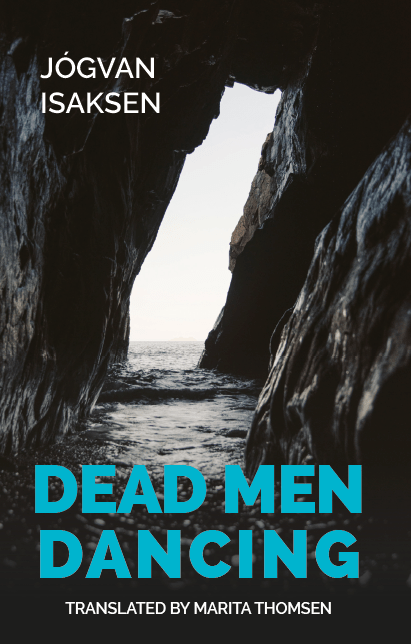
Dead Men Dancing

‘He realised that he would drown here. Someone had crafted this seat to drown people. To drown him. Terror rushed from his brain to rouse every cell in his body, but there was nothing to be done. He was well and truly tethered. Slowly it dawned on him that he did know why he was sitting here. He’d spent all his life running from this nightmare, and now he’d landed in its clutches.’

Dead Men Dancing (in Faroese Deydningar dansa á sandi), by the best-selling Faroese crime writer, Jógvan Isaksen, begins with the discovery of a corpse on the beach – the body of a man who has been shackled to rocks and left to drown. As the journalist Hannis Martinsson investigates, he comes across evidence of more deaths which have been caused in the same way, and he starts to realise that they are all linked to a local revolt several decades earlier, which tore a community apart. The repercussions have continued to the present day, and Hannis’ enquiries soon put his own life in danger.

The Hannis Martinsson detective series

With support from FarLit, Norvik Press are publishing this crime novel from Isaksen’s Martinsson series, in English translation by Marita Thomsen. You may have read other novels in the Martinsson series – Walpurgis Tide (Krossmessa), translated by John Keithsson and published by Norvik Press in 2016, is available in print and as an eBook – or you may have seen the TV series TROM, which is adapted from Isaksen’s books.

Either way, we think you’ll be interested in what follows!

Choosing the cover

The Norvik Press team looked at several different cover designs before choosing the winner, created by Essi Viitanen. With striking teal text on a dark background (and a coloured spine to match!), it depicts an eerie cave-mouth viewed from within. Readers of the opening scene of Dead Men Dancing will appreciate this reference immediately. Intriguingly, this exact cave-mouth actually exists in the Faroe Islands.

Cover design: Essi Viitanen. Cover image Easton Mok for Unsplash.

Ready to launch!

Norvik Press and the Representation of the Faroe Islands to the UK cordially invite you to the launch of Dead Men Dancing.

Join us for an evening of Faroese Noir, with renowned crime fiction and film specialist, Barry Forshaw (Crime Time) in conversation with the author Jógvan Isaksen, the translator Marita Thomsen and the screenwriter and creator of the TV crime series TROM, Torfinnur Jákupsson. We will be celebrating contemporary Faroese creativity and getting a first-hand insight into Faroese crime writing, both on the page and adapted for the screen.

A reception will follow the discussion, and copies of Dead Men Dancing will be available for purchase, as well as Walpurgis Tide.

Sign up for your free ticket here: bitly.ws/Wmw8

View our press release: Press Release – Dead Men Dancing

#FaroeseNoir

Posted on 1 Comment

Trom

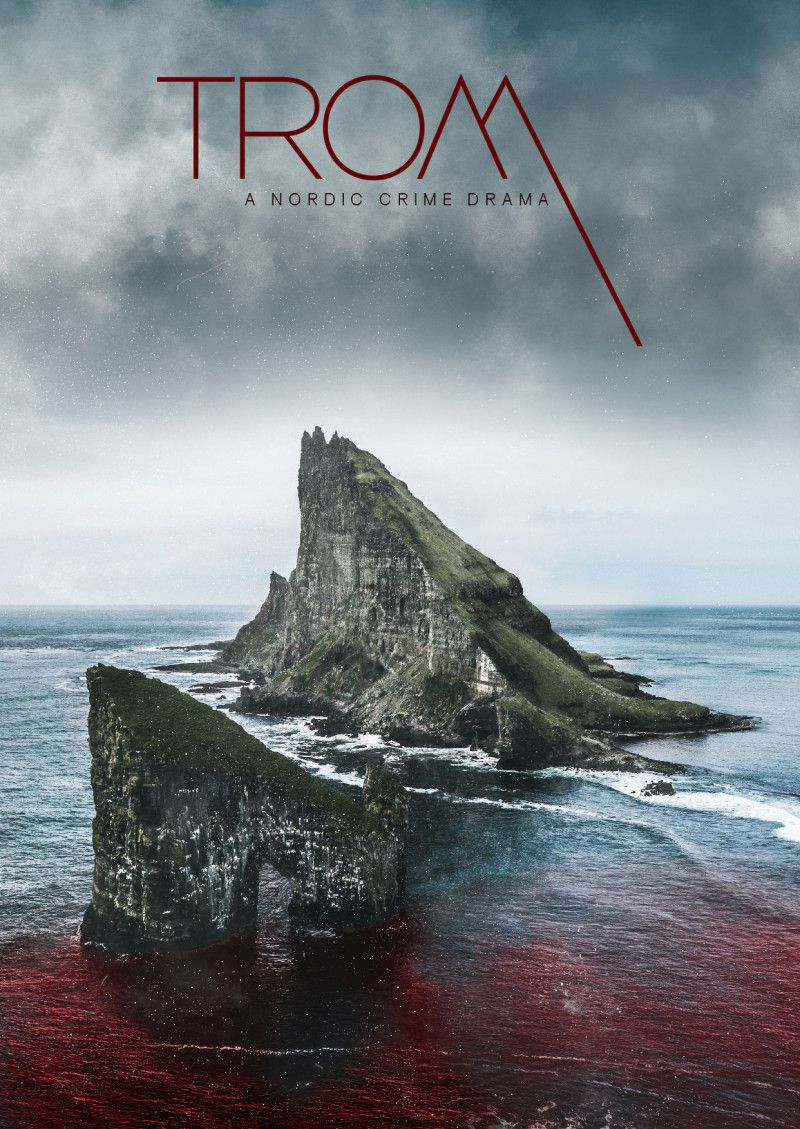
It’s good to see that the Faroe Islands have finally joined the Nordic noir scene! This weekend’s showing of the first episodes of Trom on BBC 4 really showcased the Faroese setting, with tiny rural settlements lashed by wind and rain, precipitous cliffs and pounding seas. And the resilient inhabitants going doggedly about their daily lives, dwarfed by the elements.

It is of course particularly exciting for Norvik Press that Jógvan Isaksen’s Walpurgis Tide, which we have published in translation, is one of the novels on which this series is based. Hannis Martinsson, Isaksen’s representative of the long line of amateur detectives who persist in solving crimes where the police are baffled, returns home to his native land after decades in Denmark, only to discover – and immediately lose – a daughter he did not know existed. Impelled to try to solve her murder, he embarks on an investigation which it is hinted will lead him to an international political conspiracy.

An extra dimension is provided in the dramatization by the use of Faroese actors in most of the parts. It is great to hear Faroese spoken here by native speakers – all except for Hannis and the police chief Karla, who speak Danish. A treat for linguists!

Posted on

Back to university: ebooks and reading lists

Where has the summer gone?! With the reading-hammocks being folded away and back-to-school beckoning, this week we’re highlighting two resources: our new ebook catalogue, and recommendations for university reading lists.

Hot off the (digital) press, our 2020 Ebook Catalogue collects together all the Norvik titles that are currently available for you to download and enjoy instantly on your Kindle or other e-reader device:

Vigdis Hjorth’s PEN award-winning A House in Norway, translated by Charlotte Barslund – a perfect choice for #WITMonth

Ilmar Taska’s acclaimed Pobeda 1946: A Car Called Victory, translated by Christopher Moseley

Kirsten Thorup’s timely The God of Chance, translated by Janet Garton

Jógvan Isaksen’s Walpurgis Tide, translated by John Keithsson – a slice of Faroese eco-crime

We hope to digitise more of our backlist in future, too.For those returning to campus – in-person, or remotely – we recommend some autumnal poetry: Hans Børli’s We Own the Forest: And Other Poems presents a dual-language text with facing-page English translations rendered by Louis A. Muinzer. This work by the ‘lumberjack poet’ – a phrase I’ve never had occasion to write before! – is ideal for Norwegian classes. Students of Finnish may also be interested in our forthcoming selection of poems by Pentti Saarikoski, A Window Left Open, jointly translated by Emily Jeremiah and Fleur Jeremiah and also in a dual-language format.

Posted on

Literature of the Faroe Islands

This week, we would like to draw attention to a blog written by Pardaad Chamsaz, Curator of Germanic Collections at the British Library, on the literature of the Faroe Islands: https://blogs.bl.uk/european/2020/04/this-grain-of-sand-is-nevertheless-a-whole-world-literature-of-the-faroes.html

The Faroes’ literary traditions are therefore both long-established and yet still novel; they are also both local and yet inextricably tied to Denmark and the wider world. These tensions have defined the distinctiveness of Faroese literature.  — Pardaad Chamsaz

If this has made you curious about Faroese literature, you may like to browse our two translations:

Walpurgis Tide

Jógvan Isaksen’s Walpurgis Tide, translated by John Keithsson and featuring a foreword by Dominic Hinde, is a thrilling slice of Faroese crime fiction. Two British environmental activists are discovered dead amongst the whale corpses after a whale-kill in Tórshavn. The detective Hannis Martinsson is asked to investigate by a representative of the organisation Guardians of the Sea – who shortly afterwards is killed when his private plane crashes. Suspicion falls on Faroese hunters, angry at persistent interference in their traditional whale hunt; but the investigation leads Martinsson to a much larger group of international vested interests, and the discovery of a plot which could devastate the whole country.

You can read a report of our book launch for Walpurgis Tide in a previous blog post here, and a review of it here. It’s a timely read, as this 2020 documentary by the BBC demonstrates.

Walpurgis Tide is available in print or as an eBook – perfect if you don’t want to wait for the post to arrive!

Barbara 

Originally written in Danish, Barbara was the only novel written by the Faroese author Jørgen-Frantz Jacobsen (1900–38), yet it quickly achieved international bestseller status and is still one of the best-loved classics of Danish and Faroese literature. This translation is by George Johnston.

On the face of it, Barbara appears to be a historical romance: it contains a story of passion in an exotic setting with overtones of semi-piracy; there is a powerful erotic element, an outsider who breaks up a marriage, a built-in inevitability resulting from Barbara’s own psychological make-up… everything you might desire in a page-turning love story! But Barbara stands as one of the most complex female characters in modern Scandinavian literature: beautiful, passionate, devoted, amoral and uncomprehending of her own tragedy. Jørgen-Frantz Jacobsen portrays her with fascinated devotion, and the ‘romance’ is in the vein of Daphne du Maurier’s darker tales.

Barbara is available to order here.

Further reading

The Facebook page for the Representation of the Faroes in London shares further ideas for lockdown reading on a Faroese theme: https://www.facebook.com/faroesinlondon and the FarLit website has some recommendations for your reading list too: https://www.farlit.fo/

Posted on

Nordic crime fiction event

cropped-nn_banner

On Monday 22 May, our friends at UCL’s Nordic Noir Book Club are holding a book launch and panel discussion featuring Scandinavian crime fiction authors Jorn Lier Horst (Norway), Lone Theils (Denmark) and Stefan Ahnhem (Sweden). The authors will be presenting their new and forthcoming work, and host Jakob Stougaard-Nielsen (UCL Scandinavian Studies) will be celebrating the launch of his book Scandinavian Crime Fiction, recently published by Bloomsbury.

A selection of Norvik Press books will be available for sale at the event (cash or card). Our crime fiction titles Murder in the Dark (Dan Turèll, Denmark, trans. Mark Mussari) and Walpurgis Tide (Jógvan Isaksen, Faroes, trans. John Keithsson) will be available at the special price of £10. The play The Contract Killer (Benny Andersen, Denmark, trans. Paul Russell Garrett) will be on sale at £5 – while stocks last.

The venue is Juju’s Bar & Stage in E1, and tickets are only £5. More details can be found on the EventBrite ticket booking page: click here to book via EventBrite.

We hope to see you at Juju’s on 22 May!


Posted on 3 Comments

Jógvan Isaksen’s Walpurgis Tide: Book Launch Report

Launch Panel
Our launch panel: Janet Garton, Barry Forshaw, Jógvan Isaksen and John Keithsson. Image courtesy of Kåre Gade

A large and enthusiastic audience, of whom several had already found time to read the book, gathered for the launch of our first venture into Faroese crime fiction, Walpurgis Tide by Jógvan Isaksen. The panel was introduced by the book’s editor at Norvik Press, Professor Janet Garton. Our chairman was Nordic crime-fiction aficionado Barry Forshaw, who jovially and expertly held the reins in the discussion between the book’s author and its translator John Keithsson. Jógvan Isaksen is a man of many parts who teaches at Copenhagen university and is the author of numerous books, ranging from academic titles to two successful series of crime novels, which are only now starting to be translated into English. He also finds time to take the helm at the Faroe Islands’ leading publishing house. The discussion and audience questions ranged far and wide on topics including Faroese reliance on its traditional whaling and fishing industries, the challenges of translating dialect, the Faroese tendency to live and work abroad, the stark beauty of the landscape, the broadening out of the islands’ publishing industry from more esoteric fare to include popular fiction, and the central importance of the midday radio news in Faroese cultural life.

9781909408241The author and translator explained why they had chosen to start with the third of the nine books featuring freelance journalist Hannis Martinsson as the main protagonist and pondered on which other books in the series would have appeal for the new, wider readership. Jógvan Isaksen acknowledged Agatha Christie and other Golden Age British crime writers, and American west coast crime from the likes of Hammett and Chandler, as some of his primary sources of inspiration. Parallels were drawn with Icelandic crime fiction; in both small nations, crime rates are very low and murders extremely rare, making the success of the fictionalised crime genre there all the more intriguing. We were lucky enough to have Victoria Cribb, translator of Arnaldur Indridasson and Yrsa Sigurdardóttir, in the audience.

We would like to thank the Faroese Representation in the UK and the Danish Embassy for hosting the event and making us so welcome.

Walpurgis Tide is available at all good bookstores.