Posted on

On not going out

Fear of strangers, of the danger lurking outside the safe walls of home –  this is a feeling many have become familiar with in recent weeks. In Ilmar Taska’s dramatic novel Pobeda 1946: A Car Called Victory, the fear is of a more tangible enemy, as resistance workers hide from the Soviet occupying forces in Estonia just after the Second World War. A young boy is entranced by the sudden appearance in his street of a shiny new car – and then tricked into betraying secrets he does not know he holds. 

Translated from the original Estonian by Christopher Moseley, Pobeda 1946 is a candidate for the Human Rights Book Award – HRBA and on the 2020 longlist for the International Dublin Literary Award (for which it has recently featured in a video highlighting Estonian literature here).

Baltic Station, Tallinn. 1945. @retrofotod / urbem.ee

Curious? You can read a taster extract, or order a copy from all good bookstores.

Posted on

Memories of Mårbacka

There are times over the past twelve weeks or so when our semi-isolated living situation has made us feel we’ve been transported back to an earlier age. Living in a rural area in particular, and seeing the busy – if socially distanced – local community interactions and the empty roads, you can almost feel as if you’re a resident of Mrs Gaskell’s Cranford. Or indeed of Selma Lagerlöf’s Mårbacka, where families struggle, to be sure, and life can be physically and mentally tough, but the pace of things is largely determined by the slowly changing seasons and the length of time it takes to get anywhere on foot, or in a horse and gig along the winding, hilly roads round the lakes of Värmland province.

In the lockdown months we’ve all come to appreciate the value of a full larder, and in that we have much in common with the housekeeper at Mårbacka farm, who prides herself on a full storehouse to keep the large household going. Read our evocative extract here.

Tina Stafrén/imagebank.sweden.se

Explore the world of Selma Lagerlöf not only in Mårbacka but through our whole series ‘Lagerlöf in English’, translated by Peter Graves, Linda Schenck and Sarah Death. This great Swedish storyteller brings you tales of everything from love in sickness and in health, via romance and betrayal, hauntings and untimely deaths, salty sea air and valiant derring-do, to family life with its fractious and funny moments and its small delights.

Posted on

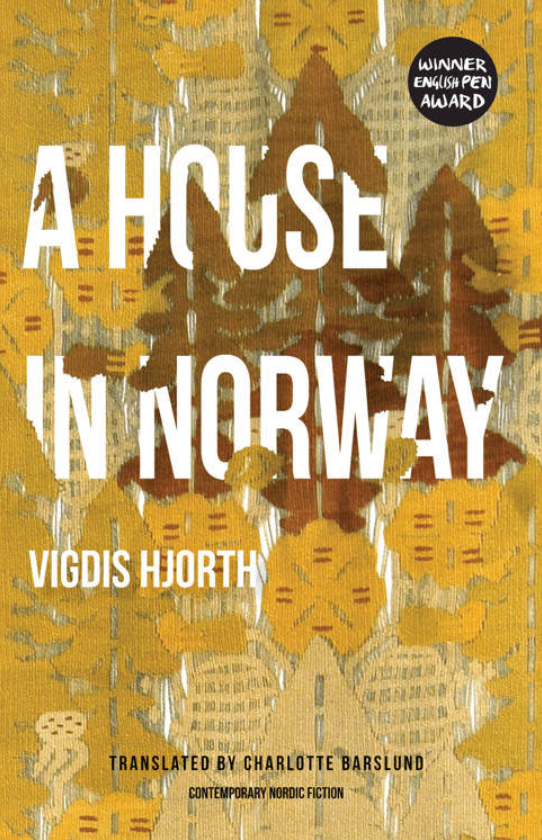
‘Surfaces matter to a textile artist’: Vigdis Hjorth’s A House in Norway

Restricted to life within the same four walls at the moment? If lockdown is continuing where you are, we would highly recommend reading the award-winning A House in Norway by Vigdis Hjorth. Translated by Charlotte Barslund and selected for an English PEN Award as part of the PEN Translates! programme, this novel is a penetrating study of power relations in contemporary Nordic society.

Hesteblomster, Frida Hansen, 1900, detail. Photo: Jensen, Stina Aadland / Stiftelsen Kulturkvartalet

The relationship between a property owner and their tenant is an uneasy one: ‘the power balance was unequal, that is if you could talk about power in such cases, and you probably could’. Petty squabbles over whose responsibility it is to clear a shared driveway of snow, wasteful electricity use, late-night shower routines and prejudices based on superficial appearances – the tenant’s bed-linen is preemptively dismissed by her landlady as ‘undoubtedly synthetic’ – accrue and accumulate, heading towards inevitable combustion.

If you would like to read for yourself how this particular tapestry of tangled lives turns out, copies can be ordered here or you can read the opening pages here. It will also be perfect pre-reading for the 20th Internationales Literaturfestival Berlin, scheduled for September this year (pandemic permitting), where Vigdis Hjorth has been invited to appear as a guest.

Posted on

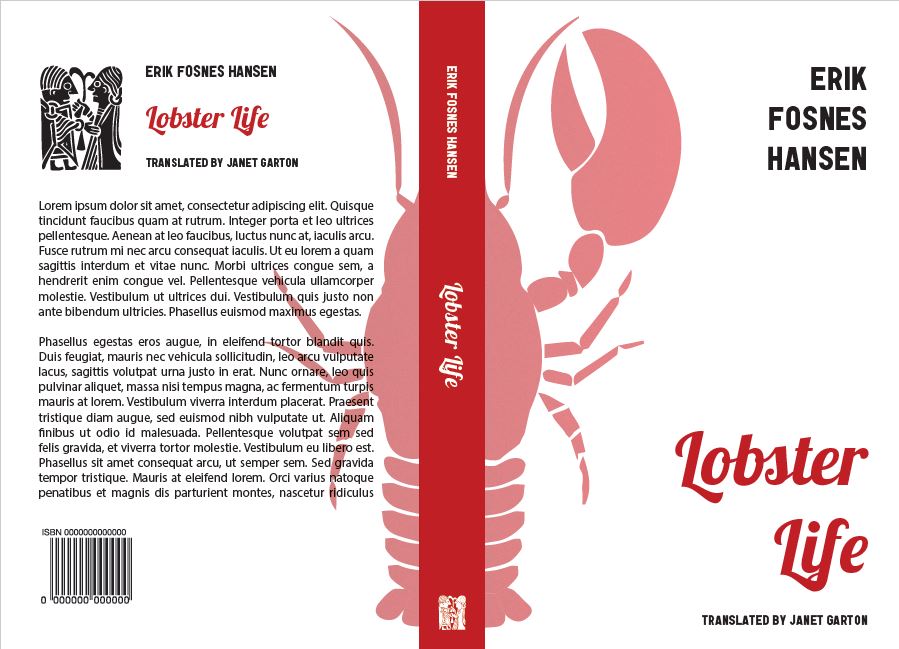
Lobster-led design (and Wes Anderson films)

This week, we have another cover art special for you!

In 2019, we published Erik Fosnes Hansen’s Lobster Life, translated from the Norwegian Et hummerliv by Janet Garton. With a title like that, we knew that we needed a cover that would honour the novel’s quirkiness and its blend of comedy and tragedy, as captured in this review:

What a totally brilliant book! Best comedy I have read in ages. It reminded me of The Natives of Hemsö, such a favourite book. Best medicine for the coronavirus blues; I’m telling everybody to read it. It made me laugh and laugh – and then it made me cry.  

Sue Prideaux, author of I am Dynamite! A Life of Friedrich Nietzsche, Winner of the Hawthornden Prize 2019.

For a taste of Lobster Life, you can read an extract here, which relates what happens when our young narrator agrees to take a group of hotel guests fishing.

Today we would like to share a few of the runner-up covers with you:

One-clawed silhouette
Lobster on the menu
Lobster tail and claws
‘Picture Wes Anderson’s Grand Budapest Hotel transplanted to the high Norwegian fells…’ (grayscale version)
Final design
(glorious technicolour version)

From sourcing images of lobsters to finding inspiration in Wes Anderson’s aesthetic, this was certainly a memorable design process. We would love to hear which design is your favourite – let us know over on our social media accounts! And if you would like the final cover gracing your own shelves, copies are available to order from all good bookstores.

Posted on

Literature of the Faroe Islands

This week, we would like to draw attention to a blog written by Pardaad Chamsaz, Curator of Germanic Collections at the British Library, on the literature of the Faroe Islands: https://blogs.bl.uk/european/2020/04/this-grain-of-sand-is-nevertheless-a-whole-world-literature-of-the-faroes.html

The Faroes’ literary traditions are therefore both long-established and yet still novel; they are also both local and yet inextricably tied to Denmark and the wider world. These tensions have defined the distinctiveness of Faroese literature.  — Pardaad Chamsaz

If this has made you curious about Faroese literature, you may like to browse our two translations:

Walpurgis Tide

Jógvan Isaksen’s Walpurgis Tide, translated by John Keithsson and featuring a foreword by Dominic Hinde, is a thrilling slice of Faroese crime fiction. Two British environmental activists are discovered dead amongst the whale corpses after a whale-kill in Tórshavn. The detective Hannis Martinsson is asked to investigate by a representative of the organisation Guardians of the Sea – who shortly afterwards is killed when his private plane crashes. Suspicion falls on Faroese hunters, angry at persistent interference in their traditional whale hunt; but the investigation leads Martinsson to a much larger group of international vested interests, and the discovery of a plot which could devastate the whole country.

You can read a report of our book launch for Walpurgis Tide in a previous blog post here, and a review of it here. It’s a timely read, as this 2020 documentary by the BBC demonstrates.

Walpurgis Tide is available in print or as an eBook – perfect if you don’t want to wait for the post to arrive!

Barbara 

Originally written in Danish, Barbara was the only novel written by the Faroese author Jørgen-Frantz Jacobsen (1900–38), yet it quickly achieved international bestseller status and is still one of the best-loved classics of Danish and Faroese literature. This translation is by George Johnston.

On the face of it, Barbara appears to be a historical romance: it contains a story of passion in an exotic setting with overtones of semi-piracy; there is a powerful erotic element, an outsider who breaks up a marriage, a built-in inevitability resulting from Barbara’s own psychological make-up… everything you might desire in a page-turning love story! But Barbara stands as one of the most complex female characters in modern Scandinavian literature: beautiful, passionate, devoted, amoral and uncomprehending of her own tragedy. Jørgen-Frantz Jacobsen portrays her with fascinated devotion, and the ‘romance’ is in the vein of Daphne du Maurier’s darker tales.

Barbara is available to order here.

Further reading

The Facebook page for the Representation of the Faroes in London shares further ideas for lockdown reading on a Faroese theme: https://www.facebook.com/faroesinlondon and the FarLit website has some recommendations for your reading list too: https://www.farlit.fo/

Posted on

Finding a look for Vega Maria

Norvik’s designer Essi Viitanen gives us a guided tour through the process of designing a cover for Chitambo. 

The process of designing a cover for Chitambo began with reading the book and discussing the material with Sarah Death, the translator of the novel. Sometimes Norvik Press book covers have original illustrations but for Chitambo’s cover we thought it best to look for an existing image. The basic requirements for the image are high resolution (at least 300dpi for printing) and suitable space for the typography: book title and names of the author and translator. If possible, it is also preferable the image is public domain and free to use.

I began by looking for photographs that might work thematically or capture a significant detail of the novel. Whilst reading the book one paragraph had caught my eye: ‘If I close my eyes, I see a blue horizon and dazzling white sails, always the same vision, and I do not know where it comes from.’ With this in mind I headed to Unsplash, an excellent source for free public domain photographs, in search of images.

Continue reading Finding a look for Vega Maria

Posted on

Lockdown reading, taster four: Chitambo

In many countries, the lockdown continues. We are thinking of you all. To help keep spirits high, here is taster four.

Adeleide Johannessen in character as Nora in her tarantella scene from Henrik Ibsen’s A Doll’s House, from a cigarette card c. 1880–82. Nasjonalbiblioteket / National Library of Norway. In this week’s extract, our heroine admires the character of Nora when she visits the theatre.
Posted on

Lockdown reading, taster three: Chitambo

It is the third week of our series of blogs focusing on the recent publication of Chitambo by Hagar Olsson, translated by Sarah Death – which means it is time for another extract! Relax with taster three.

Book cover illustration by Wäinö Aaltonen from Hagar Olsson’s Ny generation, 1925. Photo: Geert Nicolai Vestergaard-Hansen, with thanks to Nordic Women’s Literature.