Posted on

Announcing our Latest Title: A Kaleidoscope of Stories 

Selma Lagerlöf’s A Kaleidoscope of Stories (Norvik Press, July 2025)

‘Osceola’ by George Catlin (1838)

Selma Lagerlöf’s vivid recollection of discovering the heady delights of the adventure story Oseola (sometimes known as Osceola) as a child is taken from ‘Two Prophecies’, one of the autobiographical texts in this volume. It seems a fitting way to open this blogpost about the latest addition to our ‘Lagerlöf in English’ series, which turns the spotlight on the power of short stories.  The volume contains a carefully chosen selection of Lagerlöf’s most important stories covering a range of themes, genres and periods of her career, translated by our prize-winning trio of Lagerlöf translators, Linda Schenck, Peter Graves and Sarah Death. After each story they also provide explanatory notes where appropriate.

Långserud, Värmland (Martin Edström/imagebank.sweden.se)

Midsummer folk dance, Öland (Bernt Fransson)

Lucca, Church of St. John and St. Reparata, 4th Century (Syrio)

Key autobiographical pieces, morality tales both dark and light, legends from several lands and folklore-inspired narratives combine to reveal the breadth and stylistic range of Lagerlöf’s storytelling skills. This is a collection of interest to general readers but also a useful teaching tool for Swedish and comparative literature courses around the world. The volume includes a comprehensive and accessible introduction by Lagerlöf specialist Bjarne Thorup 
Thomsen (University of Edinburgh). The nine stories have been arranged into three thematic sections: Women, Work and Writing; Landscapes, Families and ‘Others’; Epochs, Societies and Values.

As our specialist scholar writes in his introduction, the collection has been designed to offer the reader a multifaceted mixture of stories. The selected narratives showcase different times, places, atmospheres, styles and genre modes. Some stories are obvious instances of prose fiction, while others are balanced somewhere between fictional and factual writing. With the nine narratives listed chronologically according to their dates of first publication, the content of the volume is as follows (annotations by Bjarne Thorup Thomsen):

‘Mamsell Fredrika’ / ‘Miss Fredrika’ – an imaginative and extravagantly expressed tribute to a female trailblazer in Swedish literature, centred, like many of Lagerlöf’s stories, around Christmas.

‘De fågelfrie’ / ‘The Outlaws’ – a narrative, steeped in nature mysticism and fin-de-siècle-feel, about clashes, but also fluid boundaries, between pagan and Christian mindsets in medieval times, fuelled by the descriptive energy that Lagerlöf attributed to her writing at the time.

‘Gudsfreden’ / ‘God’s Peace at Christmas’ – an enquiry into a close encounter, with elements of crime, between human and animal, and Lagerlöf’s first depiction of the Ingmarssons, the powerful family of peasants that would take centre stage in Jerusalem.

‘Spelmannen’ / ‘The Fiddler’ – a story, both playful and uncanny, about a self-assured musician and the shadows of abandoned family, set during a Nordic summer night in a landscape that is both attraction and trap.

‘Silvergruvan’ / ‘The Silver Mine’ – a nation-orientated narrative about the homeland’s real riches, anticipating some of the major themes in Nils Holgersson

‘Två spådomar’ / ‘Two Prophecies’ – a biographical sketch in six life moments, infused with motifs of deciphering, reading and writing, about Lagerlöf’s route to becoming an author, published at a time when her national, and indeed international, fame was growing fast.

‘Bortbytingen’ / ‘The Changeling’ – a suspense-filled story about unexpected contact and strange parallels between a human and an ‘alien’ sphere, featuring an unconventional and resourceful heroine.

‘Den heliga bilden i Lucca’ / ‘The Sacred Image in Lucca’ – a miraculous legend and picaresque travel adventure played out in Italy, foregrounding poor but hopeful working-class characters and told in a lucid style and light-hearted tone.

‘Dimman’ / ‘The Mist’ – a modern parable with a punishing ending, published in the context of the First World War and critiquing attitudes, including artistic ones, to the reality of global conflict and suffering.

We enthusiastically echo Bjarne’s assessment that Lagerlöf’s rich corpus of short stories and related forms of short prose deserves renewed attention – and up-to-date translations. These are the first retranslations of the texts in our anthology for over a century. We are sure that all anglophone readers, from committed Selma followers to those discovering her work for the first time, will fall under the spell of her storytelling in this varied volume.

Posted on

Two of our Swedish translations shortlisted for the Bernard Shaw Prize 2021

Covers of Chitambo and Crisis, the two shortlisted translations

Norvik Press are delighted to announce that two of our translators have been shortlisted for the Bernard Shaw Prize 2021:

  • Sarah Death for her translation of Chitambo by Hagar Olsson
  • Amanda Doxtater for her translation of Crisis by Karin Boye

We are immensely proud of this achievement and its potential to introduce new readers to both of these classics in Nordic modernism and feminism.

The Bernard Shaw Prize is an award for translations into English of full-length Swedish language works of literary merit and general interest. This year’s judges are Charlotte Berry and Annika Lindskog. The award is sponsored by the Embassy of Sweden, London.

The award ceremony will be held in February 2022. If you are planning on reading the shortlist in the meantime, you can read the full press release here and order copies of Chitambo and Crisis through our website or your local indie bookshop. You can also read extracts from both by revisiting our blogposts: start here for Chitambo, and here for Crisis.

Posted on

A sisterhood of necessity

Members of the Lotta Svärd organization, Finland’s equivalent of the Swedish lottor, prepare food for Finnish volunteers on a clearance camp shortly before the Continuation War (1941). Credit: Uusi Suomi.

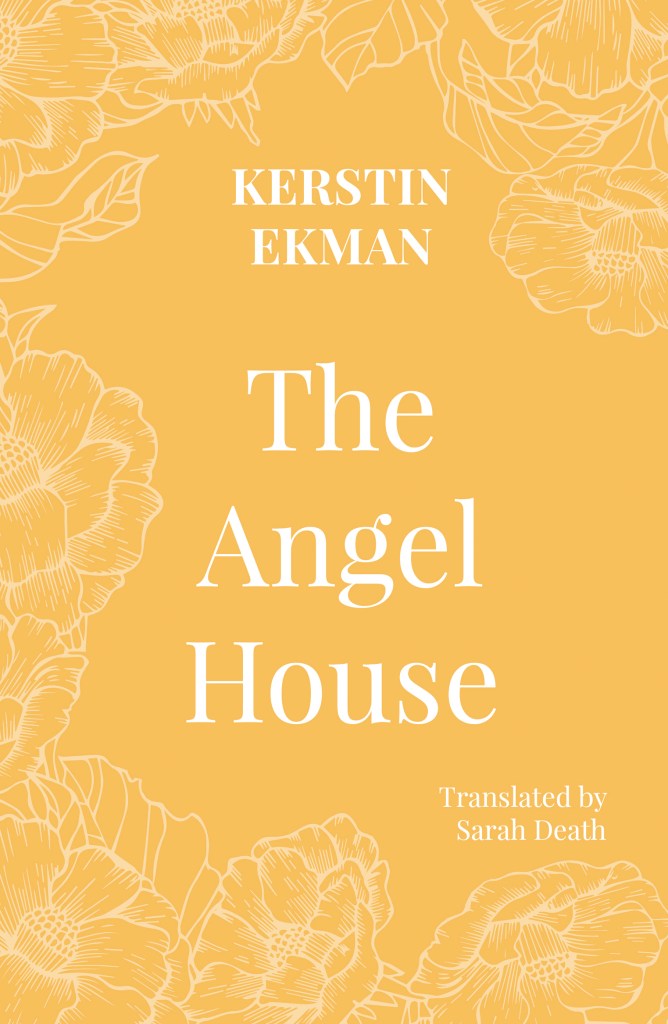
As part of our celebration of Women in Translation Month, Sarah Death introduces an extract from The Angel House, the third part of Norvik’s recently republished Katrineholm series. 

Kerstin Ekman’s central project in this quartet of novels was to depict the lives of women in a world run by men, the ‘town within the town’. The four books have become known collectively as Kvinnorna och staden, generally translated as ‘Women and the City’, and are a portrait of the town of Katrineholm in periods both before and after it gained its official city status in 1917.  It is barely more than a collection of fields and hamlets as the first novel opens and as the series unfolds we see it develop into a bustling town and thriving railway hub.

Women are not only the beating heart of Kerstin Ekman’s quartet, they are also the community’s backbone, a vital component of its workforce. We often see them labouring away on their own, as in our extract about Ingeborg Ek (see Linda Schenck’s recent post: ‘Round and round we go’). That dust keeps collecting on the furniture, those berries keep ripening and are crying out to be preserved for the winter, those nappies need an urgent wash. Individual women even labour in the night, be it nursing a new baby, setting dough and baking bread, making sweets to sell at your market stall, or hemming a frock to meet a dressmaking deadline.   Sometimes they are worn out, numb, at the end of their tether, sometimes desperately lonely, and sometimes they are relieved to be left in peace.

But there are also many scenes in the books of women working together, living in what we might call a sisterhood of necessity. This can be at an everyday level, sharing the privies and backyards, looking after the children, watering the communal gardens, feeding the cats, keeping an eye on each other’s washing and slipping through the hedge or across the stairwell to borrow a cup of sugar.  It can be at the level of individual friendships, many of which we see flourishing, like the one between Ingrid and Maud who enjoy their nights out dancing even though there is a war on. It can be in small clusters, like the group of elderly ladies, Tora, Ebba and a few other good friends who come together for a weekly whist evening and a comforting chat over beer, coffee and sandwiches as they try to come to terms with old age.

And it can be on a larger scale, the most notable example being the lottor, the Women’s Defence Volunteers, roped in from diverse walks of life to perform the heroic feat of feeding and watering the troops whose trains pull up at the station platform at any time of day or night. Dog-tired, possibly after a day’s work in their regular jobs, they drag themselves through their shifts and – rather to their own surprise – forge a precarious kind of solidarity that becomes increasingly precious to them, a bulwark against war, loneliness and all the other trials of life.

Click on the book cover below to read the extract.

Posted on

Women’s cyclical work in men’s linear world

As Norvik Press publishes its new collector’s editions of Kerstin Ekman’s ‘Women and the City’ quartet, Sarah Death considers the clashing versions of time that structure the third book in the series, The Angel House.

In one chapter of The Angel House, the author describes how the lottor, the women’s defence service volunteers, are called on to cook and serve up vast amounts of food at the railway station for soldiers in transit overnight. One of them, Hilda, reveals when chatting to an apparently friendly officer on the platform that she has worked out the times and destinations of the trains, despite precautions designed to maintain secrecy. The man turns out to be a security officer and Hilda receives a severe reprimand and is demoted to kitchen duties so she poses no further risk.

Later we find a scene in which another lotta, Jenny, one of the novel’s central characters, is also affected by the timetables of war. Wartime production of anti-aircraft guns means her husband Fredrik is constantly obliged to work overtime, but Jenny hates the war, even if it brings employment in neutral Sweden. Tired after her long night shifts at the railway station, she drags herself out of bed before six, makes Fredrik his breakfast and waves him off, but inside she feels an incoherent anger: ‘Suddenly she wanted to shout after him, open the window and shout so that everyone could hear. Good God – it’s Sunday! That’s something special, a holiday when people wear better clothes, eat different food. They can’t do this to time!’

These two episodes also have a deeper significance. They are not isolated incidents, but part of a pattern which underpins the whole novel, and indeed the whole ‘Women and the City’ series about the people and the industrialisation of a Swedish provincial town. This quartet, written between 1974 and 1983, stands out from other epics of social realism in twentieth-century Swedish literature for its sustained identification with the women’s perspective. With industrialisation seen here as essentially the men’s preserve, there is a conflict throughout between the female and male strands of the narrative. In the two episodes described above, Kerstin Ekman is showing women co-opted by, and falling foul of, Men’s Time, and conflicts of this sort erupt repeatedly.

For men, time in the world depicted by Ekman appears largely as a linear project of departure, progression and arrival, whereas women’s time is more organic and cyclical. The latter’s strands of the narrative are more likely to be expressed in seasonal or gestational time, or in the loose rhythms of domestic tasks, than in rigid clock time. Time is elastic for the women in this novel, ranging from long periods of enforced waiting to interludes of frenzied activity. Male time in The Angel House, on the other hand, is ‘tempo’, a hectic, artificial, externally imposed time which attempts to structure life and order society. It is the time of factory hooters, referees’ whistles and military exercises. Above all it is train-timetable time, the railway representing the march of progress and the triumph of technocratic solutions.

The narrative deliberately alternates between male and female episodes. Thus, for example, a chapter highlighting young Ingrid’s feelings about pregnancy and impending motherhood is followed by a history of the Carlsborg, a building in which the – male – town councillors manoeuvre for ever greater influence in smoke-filled rooms. And on Jenny and Fredrik’s summer cycling holiday, Jenny’s enjoyment of the open air and sense of identification with Stone Age female pot makers are followed by a day spent, at Fredrik’s request, touring the Bofors armaments factory.

Ekman’s individual male characters are far from caricatures, they are three-dimensional human beings, with all their failings and strengths. But when she depicts male collectives and men’s time, the tone is nearly always ironic, even comic. The tone when she writes about women and the passing of their time is quite different. She does not hesitate to reveal their weaknesses, but she charts their lives and labour (in all senses of the word) with tenderness and empathy. As Ekman writes of them elsewhere, ‘You want to fly to heaven in the company of spiritual gentlemen. But yours is a fate that is pure biology. And yours is a bloody awful story.’

Much of The Angel House is set during the Second World War and, as we have seen, wartime exigencies polarise male and female timetables still further. But running through the whole novel, in peacetime and in wartime, a vivid reminder of the two different approaches to time is provided by the contrasting pair gator/gårdar(streets/gardens) and the very different pace of life in those worlds, one public and one private, as the year passes. In one of them, there are tax officials, town councillors, property deeds changing hands and budgets recommended for child allowances and pensions. In the other, tucked away in the backyards, there are rows of privies, knotty old trees and raspberry thickets, rain on the spring vegetables, a swing, and holes in the hedges for cats and children and people who need to borrow a cup of milk.

This is a newly revised and shortened version of an essay first published in A Century of Swedish Narrative, eds. Sarah Death and Helena Forsås-Scott (Norvik Press, 1994).

Posted on

VOTES FOR WOMEN!

The centenary of voting rights for women in the United Kingdom is today, 6 February, and will be marked with commemorative events round the country in coming weeks and months. The Representation of the People Act 1918 enabled all men and some women over the age of 30 to vote for the first time and paved the way for universal suffrage 10 years later.

So there is no better time to remind readers about our English translation of Elin Wägner’s Penwoman, the classic novel of the Swedish women’s suffrage movement, written in 1910 amid the hopes, fears, triumphs and setbacks of campaigning.

The novel, whose central character is a young female journalist, offers exceptional insights into the dedicated work and strong sense of sisterhood uniting a group of women campaigning for suffrage. But it also explores a range of other issues affecting the situation of women in Sweden at the time, from the role of paid work to matters of morality, eroticism and love. The refreshingly disrespectful and witty style has helped make the novel one of Wägner’s most enduringly popular.

We still have some copies of this hard to find novel in our office. Please email norvik.press@ucl.ac.uk to get hold of one.