
You can now read Kirsten Thorup’s The God of Chance, translated by Janet Garton, on your Kindle. More Norvik e-books to follow in the near future. Please let us know what you think! (norvik.press@ucl.ac.uk)
Category: Authors
Two Norvik authors nominated for Nordic Council Literature Prize
We are delighted that two authors whose work has been published by Norvik Press have been nominated for this year’s Nordic Council Literature Prize.
Norwegian author Vigdis Hjorth has been nominated for her novel Arv og miljø (Inheritance and Environment, Cappelen Damm, 2016). A House in Norway, Charlotte Barslund’s translation of Vigdis Hjorth’s Et norsk hus, was launched this week by Norvik Press.
One of this year’s Danish nominees is Kirsten Thorup, for her latest novel Erindring om kærligheden (Remembrance of Love, Gyldendal, 2016). Kirsten Thorup’s Tilfældets Gud was translated as The God of Chance by Janet Garton, and published by Norvik Press in 2013. Listen to Helen Cross discussing The God of Chance on BBC Radio 4’s ‘A Good Read’.
Warmest congratulations to Vigdis Hjorth and Kirsten Thorup!
Browse the full list of nominees on the Nordic Council’s website.
A House in Norway: launch 22 February

Join us for the Norvik Press book launch of Vigdis Hjorth’s A House in Norway. This novel looks at one of the big political questions of our time, the crisis of population movements and the desire to give assistance versus the threat to our traditional way of life, and makes it personal and gripping. The central character Alma, who sees herself as enlightened and altruistic, is challenged to reassess her priorities in confrontation with untidy realities.
The event will feature a panel discussion with author Vigdis Hjorth and translator Charlotte Barslund chaired by Professor Janet Garton. This is followed by drinks and light refreshments.
Come join us for an evening of lively discussion on literature, translation and European immigration.
All welcome, but registration is required via this EventBrite page
Wednesday 22 February 2017, 17.30-19.00
UCL Centre for Advancing Learning and Teaching (CALT)
Main Arena Room (Ground Floor)
1-19 Torrington Place, London, WC1E 7HB
This publication was generously supported by NORLA and by English PEN |Arts Council England.


Norvik Press Launch and 30 Year Celebration Report
 It was an enthusiastic and well versed audience that assembled to celebrate the launch of Norvik Press’ two new publications, the latest additions to the “Lagerlöf in English” series; Anna Svärd and Mårbacka. The translators, Linda Schenck and Sarah Death, were in attendance, joined by Janet Garton, director and co-founder of Norvik Press.
The panel was chaired by Professor John Mullan, the Acting Dean of the Faculty of Arts and Humanities, UCL, who was most entertaining in making the panel very accessible for those less familiar with the work of Norvik Press and of Selma Lagerlöf. The book launch also served as a celebration of Norvik Press’ 30th anniversary, its first book having been published back in 1986.
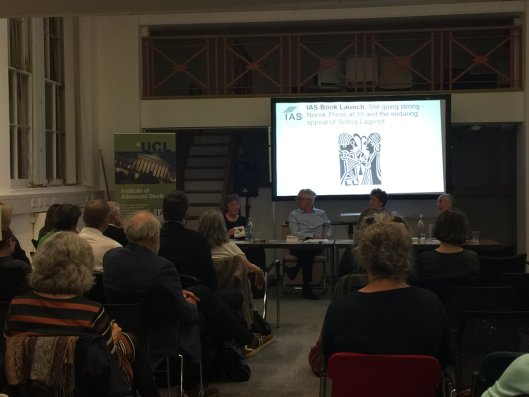
 The panel presented to us Anna Svärd, the final volume of Lagerlöf’s Löwensköld Ring trilogy and originally published in 1928, translated by Linda Schenck, who explained the enduring appeal of Lagerlöf’s works. She described Anna Svärd, and Lagerlöf’s works in general, as being “mischievious” and at the same time “very serious”, and pointed out that Selma Lagerlöf’s continuing appeal is evident as we are witnessing somewhat of a “Lagerlöf renaissance”. There was discussion about the need for a re-translation of Lagerlöf’s works, to continue to bring these novels into the English speaking world, even if the funding for such a project could be hard to come by.
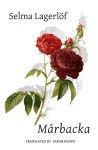 Mårbacka, translated by Sarah Death and originally published in 1922, is the first of another of Lagerlöf’s trilogies, and is a work of “autofiction”, as the translator herself put it; a fictionalised account of Selma Lagerlöf’s childhood in her family home, told through the innocent eyes of a young Selma herself.
These new publications are two additions to a large collection of translated books published by Norvik Press, set up to raise awareness for the “overlooked classics”, as Janet Garton described them, of Scandinavian literature, whether contemporary or not. The panel joked about how Norvik Press had not been immune to the Nordic Noir trend, having recently published the crime fiction title Walpurgis Tide by Faroese writer Jógvan Isaksen.
Janet Garton also mentioned how the publishing house was now made up of an all-female team, which is somewhat refreshing and perhaps accounts for the prevalence of female writers in the list of Norvik Press’ publications. Overall, there was a feeling that Norvik Press was still succeeding in what it set out to do, and these new publications show that, even at 30, Norvik Press is indeed still going strong.
Alice Fletcher




Little Lord, by Johan Borgen, Preview
For those wanting to take a peek inside our latest Norwegian publication, here are the first few pages of Little Lord, by Johan Borgen, translated by Janet Garton. The launch for the book is November 14, 2016 with details coming soon. If you like what you read, it is available to buy at all good bookstores.
 The uncles and aunts came in snorting from the cold. Their breath looked like smoke coming out of their mouths as they passed through the narrow porch, where the maid was waiting to receive them. Then they came in, stamping, to the large square hall with the elk’s head over the fireplace opposite and tapestries on all the walls. There it was warm. There it was inside.
Little Lord was standing on the carpet in the middle of the drawing room, listening to their arrival through the closed door. He was aware of exactly what was happening as they entered in turn and breathed in the aroma, an aroma of wood and carpets and the discreet hum of an imminent family dinner, asparagus soup, trout, venison steak. He knew where and how the housemaid Lilly would help them out of their overcoats, how Uncle René would say with mild coquettishness: ‘No thank you, young lady, I’m not that old …’ and walk over with his sable-lined coat and hang it in the cloakroom to the left of the front door, whilst tubby Uncle Martin – despite the fact that he was much younger – would let himself be assisted with straightforward pleasure: anything to make life easier … and the aunts, how they would say hello quickly to one another in front of the mirror, say hello to a reflection as it appeared – and then shake hands properly just after with the real person, and how someone would say something about the cold and that there was snow in the air. Little Lord could see it more clearly than if he had seen it and hear it more fully and richly in his imagination as he stood there in the middle of the room, exactly where he should be when they came in, to play the little host who just happened to be standing there when the housemaid opened the door a moment later. A ritual each time – so that Mother could then emerge as if slightly surprised from the interior of the house, just a moment too late, the busy housewife … He stood in the middle of the floor, enjoying it. A nervous pleasure at the festivities to come made him tingle. He heard the train pass – an outgoing train to Skarpsno – just below the windows facing towards Frognerkilen bay. On any other day he would have run to the bay window, which was a step higher than the rest of the drawing room, in order to see the shower of sparks from the tall chimney of the locomotive come dancing out into the dark winter’s afternoon, and slowly fade in the air or along the banks of snow on both sides of the railway line, often right into the garden, between the summerhouse and the old fountain with the walnut tree standing proudly beside it.
Not today, no sparks today. Nothing other than to be standing in the middle of the floor because that was where he should be, and because he enjoyed it, and someone would say ‘the little man of the house’ – it was Aunt Kristine who would say it: ‘the little man of the house, already at his post’, she would say, and there would be an intoxicating scent of cocoa and vanilla around her – or perhaps that was just something he imagined because she produced ‘home-made confectionery’ in her tiny little kitchen, and had her own shop in Kongens gate, and everyone said she was ‘admirable’; at one time she had played the lute and sung in elegant restaurants abroad, and once someone had said that she was admirable, but perhaps a little, you know … and then one of those quick sideways glances from Mother which indicated that there was a child listening. But Mother knew that the child knew that Aunt Kristine’s eyes became as soft as velvet after dinner, and her voice became melodious, and she quietly kicked off her shoes under the sofa and leant forward with her plunging décolleté.
And he could see through the closed door how Uncle René folded his thin hands which could disappear into each other as he came back from the cloakroom, and briefly inspected his moustache which was waxed at the points as he passed the mirror, and with a diminutive comb which appeared and disappeared in his magician’s hands – as everything could appear and disappear in those hands – smoothed his thin greyblond hair, smoothed it down across his forehead, with one of those lightning movements his hands were created for, and how a moment later he would be standing in the doorway on the point of entering, in order to – at the last moment and with exaggerated politeness – make way for Aunt Charlotte, who in contrast would come foaming in with the silken rush of her many skirts – and Uncle René would say ‘mon petit garçon’ and raise the dark brown eyebrows which Mother had once said he dyed, and twinkle down at him with a playfulness which didn’t really have any special meaning, but was agreeable, and formed part of the occasion as well …
After that Uncle Martin with his tight-fitting striped trousers, which spread out grandly from the prison of his waistcoat, would say his piece about ‘masculinum’; but that would not be until after Mother had come in.
Not until then – a good while after the others – and he knew it was in order to make a point of her lack of importance – would Aunt Klara come in, black-clothed and flat-chested, and excuse herself more and more, the more heartily Mother welcomed her …
Little Lord stood in the middle of the floor, listening to the sound of the train receding. Soon the incoming train from Skarpsno would pass, and for a moment throw its long light beams out over Frognerkilen, where the ice gleamed dully and there was hardly any snow. And this clamour from a world outside merely increased the tingling pleasure at being here, being inside, at the many people, at the smell of roast venison, at the memory of the gentle plop of the bottles of red wine which had been opened a good hour ago … at the shimmer of coloured light from the oriental lamps in the bay window. It flickered over brass trays and scary Bengal masks which looked friendly now – and dancers in Meissen porcelain, who stood gracefully frozen in the uneven light, dancing brilliantly to the end of time on the dresser, unremarked by the grown-ups who walked past them or glanced at them distractedly, but not by him who had made their flowing movements, poised to leap, identical with a movement in himself: poised on the brink.
Little Lord by Johan Borgen
Norvik Press is thrilled to announce the publication of its English translation of Johan Borgen’s Norwegian classic Little Lord.
Johan Borgen’s Little Lord is the story of the adolescent Wilfred Sagen, nicknamed Lillelord (Little Lord) by his mother, who is growing up in Kristiania, later to become Oslo, in the years just before the first World War. The novel focuses on a period of about 18 months, from early 1912 to autumn 1913, when Wilfred is 14-15 years old, although there are many flashbacks to his earlier life. He is a precocious only child, the darling of the family, intellectually far ahead of his class, a gifted piano player and sophisticated art lover. Yet behind this polished façade there is another Wilfred, an adventurer who seeks out risk, who steals out of the house at night and roams the streets of Kristiania, the leader of a band of boys who steal, capable of violence and of arson. As time goes on it becomes increasingly difficult for him to keep the two sides of his personality distinct, and he eventually has a breakdown, which leaves him incapable of speech, literally silences him. He is taken to Vienna to see a psychiatrist – whose name is not mentioned, but who bears a striking resemblance to Freud – and is seemingly cured, though the psychiatrist warns him that his neurosis needs long-term therapy if he is to be properly healed. Wilfred returns to his old double life, but his desperation is only repressed, not resolved, and eventually the past catches up with him and he runs out of places to hide.
Borgen’s novel is a Bildungsroman, a study of a young boy growing up and his intellectual, emotional and sexual initiation into adulthood. It is a study of psychosis, and a portrait of the artist as a young man. It is a city novel; the reader can follow Wilfred’s excursions around the map of Kristiania/Oslo from the comforts of his upper-middle-class home on Drammensveien, across the bay by ferry to the pastoral idyll of Bygdøy, by tram to the east-end poverty of Grünerløkken or in Uncle Martin’s automobile up to the open-air display ground in Etterstad. It is also a cultural and historical study of a whole society, one on the brink of a devastating upheaval which will change the lives of all its members irrevocably.
Available at all good bookstores.
Anna Svärd by Selma Lagerlöf
 Anna Svärd, the latest addition to Norvik Press’s “Lagerlöf in English” series, is the third and final volume of what is known as the Löwensköld Ring trilogy. The characters from Charlotte Löwensköld, the second book in the trilogy, reappear in this novel, and the curse that has rested upon the Löwenskölds relating to the eponymous ring comes to fulfillment. Anna Svärd focuses on what makes a relationship, and what creates or destroys a family.
As if by design, but in fact entirely by coincidence, the Västanå Theatre group, which performs in Värmland every summer, often but not always putting on bright, musical renditions of Lagerlöf works, will be performing The Löwensköld Ring (Löwensköldska ringen) this summer, beginning on midsummer day and continuing into the autumn.
The story of the Löwensköld family, its secrets and its complications, is both a fine portrait of late nineteenth-century life in Värmland and astonishingly topical in its insights into human behavior, not least gender roles. These were late Lagerlöf works, in fact the last strictly fictional books she wrote, and they reflect a mature and perceptive writer.
For anyone traveling around Sweden this summer, even a non-Swedish speaker, reading the books (or even just the first volume, which I understand will be the focus of the play) in English would surely make it entirely possible to enjoy the performance which, although in Swedish, will be so full of song and dance and excitement that the language might seem almost irrelevant.

This slideshow, although not from this summer’s performance which hasn’t yet opened, gives a good idea of what Västanå’s plays are like. They are performed in a wonderful old barn called Berättarladan, or “Storyteller’s Barn”, beautifully situated just next to the lovely Rottneros Park, well worth a visit, and not far from Selma Lagerlöf’s home Mårbacka, where visitors to the house and grounds can anticipate Norvik’s soon-to-be published translation, by Sarah Death, of Lagerlöf’s somewhat fictionalized memoir of the same name:
Wishing all readers and visitors to Sweden a full and satisfying summer.
Linda Schenck, translator
Anna Svärd by Selma Lagerlöf and translated from Swedish by Linda Schenck.
Now available at all good bookstores.
The Ring Trilogy by Selma Lagerlöf
The Löwensköld Ring
Charlotte Löwensköld
Anna Svärd
Memorial Event for Professor Forsås-Scott
A memorial event will be held at UCL on the 17th May 2016 to honour the life and work of Professor Helena Forsås-Scott, a much respected Director at Norvik Press.
 Memorial Event for Professor Forsås-Scott
Tuesday 17 May 2016, 2-4.30pm
Haldane Room, Wilkins Building
UCL
Gower Street
London WC1E 6BT
Helena joined UCL in 1994 and retired in 2010 as Professor of Swedish and Gender Studies. She was a pioneering force in Gender Studies at UCL and a much-loved colleague, supervisor, mentor and teacher in the Department of Scandinavian Studies.
Helena’s major publications include Re-Writing the Script: Gender and Community in Elin Wägner (2009), Gender-Power-Text: Gender and Modernity in Twentieth-Century Scandinavia (2004), Swedish Women’s Writing 1850-1995 (1997) and A Century of Swedish Narrative: Essays in Honour of Karin Petherick (1994).
Helena was a Director of Norvik Press and Editor of the ground-breaking translation series Lagerlöf in English.
Personal reflections
During the event there will be short contributions from some of Helena’s friends and colleagues. We would however also like to collate personal reflections from those who knew and admired Helena’s work. If you would like to share your personal reflections on Helena and her work, please email these to elettra.carbone@ucl.ac.uk
Book a place
A limited number of spaces will be available for this event so we would kindly ask those who wish to attend to book a place as soon as possible via Eventbrite: Book a Place >
Tributes
Norvik Press
The University of Edinburgh
The University of Washington
Scandinavica, An International Journal of Scandinavian Studies (pdf)
SELTA (The Swedish-English Literary Translators’ Association)
Swedish Book Review
UCL
Jógvan Isaksen’s Walpurgis Tide: Book Launch Report

A large and enthusiastic audience, of whom several had already found time to read the book, gathered for the launch of our first venture into Faroese crime fiction, Walpurgis Tide by Jógvan Isaksen. The panel was introduced by the book’s editor at Norvik Press, Professor Janet Garton. Our chairman was Nordic crime-fiction aficionado Barry Forshaw, who jovially and expertly held the reins in the discussion between the book’s author and its translator John Keithsson. Jógvan Isaksen is a man of many parts who teaches at Copenhagen university and is the author of numerous books, ranging from academic titles to two successful series of crime novels, which are only now starting to be translated into English. He also finds time to take the helm at the Faroe Islands’ leading publishing house. The discussion and audience questions ranged far and wide on topics including Faroese reliance on its traditional whaling and fishing industries, the challenges of translating dialect, the Faroese tendency to live and work abroad, the stark beauty of the landscape, the broadening out of the islands’ publishing industry from more esoteric fare to include popular fiction, and the central importance of the midday radio news in Faroese cultural life.
 The author and translator explained why they had chosen to start with the third of the nine books featuring freelance journalist Hannis Martinsson as the main protagonist and pondered on which other books in the series would have appeal for the new, wider readership. Jógvan Isaksen acknowledged Agatha Christie and other Golden Age British crime writers, and American west coast crime from the likes of Hammett and Chandler, as some of his primary sources of inspiration. Parallels were drawn with Icelandic crime fiction; in both small nations, crime rates are very low and murders extremely rare, making the success of the fictionalised crime genre there all the more intriguing. We were lucky enough to have Victoria Cribb, translator of Arnaldur Indridasson and Yrsa Sigurdardóttir, in the audience.
We would like to thank the Faroese Representation in the UK and the Danish Embassy for hosting the event and making us so welcome.
Walpurgis Tide is available at all good bookstores.
Childhood by Kerstin Ekman
 Kestin Ekman’s wonderful poem Childhood, now published by Norvik Press as a dual language English/Swedish publication. Translated from Swedish by Rochelle Wright.
Kerstin Ekman is primarily known as a novelist, but she has occasionally turned to free verse, especially when the subject is autobiographical. In 1993-1994, Swedish TV 1 conducted a series of talks with prominent writers under the rubric ‘Seven Boys and Seven Girls’. In place of an ordinary interview, Kerstin Ekman read aloud Barndom (Childhood). The poem, which was published for the first time in Swedish Book Review in 1995, appears here with original photographs kindly provided by the author. The prose passages are quotations from Ekman’s 1988 novel Rövarna i Skuleskogen (The Forest of Hours, transl. Anna Paterson, Chatto & Windus, 1998).
Childhood has a new foreword by Kerstin Ekman, translated by Linda Schenck. The volume also includes a bibliography of critical literature (largely in English) on the author and her work, plus a full list of Ekman titles available in English translation.
This publication was the initiative of Norvik Press director Helena Forsås-Scott, who sadly lost her life to leukemia before the project came to fruition. The book is dedicated to her. Norvik Press will donate the first year’s profit on sales of the publication to the Marie Curie charity in the UK in memory of Helena, who was cared for at the Marie Curie Hospice in Edinburgh in her final days.
Available to purchase from all good bookstores.