Posted on

Amalie Skram’s Bergen

The Bergen in which Amalie Skram was born and grew up was a bustling cosmopolitan port, with trading links to the rest of Europe and beyond, in many ways a more important centre than the capital Christiania over the other side of the country. From a young age she was allowed to roam freely around the town, observing the characters and settings which were to provide inspiration for some of her best writing. The series of novels known as The People of Hellemyr is largely set in and around Bergen, as the fate of the family is followed through several generations, from subsistence farmers to aspiring middle-class citizens. 

Amalie Skram (1846-1905)

Although Bergen has of course grown and changed dramatically since the mid-nineteenth century, a large part of the old town which Amalie knew so well has survived to this day. With its narrow alleyways and steep cobbled streets, wooden merchants’ houses and wharves, it makes it easy to imagine Madam Tosspot and Tippler Tom stumbling drunkenly through the byways or Sivert watching the ships tying up and dreaming of running away to sea.

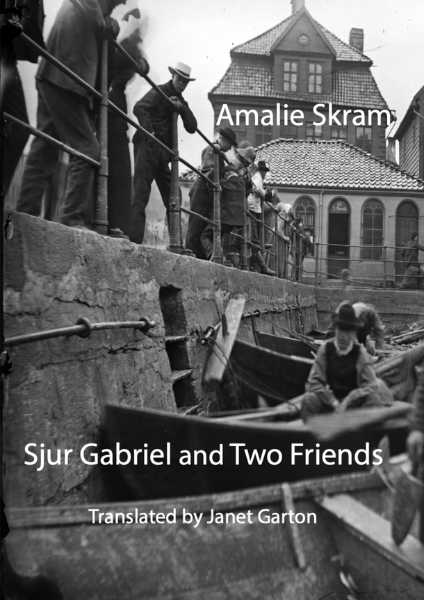
Port of Bergen, late 19th Century (Bergen University Library Collections)
Bergen today (© Janet Garton)

The first chapters of Two Friends bring together the characters of Oline (Madam Tosspot) and her grandson Sivert, whose shame at his grandmother’s drunkenness drives him as far away from the town as he can go – by ship all the way to Jamaica. But nowhere is far enough away to escape the inherited flaws which he will always carry with him.

Here is a short excerpt from the beginning of the novel, following Sivert and his grandmother in the streets of Bergen:

A fifteen-year-old boy in grey trousers held up by braces over his shoulders with a grey woollen shirt underneath came walking up Øvregaden. He was humming a popular song, marking the beats by stamping his wooden clogs on the sharp cobbles; when the melody demanded it he took a few dance steps. On his head sat a cap with a stiff peak shading his eyes, and under his arm he carried a bundle.

When he caught sight of the crowd up by Smedesmugalmindingen, he stretched out his neck with a look of curiosity in his wide-open eyes, and set off running towards it.

At that moment the knot of people began to move. The circle opened up, and he could see Tippler Tom with something in his hand which he was dragging along the street, and with Oline on his arm, lurching towards him. With a jerk the boy came to a sudden halt. His head sank forwards as if his neck had been broken. His fingers groped irresolutely down his trousers, and he turned round slowly. All at once his back hunched and his whole body seemed to shrink. It looked as if he wanted to leave, but couldn’t move. He stared down as if paralysed at one of his clogs which had fallen off his foot. He could hear the crowd approaching. In a moment it would knock him over if he didn’t move. He stole a glance to each side. Just next to him on the left was Bødkersmuget. Suddenly he bent down, snatched up the clog, took a couple of long unsteady strides over the gutter and the narrow pavement and reached the alley, starting to climb up its steep stone steps.

‘Come along wi’ us, Sivert! Tippler Tom an’ Madam Tosspot’s goin’ t’ Påtholleter sell ‘er skirt for booze!’ a boy’s voice called after him.

Bergen today (© Janet Garton)
Janet Garton by the statue of Amalie Skram, Bergen (© Gunnar Staalesen)

The book Sjur Gabriel and Two Friends can be purchased by clicking here.

Posted on

26th September: The European Day of Languages

John Linnell (1792-1882), after Edward Price (active c.1823-1854), View Across the Fiord from Herrinsholmen, circa 1826-27 from series Seven Views in Norway, etching on paper (UCL Art Museum LDUCS-1456).

Celebrate The European Day of Languages on 26 September by learning a Nordic language!

Did you know that 26 September is The European Day of Languages (EDL)? This celebration was first introduced in 2001 during the European Year of Languages when the Council of Europe’s Committee of Ministers ultimately decided to make EDL a yearly occurrence. The day is an opportunity to promote multilingualism, linguistic diversity and language learning.

At Norvik Press we are obviously big fans of this yearly celebration and of the many activities organised to draw attention to Europe’s linguistic and cultural diversity. So why not mark the day by learning something new about one of the languages of the Nordic Region? 

You can do this, for instance, by exploring The Language and Culture Show and Tell series, a set of free online language tasters and related materials created around objects mostly from UCL Art Collections. In January 2023, the series also became the basis of the UCL Art Museum exhibition called ‘Not Just Words: Learning Languages through Art and Objects’, which one of our Directors, Dr Elettra Carbone, co-curated with Dr Andrea Fredericksen (Curator, UCL Art Museum). 

The ‘Not Just Words’ exhibition in the Summer of 2024. Photographer: K. Holst. 

The series and the exhibition show how a collection-based approach to language learning can successfully and simultaneously promote the importance of language awareness and the relevance of university collections to academic and non-academic audiences. Many modern languages spoken in the Nordic Region are represented in this series, including Danish, Faroese, Finnish, Icelandic, Norwegian and Swedish. We hope you enjoy these resources and wish a happy EDL to all our readers and followers!

Posted on

Bookshop twinning for Independent Bookshop Week 2024: Meet our ‘twin’, Script Haven

To celebrate Independent Bookshop Week (Saturday 15 – Saturday 22 June), we are teaming up with indie bookseller and community hub Script Haven, in Worcester, UK. We interviewed Script Haven’s founder, poet and spoken word artist Leena Batchelor to launch our partnership.

Norvik Press: What would be the first line of the story of Script Haven?

Leena Batchelor: A dream manifested into reality, against the odds.

NP: How did bookselling begin for you?

LB: As a self-published author, I usually take my own books to events to sell. I was disappointed to discover mainstream bookshops wouldn’t stock them, especially when I won a publishing contract with a local publisher as part of winning the Worcestershire Poet Laureate competition in 2020. Gradually, I became aware of other indie authors and publishers who had the same experience, and decided I wanted to try and correct the situation.

NP: Which books are your favourites to hand-sell?

LB: Always those by indie authors and indie publishers, especially the more esoteric titles.

NP: Do you host or belong to any reading groups?

LB: We do! We have a monthly book group called Worcester Worms run by one of our very successful crime authors, Carla Kovach.

NP: Where do you usually discover or learn about new books to add to stock?

LB: From a variety of sources. Often, authors and publishers reach out to us, and the Booksellers Association is a great resource (and support!).

NP: How does the local community make use of Script Haven?

LB: Wow – where do I start! We host a huge variety of community events to support local causes, and provide a safe haven for those who simply want somewhere to come and relax. To date, we have facilitated sign language sessions, LGBTQ+ talks, open mic poetry events to raise awareness of issues such as Multiple sclerosis (MS), homelessness, Amnesty’s work, mental health, the list is growing! We’re all about ensuring the local community can easily engage with creativity in all its forms in a safe and welcoming environment.

NP: Script Haven is also an events space. Tell us about what’s coming up/what you’re looking forward to 🙂 

LB: We host 3–5 events a week, so our diary is crammed! We’re excited for our first CreARTivity Festival during the May half-term, a week full of family-friendly events and evening performances, each day having a different theme. We’ve got numerous book launches booked in (pun intended!), including TM Logan (The Holiday, The Catch) and Melita Thomas (1000 Tudor People). We’re also holding an event to celebrate Lughnasadh with a meal and stories.

We’re all about ensuring the local community can easily engage with creativity in all its forms in a safe and welcoming environment.

LEENA BATCHELOR

NP: Script Haven is dog-friendly – tell us about the dogs who come in!

LB: They are fluffy, snuggly, and great characters! They adore the treats we provide too. Our furry friends add so much life to our days, and we have quite a few regulars, too. I know I’m biased, but my favourite is my youngest daughter’s Irish Doodle, who is the size of a small pony already at 7 months old, but such a gentle cuddly teddy-bear!

NP: What shows up on your TikTok ‘For You Page’? We’re intrigued by the cellar you featured on your account recently – the perfect spooky addition to any bookshop…!

LB: Cute animals and book- and coffee-adverts! The cellar was an unexpected find during renovation works. Turns out our building dates back to the 16th century, and was at one stage a hotel, with the cellar being used to store barrels; the original barrel chute is still there. It’s a perfect spooky theme for us as we also host 42Worcester, the UK’s only alternative-genre spoken word event (think gothic horror, fantasy, sci-fi). I also write and perform at the event monthly.

NP: What was the last meme or post that made you laugh?

LB: It would either be a video of my cat, Mozart, giving my Social Media Manager head-boops when she was looking after him; or a meme she sent me, with a pigeon and the caption ‘send this to someone so that they have to open their phone and see this pigeon bopping his head uncontrollably’ – of course I had to open it!

NP: Do you read any zines/literary magazines?

LB: I try to fit them in when I can, and we stock The Palimpsest edited by Chloe Hanks. I love reading novels as an escape, and am currently enjoying The Innocents by Bridget Walsh, a Victorian-noir mystery.

NP: You have Finnish heritage. Have you ever visited Nurmes, or would you like to visit one day?

LB: Sadly I haven’t yet, but absolutely. I’d love to meet up with my aunt and her children, who I haven’t seen for over 30 years.

NP: Would you like to share a snippet of your poetry with us?

LB: Sure. This is a poem I wrote recently about what words and writing mean to me:

Illuminated letters

As scribes of old with desire of coloured ink upon parchment wrote,

You illume my life.

As whirlpools swirl the waters and seas,

I find my heart wrapped in yours.

As the moon calls to the tide,

The sun to life, and winds to breath,

So you encompass treasures in my life.

NP: Thank you, Leena!


Stay tuned for our ‘twinning’ with Script Haven this summer.


Script Haven opened in August 2023 and is Worcester’s only independent bookshop. It predominantly supports indie authors and publishers, and in January was voted by The Times readers as the 3rd Best Indie Bookshop in the UK.

Support Script Haven by ordering from their Bookshop.org shop here.

Posted on

International Polar Bear Day

It may surprise our readers to know that in the room where the Norvik Press team gathers for our meetings, there resides a polar bear skull and a family of cuddly polar bears! (Or, this might not be surprising at all – we are the publishers of the quirky Lobster Life!)

This curious fact is relevant beacause 27 February 2024 is International Polar Bear Day. To celebrate, UCL Scandinavian Studies is hosting an afternoon of in-person events, including a language taster, exhibition, and panel: Stories from the Nordic North Atlantic and The Arctic. Please come along! The celebrations are free to attend, and you can drop-in or book through Eventbrite here.

The full programme is below:

1–2pm: Language Taster: Words for Snow and Ice in Arctic Languages (Dr Riitta Valijärvi, Associate Professor of Finnish and Minority Languages), UCL Art Museum (drop-in)

This taster is about words for snow and ice in a selection of Arctic languages. We will begin with a discussion about culture-specific vocabulary across languages, followed by plenty of examples from languages like Finnish, Swedish, North Sámi, Greenlandic, and Nenets. We will touch upon language families, climate change, and English vocabulary. The session includes lots of pictures and an interactive element.


2–5.30pm: Pop-up Exhibition: The Arctic and Nordic Landscapes, UCL Art Museum (drop-in)

Come and have a look at some of the items in UCL’s collections that represent (hi)stories from the Nordic region.


5.30–7pm: Panel Discussion: Storied Arctics / Arctic Voices, Medical Sciences and Anatomy, G46, H O Schild Pharmacology Lecture Theatre (booking required)

Conversations with polar researchers, authors, and poets.


7–8pmReception, North Cloisters (booking required)


We look forward to seeing you there!