
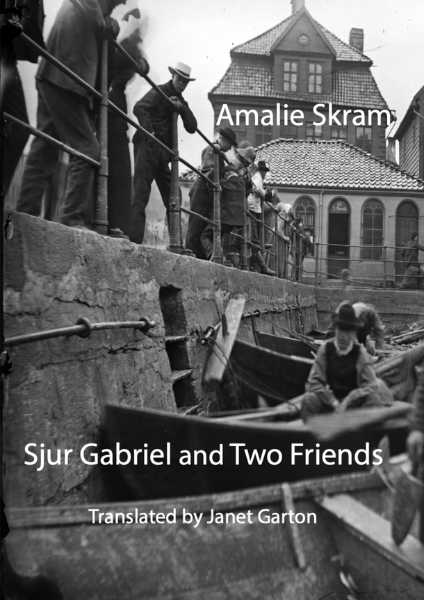
The Bergen in which Amalie Skram was born and grew up was a bustling cosmopolitan port, with trading links to the rest of Europe and beyond, in many ways a more important centre than the capital Christiania over the other side of the country. From a young age she was allowed to roam freely around the town, observing the characters and settings which were to provide inspiration for some of her best writing. The series of novels known as The People of Hellemyr is largely set in and around Bergen, as the fate of the family is followed through several generations, from subsistence farmers to aspiring middle-class citizens.

Although Bergen has of course grown and changed dramatically since the mid-nineteenth century, a large part of the old town which Amalie knew so well has survived to this day. With its narrow alleyways and steep cobbled streets, wooden merchants’ houses and wharves, it makes it easy to imagine Madam Tosspot and Tippler Tom stumbling drunkenly through the byways or Sivert watching the ships tying up and dreaming of running away to sea.


The first chapters of Two Friends bring together the characters of Oline (Madam Tosspot) and her grandson Sivert, whose shame at his grandmother’s drunkenness drives him as far away from the town as he can go – by ship all the way to Jamaica. But nowhere is far enough away to escape the inherited flaws which he will always carry with him.
Here is a short excerpt from the beginning of the novel, following Sivert and his grandmother in the streets of Bergen:
A fifteen-year-old boy in grey trousers held up by braces over his shoulders with a grey woollen shirt underneath came walking up Øvregaden. He was humming a popular song, marking the beats by stamping his wooden clogs on the sharp cobbles; when the melody demanded it he took a few dance steps. On his head sat a cap with a stiff peak shading his eyes, and under his arm he carried a bundle.
When he caught sight of the crowd up by Smedesmugalmindingen, he stretched out his neck with a look of curiosity in his wide-open eyes, and set off running towards it.
At that moment the knot of people began to move. The circle opened up, and he could see Tippler Tom with something in his hand which he was dragging along the street, and with Oline on his arm, lurching towards him. With a jerk the boy came to a sudden halt. His head sank forwards as if his neck had been broken. His fingers groped irresolutely down his trousers, and he turned round slowly. All at once his back hunched and his whole body seemed to shrink. It looked as if he wanted to leave, but couldn’t move. He stared down as if paralysed at one of his clogs which had fallen off his foot. He could hear the crowd approaching. In a moment it would knock him over if he didn’t move. He stole a glance to each side. Just next to him on the left was Bødkersmuget. Suddenly he bent down, snatched up the clog, took a couple of long unsteady strides over the gutter and the narrow pavement and reached the alley, starting to climb up its steep stone steps.
‘Come along wi’ us, Sivert! Tippler Tom an’ Madam Tosspot’s goin’ t’ Påtholleter sell ‘er skirt for booze!’ a boy’s voice called after him.


The book Sjur Gabriel and Two Friends can be purchased by clicking here.