Posted on — 1 Comment

Lockdown reading, taster one: Chitambo

Looking for some reading to make lockdown life a little more bearable? We have just published Hagar Olsson’s Chitambo, translated by Sarah Death – and you can read taster one today!

Hagar Olsson in the 1920s

From birth, Vega Maria Dreary is caught in a vice of conflicting parental expectations. Her father brings her up to admire history’s heroic male adventurers, while her mother channels her towards housework and conformity. But when puberty comes, paternal half-promises evaporate and Vega has to fight her own way out of the domestic cage. In a time of revolution and civil war in early twentieth-century Finland, she finds it hard to identify her own calling, alighting first on the cause of feminism but feeling her way towards a wider humanitarian mission.

The adult Vega looks back on her younger self with ironic humour, but is in despair about the end of a rocky relationship with her beloved Ta, now transformed by his wartime experiences. She recovers and opts to emulate her childhood hero Livingstone, beating new paths through her own psychological jungle.

A kaleidoscope of changing roles for Vega whirls us through this compelling modernist novel, multi-layered but eminently accessible, with a wonderful feel for language, and vibrant evocations of an era and a place. Considered by many to be Hagar Olsson’s best novel, Chitambo is now available in English for the first time.

Posted on

Amanda Doxtater talks about her translation of Karin Boye’s queer classic

Literary translation, not unlike Boye’s literary production, can be a personal, creative endeavor with political implications. Translating and publishing this novel marks a concerted attempt to broaden a canon of modernist literature still dominated by white, straight, male Anglophone writers. But as a translator working in the academy, I am equally excited about the ways that translating a book like Crisis might open up the possibility for new forms of literary scholarship that draw no significant distinction between emotion and intellect, or between translation and the scholarly practice of literary criticism. This is a decidedly political proposition. Crisis is a book that screams out for the personal to be acknowledged and attended to rather than ignored or subdued in the name of objectivity or equivalence, and I have tried to hear that.

This novel, with all of its elegance and awkward peculiarities, has compelled me for half of my life — unlike any other book I’ve encountered. I was an awkward nineteen-year-old when I first read it in a course on Swedish women’s literature at the University of Washington — an initial exposure that coincided with my first taste of Nietzsche, Freud, and Marx, all of whom Boye had engaged with to write it. Undaunted by the fact that Boye’s prose would stretch my undergraduate Swedish skills to their utmost limits, I set out (pencil to paper, with a heavy, bound dictionary) to bring it into English. It was an automatic reflex. I was self-aware enough to know that it was a naïve undertaking, but I was convinced that being so close in age to Malin would afford me insight into her experience that would compensate for my deficiencies. Thinking back, I would like to believe that my decision to translate Crisis went something like the moment when Malin first glimpses Siv sitting in front of her and is both struck and soothed by the beauty of her gently-sloping shoulders. As it did with Malin, the vision of Siv also offered me a reprieve of sorts after having made my way through a significant portion of a book that I still find largely perplexing (if wondrous). The scene sparked desire, and translation was the most appropriate way for me to express it. If undertaking the labor of translation began with a flush of infatuation, it eventually transformed into a project of admiration and even a kind of love. Crisis became the center of my own intellectual Bildungsroman. I returned to it as an MA student and wrote my thesis on the novel, comparing Malin to Diva, the protagonist in Monika Fagerholm’s postmodern novel by the same name. The two protagonists had too many compelling similarities, I argued, to allow us to draw a sharp distinction between modernism and postmodernism. During this period, I had the fortunate opportunity to workshop a section of my draft in a translation seminar with the amazing translator, Tiina Nunnally. I finished my thesis, but set the translation aside for more than a decade.

This is the opening of the Translator’s Afterword. To read more from Amanda Doxtater about her working relationship with this original and exciting book, get your copy of Crisis here.

Karin Boye, circa 1930s. Public domain.
Posted on

Karin Boye’s modernist classic now published in English for the first time

Malin Forst is a precocious, devout twenty-year-old woman attending a Stockholm teachers’ college in the 1930s. Confounded by a sudden crisis of faith, Malin plunges into a depression and a paralysis of will. Oscillating between poetic prose, social realism, fragments of correspondence, and imagined dialogues between the forces of nature, Crisis telescopes Malin’s distress out into metaphysical planes and back, as her mind stages struggles between black and white, Dionysian and Apollonian, and with an everyday existence that has become unbearably arduous.

And then an intense infatuation with a classmate reorients everything.

First published in Swedish as Kris in 1934, Boye’s meditation on a crisis of faith and queer desire is recognised as a modernist classic for its stylistic and literary experimentation. Now, in January 2020, the full text is available in English for the first time, translated by Amanda Doxtater. You can find it in all good bookstores, or via norvikpress.com.

For a taster of a key scene, download an extract here.

Posted on

The Brain in the Aquarium

When are we alive? Which lives are worth living? What constitutes a real life? And how should we treat lives that are not human? I was left with a number of existential questions after reading A Living Soul. At first I thought a story about a brain in an aquarium would be quite a tedious affair, but I was very wrong.

Not only is A Living Soul philosophical and thought provoking, but it is also exciting, nerve- wracking and tragically romantic (how can a story with a brain as a protagonist be romantic? Well, hence the tragic bit). The disembodied brain Ypsilon is living in a world which is similar to our own but slightly more scientifically advanced. First of all, in this world we can keep a brain with no body alive in a water tank in a science lab. This brain is perfectly able to think and feel like any other human being, but it is of course not able to live a full life. The only other inhabitants of the lab are a dog and some rats. And like the dog and the rats, Ypsilon is a disposable part of a project; a guinea pig. But what happens when this guinea pig is perfectly able to understand what is going on, perfectly able to envision a life outside the prison walls of the water tank, and demands to know the truth of its existence?

P. C. Jersild is, to coin a phrase, the brain behind it all. He wrote his first novel at the age of fifteen, but he thought a writing career would be an insecure path to take and decided to study medicine to give him the prospect of a real job. Luckily, he continued writing, and after a while he realised he could live by his pen. However, the medical world proved to be very fruitful for his authorship, and nearly all his works have featured experiences from life as a doctor and a psychiatrist. This is especially apparent in A Living Soul. It was originally published in Swedish in 1980 and has become the quintessential Swedish sci-fi classic. Jersild has since said that it is one of his favourite works, and one of his more recent novels, Ypsilon, is named after the main character in A Living Soul.

The novel was first published in English by Norvik Press in 1988, translated by Rika Lesser, an award-winning American poet. It is one of those timeless stories that stick with us and keep us posing the important questions. To bring this memorable novel to new, English-reading audiences, we are now issuing a reprint with a stunning new cover.

By Kristin Lorentsen, production assistant

Posted on

Dorrit Willumsen in London

Norvik Press brought one of Denmark’s greatest writers, Dorrit Willumsen, author of the novel Bang, over the North Sea for a chat with her translator, Professor Marina Allemano, about their love of the nineteenth-century author Herman Bang, and walking over cracks in the ground. The event took place high above the ground on the tenth floor in the Arena Centre in Bloomsbury. With an amazing view of the London skyline, the city itself made a poetic backdrop to the literary conversation.

The idea of the book originated when Willumsen was asked to write about one of her heroes. She had two subjects in mind, one being her grandfather, and the other Herman Bang – her favourite Danish writer. Known for re-imagining historical figures using the first person, Willumsen used the same technique for the protagonist in Bang. The work was originally commissioned by her publisher as a biography. Willumsen, however, discovered this was problematic, as there were so many biographies about Bang already in print. She read them all, and as she progressed in her research, it became increasingly difficult for her to hold her creativeness at bay. Eventually, the book turned out to be a novel about the last days of the eccentric, flamboyant writer and inspiring actor. The story unfolds through a series of flashbacks as we follow Bang on his final book tour through America. He is ill, dependent on help from others and on his morphine to get to sleep. But the reader also gets to know the younger, livelier man through his reminiscing.

A household name in Denmark, Dorrit Willumsen started out as a writer in 1965, although sadly not much of her work is translated into English. This translation of Bang goes some way towards remedying that. And that task was undertaken by Allemano, who has always had a great admiration for Willumsen and published a biography about her in Danish in 2015. When asked where she positions herself as a translator, Allemano humbly defined herself as a servant to the original work, a technician; a problem solver. She described the translating process with an analogy: imagine walking on an Earth full of cracks. When you look down between the cracks, you can vaguely distinguish the real, more beautiful world underneath, but you can never fully get to it. However, this modest depiction of her own efforts was quickly modified by voices in the audience. Translation is also a rewriting of the script and demands a great deal of artistic imagination.

Throughout the evening Willumsen lapsed into several entertaining anecdotes of the writing process and how Bang lived his life. The audience learnt that he was a man with a love of spending money when he had it and reduced to borrowing when he did not. He even went so far as borrowing from his doctor and then from his doctor’s wife, with a plea that she would not tell her husband … Willumsen also described what it was like working on a project like Bang, saying it took her five years to write the book; when she had finally finished, her son was relieved that Bang had moved out after living in their home for so long.

Rounding off the evening, as the darkness had settled – creating the perfect storytelling ambience – Dorrit and Marina delighted the audience with the opening passage of Bang in both Danish and English. Herman Bang’s brusque meeting with the big city of New York made a stark contrast to the romantic twinkling of the skyline in the background.

Posted on

Betrayed

This is a new translation of a Norwegian literary classic, Forraadt (Betrayed) by Amalie Skram. When Forraadt was first published in 1892, Skram was well-known in Scandinavia as the controversial author of novels that exposed marriage as an institution demeaning to women. She had broken social taboos with her frank discussions about sexuality and the double standard. In Constance Ring, Lucie and Fru Inés she had explored the demoralizing effect of a system which allowed men to pursue sexual pleasure freely while insisting women remain pure before marriage and then absolutely faithful to their husbands. In Betrayed she sharpens her focus and examines a marital relationship from its very beginning.

The novel opens on the night of Ory’s wedding. Family and friends are gathered in the home of Ory’s parents to celebrate the marriage; the party is breaking up and the groom, Captain Adolph Riber, is impatient to leave with his young bride and finally be alone with her. But Ory wants desperately to stay, not merely in her parents’ home, but in the nursery with her younger brothers and sisters—she has just been told she will be sleeping in the same room, even the same bed, as Captain Riber, and she is terrified.     

If you think you know where this story is headed, you may be surprised. You would expect Skram’s sympathy to be squarely with Ory, the child bride whose mother failed to prepare her for married life. The mother’s parting admonition to her daughter is to honour and obey her husband, strive to please him in every way. But the Captain, though gruff and short tempered, is not a demanding and unfeeling husband. He is troubled by his wife’s unhappiness, struggles to understand what is causing it, asks himself what he might have done or said to offend her. Riber is well-intentioned, but not very perceptive; and Ory is not always as sweet-tempered and innocent as she first appeared. The reader finds her sympathy shifting as the story unfolds.

Skram is a wonderfully descriptive writer and one of the pleasures of reading Betrayed is taking in the sights and sounds and smells of life in London and aboard a merchant ship in the 1860s. The day after their wedding the newlyweds sail from Bergen to London where Captain Riber’s ship is being loaded with cargo. There are vivid depictions of London’s street life, restaurants and dance halls, and the wharf on the Thames where the Orion is docked. The last half of the novel takes place at sea and the ship and its crew are portrayed in authentic detail—as a young woman Skram had herself sailed as a captain’s wife on Norwegian merchant ships. As the Orion passes through storms, then good weather, and is finally becalmed in the doldrums, the onboard tensions build to a horrifying conclusion.

By Katherine Hanson and Judith Messick, translators of Amalie Skram’s Betrayed.

Click here to purchase Betrayed from Waterstone’s.

Posted on

An evening with Danish author Dorrit Willumsen and translator Marina Allemano

Bang coverA reading and panel discussion with author Dorrit Willumsen and translator Marina Allemano

Tuesday 16 October 2018, 6.00-7.30pm
UCL Arena Centre
10th Floor, 1-19 Torrington Place, London, WC1E 7HB
Tickets are free, but pre-registration is essential. To book your place, please email norvikevents@gmail.com by 9 October

Join us over a glass of wine with Danish author Dorrit Willumsen and translator Marina Allemano, as they discuss the process of bringing Herman Bang to the English-speaking world. Bang will be available for sale at a special discounted price for one night only. 

In Bang, winner of the 1997 Nordic Council Literature Prize, Dorrit Willumsen re-works the life story of Danish author, journalist and dramaturge Herman Bang (1857-1912). In a series of compelling flashbacks that unfold during his last fateful train ride across the USA, we are transported to fin-de-siècle St Petersburg, Prague, Copenhagen, and a Norwegian mountainside. A key figure in Scandinavia’s Modern Breakthrough, Herman Bang’s major works include Haabløse Slægter (Hopeless Generations, 1880), Stuk (Stucco, 1887) and Tine (Tina, 1889).

Read more about Bang here

Read an extract from Bang here

Browse and buy Bang and other books in all good bookshops and at norvikpress.com

Posted on

Ten Lagerlöf masterpieces for £100

Women in Translation Month is almost over, but we couldn’t let it pass without celebrating the woman whose shadow looms large over our catalogue, and the women and men who have translated her work: Selma Lagerlöf.

For a limited time only, we’re offering ten Lagerlöf masterpieces for £100. Read on for more details…

Print

To date, Norvik Press has published ten of Lagerlöf’s works in English translation [click here to download the series leaflet]:

A Manor House Tale: a psychological novella and a folk tale in which two young and damaged people redeem each other.

Banished: infused with the visceral horrors of the First World War, Banished is a tale of love, loneliness, and the extremes of human morality. Read an extract here.

The Emperor of Portugallia: A compelling exploration of father-daughter relationships and of madness.

The Phantom Carriage: an atmospheric ghost story and a cautionary tale of the effects of tuberculosis and alcoholism, famously adapted to film by the great Swedish director Victor Sjöström.

Lord Arne’s Silver: from a 16th-century killing unfolds a tale of retribution, love and betrayal.

Mårbacka: part memoir, part mischievous satire set on Lagerlöf’s childhood estate. Read an extract from Mårbacka in English here.

The Löwensköld Trilogy: Lagerlöf’s last work of fiction, the trilogy follows several generations of a cursed family and explores destiny, evil, motherhood, and many other themes along the way. The trilogy consists of three volumes:  The Löwensköld Ring, Charlotte Löwensköld, and Anna Svärd.

The internationally beloved tale of a boy and his goose, Nils Holgersson’s Wonderful Journey through Sweden, Volume 1 and Volume 2 (Nils Holgersson is also available in a single-volume hardback collector’s edition).

Purchased individually, all eleven paperbacks (including the two paperback volumes of Nils Holgersson) cost a total of £135 (plus P&P). Until 14 September 2018, we are offering a limited number of complete sets of eleven paperbacks at the discounted price of £100 (plus P&P). This special price is only available on orders placed directly with Norvik Press, not through book stores or online. Please email norvik.press@ucl.ac.uk to place your order. First come, first served – available only while stocks last!

Print

Posted on

The Lagerlöf in English series

In June 2011, Norvik Press published Lord Arne’s Silver, The Phantom Carriage and The Löwensköld Ring, three short novels by the world-renowned author Selma Lagerlöf. It was the start of an exciting and, for us, very gratifying project – the Lagerlöf in English Series – which has turned into twelve books so far. The translations are done by Linda Schenck, Peter Graves and Sarah Death, all experienced and prize-winning translators from Swedish to English. In addition to the substantial job of translating a Nobel Prize winner, Schenck, Graves and Death have also contributed with their own translators’ afterwords in their respective translations. These chapters make for an intriguing read about different aspects of translating each particular book and give in-depth information about Lagerlöf’s work. Furthermore, each book is introduced by an exciting and informative preface written by the late Helena Forsås-Scott, the pioneering mind behind the series.

The series now comprises 12 titles, most recently Memoirs of a Child (volume II of the Mårbacka trilogy), published in 2022.

You can download the Series brochure, or read more about the Series below.

Banished

What happens to an individual who is rejected by society? What happens to a society that eventually realises the living are more important than the dead, and that it is suffering a crisis of values and priorities? What does war do to us and to our outlook on the world? Selma Lagerlöf struggled with these issues throughout World War I and experienced a mental block in writing about them. Then she found an opening and produced a thought-provoking tale of love, death and survival that grapples with moral dilemmas as relevant today as they were a century ago.

The Emperor of Portugallia

For poverty-stricken farm labourer Jan, the birth of his daughter Klara gives life a new meaning; his devotion to her develops into an obsession that excludes all else. We are taken from the miracle of a new-born child and a father’s love for his baby girl into a fantasy world emerging as a result of extreme external pressures, in which Jan creates for himself the role of Emperor of Portugallia. Yet this seemingly mad world generates surprising insights and support. Described as ‘perhaps the most private of Selma Lagerlöf’s books’, the novel takes us deep into a father-daughter relationship that carries the seeds of tragedy within it almost from the start.

Mårbacka

The property of Mårbacka in Värmland was where Selma Lagerlöf grew up, immersed in a tradition of storytelling. Financial difficulties led to the loss of the house, but Lagerlöf was later able to buy it back, rebuild it and make it the centre of her world. The book Mårbacka, the first part of a trilogy written in 1922–32, can be read as many different things: memoir, fictionalised autobiography, even part of Lagerlöf’s myth-making about her own successful career as an author. It is part social and family history, part mischievous satire in the guise of innocent, first-person child narration, part declaration of filial love.

The Löwensköld Ring

The Löwensköld Ring is the first volume of a trilogy originally published between 1925 and 1928. In addition to being a disturbing saga of revenge from beyond the grave, it is a tale of courageous, persistent women, with interesting narrative twists and a permeating sense of ambiguity. The potent ring of the title brings suffering and violent death in its wake and its spell continues from one generation to the next, as well as into the two subsequent novels in the trilogy. The Löwensköld trilogy was Lagerlöf’s last work of pure fiction, and is now considered a masterpiece.

Charlotte Löwensköld

A curse rests on the Löwensköld family, as narrated in The Löwensköld Ring. Charlotte Löwensköld is the tale of the following generations, a story of psychological insight and social commentary, and of the complexities of a mother-son relationship. Charlotte is in love with Karl-Arthur – both have some Löwensköld blood. Their young love is ill-fated; each goes on to marry another. How we make our life ‘choices’ and what evil forces can be at play around us is beautifully and ironically depicted by Selma Lagerlöf, who was in her sixties when she wrote this tour de force with the lightest imaginable touch.

Anna Svärd

The curse on the Löwensköld family comes to fruition in unexpected ways in this final volume of the Löwensköld cycle. Anna Svärd is also very much a novel of women’s struggle toward finding fulfilment. The Löwensköld Ring resonates with ‘beggars cannot be choosers’ in relation to what a poor woman can expect in life, while Charlotte Löwensköld moves toward women having some choices. In Anna Svärd the eponymous protagonist takes full and impressive control of her own life and destiny. The question of motherhood and the fates of the children with whom the characters engage is another theme. The reader goes on to follow Charlotte, Karl-Artur, Thea and their families, familiar from the previous volume, through this compact novel as it moves relentlessly toward a chilling dénouement.

A Manor House Tale

Written in 1899, Selma Lagerlöf’s novella A Manor House Tale is at one and the same time a complex psychological novel and a folk tale, a love story and a Gothic melodrama. It crosses genre boundaries and locates itself in a borderland between reality and fantasy, madness and sanity, darkness and light, possession and loss, life and death. Lagerlöf’s two young characters, Gunnar and Ingrid, the one driven to madness by the horrific death of his goats in a blizzard, the other falling into a death-like trance as a result of the absence of familial warmth, rescue each other from their psychological underworlds and return to an everyday world that is now enhanced by the victory of goodness and love.

Nils Holgersson’s Wonderful Journey through Sweden: The Complete Volume

Starting life as a commissioned school reader designed to present the geography of Sweden to nine-year-olds, this absorbing tale quickly won the international fame and popularity it still enjoys over a century later. The story of the naughty boy who climbs on the gander’s back and is then carried the length of the country, learning both geography and good behaviour as he goes, has captivated adults and children alike, as well as inspiring film-makers and illustrators. The elegance of the present translation – the first full translation into English – is beautifully complemented by the illustrations specially created for the volume.

The Phantom Carriage

Written in 1912, Selma Lagerlöf’s The Phantom Carriage is a powerful combination of ghost story and social realism, partly played out among the slums and partly in the transitional sphere between life and death. The vengeful and alcoholic David Holm is led to atonement and salvation by the love of a dying Salvation Army slum sister under the guidance of the driver of the death-cart that gathers in the souls of the dying poor. Inspired by Charles Dickens’ A Christmas Carol, The Phantom Carriage remained one of Lagerlöf’s own favourites, and Victor Sjöström’s 1920 film version of the story is one of the greatest achievements of the Swedish silent cinema.

Lord Arne’s Silver

An economical and haunting tale, published in book form in 1904 and set in the sixteenth century on the snowbound west coast of Sweden, Lord Arne’s Silver is a classic from the pen of an author consummately skilled in the deployment of narrative power and ambivalence. A story of robbery and murder, retribution, love and betrayal plays out against the backdrop of the stalwart fishing community of the archipelago. Young Elsalill, sole survivor of the mass killing in the home of rich cleric Lord Arne, becomes a pawn in dangerous games both earthly and supernatural. As the deep-frozen sea stops the murderers escaping, sacrifice and atonement are the price that has to be paid.

Posted on

Why You Need to Read Suzanne Brøgger

Suzanne Brøgger is a Danish icon. With her 1973 collection of essays Fri os fra kœrligheden (Deliver Us from Love) she put herself on the map as a powerful feminist voice and became the spokesperson for a whole generation of Scandinavian women. She wants change and challenges traditional boundaries of sexuality and gender in her work. In her early writings, there is a distinct polemic voice fighting for social transformation, but later on in her authorship, Brøgger becomes more philosophical, posing the big existential questions about human life. She fills her stories with herself, transgressing the line between fiction and autobiography, in order to convey the spirit of the age she is living in. But using herself as material has led to a lifetime of trying to balance the role of subject and object. Because in addition to being an author, Brøgger is a striking beauty with an aura of sensuality – a combination that has spurred curiosity and desire since she made her debut in the public sphere. However, it seems this has only prompted Brøgger to be more innovative, constantly reinventing herself and her writing, flouting generic conventions.

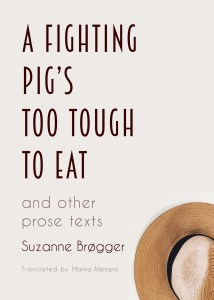
Brøgger’s collection of essays A Fighting Pig’s Too Tough to Eat is now out in a beautiful new reprint. It contains several essays, including ‘Who Needs Witches’ where she celebrates female power and the human body, and ‘The Love of Death’ which starts out with an allegorical train ride where a woman is either having sex or dying; Brøgger is investigating our fear, disgust and fascination with both phenomena. In the midsection of A Fighting Pig’s Too Tough to Eat, you will find a short novel with the same title. This novel is one of Brøgger’s most popular books and is about rural life in the small community Løve, interwoven with observations of the Cluny Tapestries, The Lady and the Unicorn. It is an exploration of the concepts of alterity, textuality and change and is divided into sections according to the senses, with chapter titles like ‘To Taste’ and ‘To Touch’.

We hope that you will enjoy this reprint and that it might stir you to think differently about the world we live in.